Question
Hydrogen atom has only one electron, so mutual repulsion between electrons is absent. However, in multielectron atoms mutual repulsion between the electrons is significant. How does this affect the energy of an electron in the orbitals of the same principal quantum number in multielectron atoms?
Answer

The energy of an electron in a hydrogen atom is determined solely by the principal quantum number. Thus, the energy of the orbitals increases as follows:
1s < 2s = 2p < 3s = 3p = 3d < 4s = 4p = 4d = 4f < (2.23),
The energy of an electron in a multielectron atom, that of the hydrogen atom, depends not only on its principal quantum number (shell), but also on its azimuthal quantum number (subshell). That is, for a given principal quantum number, s, p, d, f .... all have different energies.

Need a full question paper?

Generate a complete, print-ready paper with questions like this in minutes — across 16+ boards, with answer keys.

Start Generating Free

Similar questions

  1. Name a compound that will be required to obtain butane using Kolbe's electrolytic method.
  2. Why does benzene show electrophilic substitution easily?
  3. Complete the following:

$\text{CH}_3-\text{C}=\text{CH}_2+\text{H}_2\text{O}\xrightarrow{\text{H}^+}\\ \ \ \ \ \ \ \ \ \ \ \ \ \ |\\ \ \ \ \ \ \ \ \ \ \ \ \ \text{CH}_3$

The solubility of Sr(OH)2 at 298K is 19.23g/L of solution. Calculate the concentrations of strontium and hydroxyl ions and the pH of the solution.
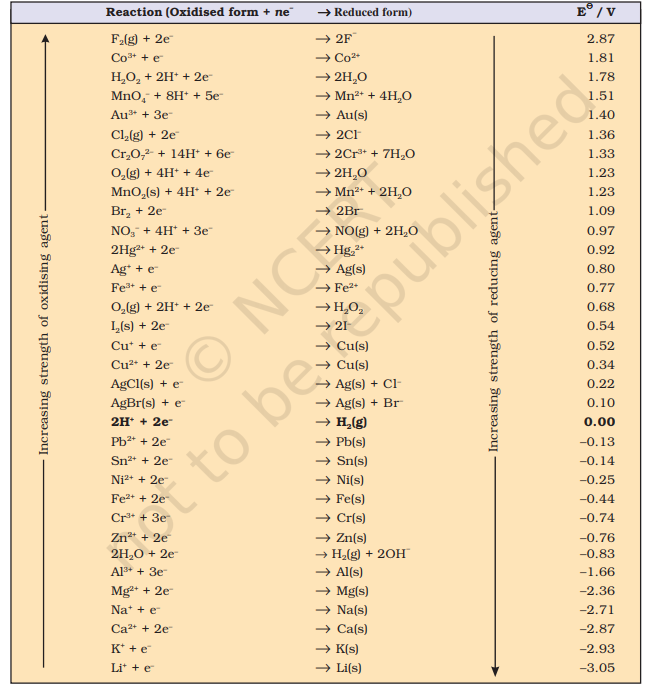
Using the standard electrode potentials given in the Table, predict if the reaction between the following is feasible:

Br2(aq) and Fe2+(aq).
100 mL of a liquid is contained in an insulated container at a pressure of 1 bar. The pressure is steeply increased to 100 bar. The volume of the liquid is decreased by 1 mL at this constant pressure. Find $\Delta H$ and $\Delta U$.
The equilibrium constant for the following reaction is $1.6 \times 10^5$ at 1024 K
$H _2( g )+ B r _2( g ) \rightleftharpoons 2 H B r ( g )$
Find the equilibrium pressure of all gases if 10.0 bar of HBr is introduced into a sealed container at 1024 K .
Assign the position of the element having outer electronic configuration (i) $n s^2 n p^4$ for $n=3$
(ii) $(n-1) d^2 n s^2$ for $n=4$, and (iii) $(n-2) f^7(n-1)$ $d^1 n s^2$ for $n=6$, in the periodic table.
  1. What is the oxidation number of 'S'in H2SO5
  2. Balance the following equation:

$\text{Zn}\text{(s)}+\text{NO}_3^-\text{(aq)}\xrightarrow{ \ \ \ \ \ \ \ \ }\text{Zn}^{2+}\text{(aq)}+\text{NH}_4^+\text{(aq)}+\text{H}^+$ (Acidic medium)

Similar to electron diffraction, neutron diffraction microscope is also used for the determination of the structure of molecules. If the wavelength used here is 800pm, calculate the characteristic velocity associated with the neutron.
Compute the mass of one molecule and the molecular mass of C6H6 (benzene) (At. mass of C = 12, H = 1u).
$\begin{matrix}\text{A }\rightleftharpoons\text{ B }&\text{K}_1=1&\text{B }\rightleftharpoons\text{ C}&\text{K}_2=2\\\text{C }\rightleftharpoons\text{ D}&\text{K}_3=3&\text{D }\rightleftharpoons\text{ E}&\text{K}_4=4\end{matrix}$
What is value of K for $\text{A }\rightleftharpoons\text{ E}?$