Question
Using the standard electrode potentials given in the Table, predict if the reaction between the following is feasible:
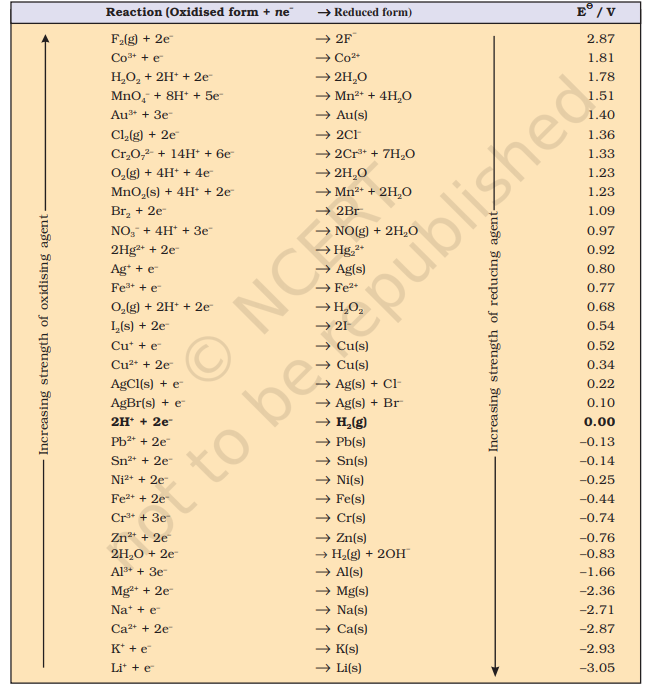
Fe3+(aq) and I-(aq).

Answer

The possible reaction between Fe3+(aq) + I-(aq) is given by,

$2\text{Fe}^{3+}_{(\text{aq})}+2\text{I}^-_{(\text{aq})}\rightarrow2\text{Fe}^{2+}_{(\text{aq})}+\text{I}_{2(\text{s})}$

$\text{Oxidation half equation:}\ \ \ \ \ \ \ \ \ \ 2\text{I}^-_{(\text{aq})}\xrightarrow{\ \ \ \ \ \ \ }\text{I}_{2(\text{s})}+2\text{e}^-;\ \ \text{E}^\circ=-0.54\text{V}\\\text{Reduction half equation:}\ [\text{Fe}^{3+}_{(\text{aq})}+\text{e}^-\xrightarrow{\ \ \ \ \ \ }\text{Fe}^{2+}_{(\text{aq})}]\times2;\ \ \text{E}^\circ=+0.77\text{V}\\\overline{\ \ \ \ \ \ \ \ \ \ \ \ \ \ \ \ \ \ \ \ \ \ \ \ \ \ \ \ \ \ \ \ \ \ \ \ \ \ \ \ \ \ \ \ \ \ \ \ \ \ \ \ \ \ \ \ \ \ \ \ \ \ \ \ \ \ \ \ \ \ \ \ \ \ \ \ \ \ \ \ \ \ \ \ \ \ \ \ \ \ \ \ \ \ \ \ \ \ \ \ \ \ \ \ \ \ \ \ \ \ \ \ \ \ \ \ \ \ }\\ \ \ \ \ \ \ \ \ \ \ \ \ \ \ \ \ \ \ \ \ \ \ \ \ \ \ \ \ \ \ \ \ \ \ \ \ \ \ 2\text{Fe}^{3+}_{(\text{aq})}+2\text{I}^-_{(\text{aq})}\xrightarrow{\ \ \ \ \ \ \ \ }2\text{Fe}^{2+}_{(\text{aq})}+\text{I}_{2(\text{s})};\ \ \text{E}^\circ=+0.23\text{V}$

E° for the overall reaction is positive. Thus, the reaction between $\text{Fe}^{3+}_{(\text{aq})}$ and $\text{I}^-_{(\text{aq})}$ is feasible.

Need a full question paper?

Generate a complete, print-ready paper with questions like this in minutes — across 16+ boards, with answer keys.

Start Generating Free

Similar questions

What is the equilibrium concentration of each of the substances in the equilibrium when the initial concentration of ICl was 0.78 M ?
$2 ICl ( g ) \rightleftharpoons I _2(g)+ Cl _2(g) ; \quad K _{ c }=0.14$
Account for the following:

  1. Which is smaller Fe2+ or Fe3+, why?
  2. Chlorine (Cl) have more negative electron gain enthalpy than Fluorine (F).

[Atomic no.: F = 9, Cl = 17]

  1. Anions are bigger in size than their parent atom.
A liquid is in equilibrium with its vapour in a sealed container at a fixed temperature. The volume of the container is suddenly increased.
(a) What is the initial effect of the change on vapour pressure?
(b) How do rates of evaporation and condensation change initially?
(c) What happens when equilibrium is restored finally and what will be the final vapour pressure?
By complete combustion of 3 mole benzene :
(a) How many moles of $CO _2$ will form?
(b) How many gm of $H _2 O$ will form?
For the following bond cleavages, use curved-arrows to show the electron flow and classify each as homolysis or heterolysis. Identify reactive intermediate produced as free radical, carbocation and carbanion.

Find out the value of Kc for each of the following equilibria from the value of Kp:
$2\text{CaCO}_3\text{ (S)}\rightleftharpoons\text{CaO(S) + CO}_2\text{ (g)};\text{ k}_{\text{p}}=167\text{ at }1073\text{K}$
Define electronegativity. How does it differ from electron gain enthalpy?
According to de Broglie, matter should exhibit dual behaviour, that is both particle and wave like properties. However, a cricket ball of mass 100g does not move like a wave when it is thrown by a bowler at a speed of 100km/ h. Calculate the wavelength of the ball and explain why it does not show wave nature.
Write the bond angles in CH4, NH3 and H2O molecules and give reason.
Which of the compounds in pair of compounds has higher dipole moment?
  1. BCl3 and BF3
  2. SO2 and SO3
  3. H2O and H2S
