Question
Write the bond angles in CH4, NH3 and H2O molecules and give reason.

Answer

CH4 has bond angle 109.5° because it has 4bp and no lone pair. NH3 has bond angle $\because$ 107°, it has 3bp and 1 lp.
H2O has bond angle 104.59, $\because$ it has 2 bp and 1lp.

Need a full question paper?

Generate a complete, print-ready paper with questions like this in minutes — across 16+ boards, with answer keys.

Start Generating Free

Similar questions

How much energy is required to ionise a H atom if the electron occupies n = 5 orbit? Compare your answer with the ionization enthalpy of H atom (energy required to remove the electron from n = 1 orbit).
If two elements can combine to form more than one compound, the masses of one element that combine with a fixed mass of the other element, are in whole number ratio.
  1. Is this statement true?
  2. If yes, according to which law?
  3. Give one example related to this law.
Equal volumes of 0.002 M solutions of sodium iodate and cupric chlorate are mixed together. Will it lead to precipitation of copper iodate? (For cupric iodate $K_{s p}=7.4 \times 10^{-8}$ )
Calculate the mass of ferric oxide that will be obtained by complete oxidation of 2g of Fe. [Atomic weights of Fe = 56u, 0 = 16u]
  1. How will you convert benzene into:
  1. Acetophenone?
  2. m-nitrochlorobenzene?
  1. Write the structures of products obtained by ozonolysis of pent-2-ene.
The heat of combustion of C2H6 is -368.4kcal. Calculate heat of combustion of C2H4, heat of combustion of H2 is 68.32kcal mol-1. $\Delta\text{H}$ for the following reaction is -37.1kcal.

$\text{C}_2\text{H}_4(\text{g})+\text{H}_2(\text{g})\overrightarrow{\ \ \ \ \ \ }\ \text{C}_2\text{H}_6(\text{g})$
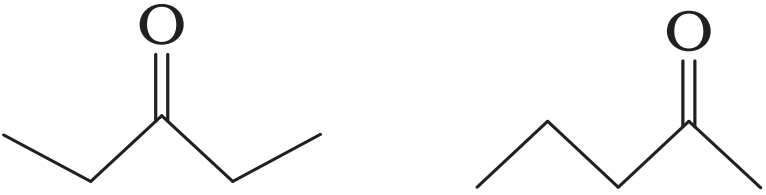
What is the relationship between the members of following pairs of structures? Are they structural or geometrical isomers or resonance contributors?

Calculate the number of atoms in each of the following
1. 52 mole of Ar
2. 52 u of He
3. 52 g of He .
Dinitrogen and dihydrogen react with each other to produce ammonia according to the following chemical equation:
N2(g) + H2(g) → 2NH3(g)
Calculate the mass of ammonia produced if 2.00 × 10³g dinitrogen reacts with 1.00 × 10³g of dihydrogen.
Balance the following redox reactions by ion-electron method:

H2O2(aq) + Fe2+(aq) → Fe3+(aq) + H2O(l) (in acidic solution).