Question
Using various resources such as your school Library or the internet and discussions with your teacher, trace the evolutionary stages of any one animal say horse.
Answer

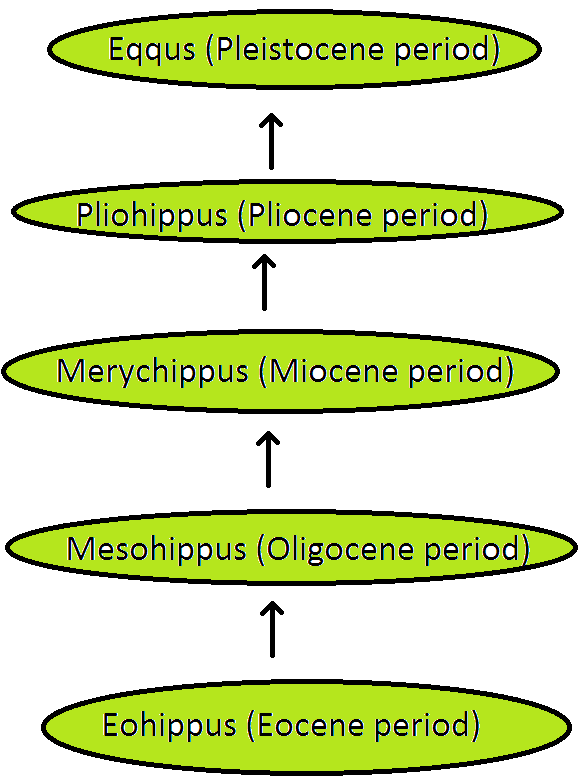
The evolution of horse started with Eohippus during Eocene period.
It involved the following evolutionary stages:
  • Gradual increase in body size.
  • Elongation of head and neck region.
  • Increase in the length of limbs and feet.
  • Gradual reduction of lateral digits.
  • Enlargement of third functional toe.
  • Strengthening of the back.
  • Development of brain and sensory organsn.
  • Crease in the complexity of teeth for feeding on grass.
The evolution of horse is represented as,

  1. Eohippus: It had a short head and neck. It had four functional toes and a splint of 1 and 5 on each hind limb and a splint of 1 and 3 in each forelimb. The molars were short crowned that were adapted for grinding the plant diet.
  2. Mesohippus: It was slightly taller than Eohippus. It had three toes in each foot.
  3. Merychippus: It had the size of approximately 100 cm. Although it still had three toes in each foot, but it could run on one toe. The side toe did not touch the ground. The molars were adapted for chewing the grass.​​​​​​​
  4. Pliohippus: It resembled the modern horse and was around 108 cm tall. It had a single functional toe with splint of 2nd and 4th in each limb.​​​​​​​
  5. Equus: Pliohippus gave rise to Equus or the modern horse with one toe in each foot. They have incisors for cutting grass and molars for grinding food.​​​​​​​

Need a full question paper?

Generate a complete, print-ready paper with questions like this in minutes — across 16+ boards, with answer keys.
Start Generating Free

Similar questions

List the various abiotic environmental factors.
Anukool is a big businessman in Delhi, but belongs to a small village. He went to his village during Christmas holiday. He was very disturbed to see women still using cowdung's cakes to prepare food there. He decided to set up a biogas plant so that people can use gas obtained from it for cooking. The villagers were very thankful to Anukool for his valuable help.
  1. What is biogas?
  2. What are the uses of biogas?
  3. Name some microorganisms involved in biogas production.
  4. What are the values shown by Anukool?
Give reasons for the following:
  1. Shivering in malaria.
  2. Plasmodium is considered a digenetic parasite.
  3. Dengue fever is also known as break bone fever.
  4. Swelling of lower limbs in filariasis.
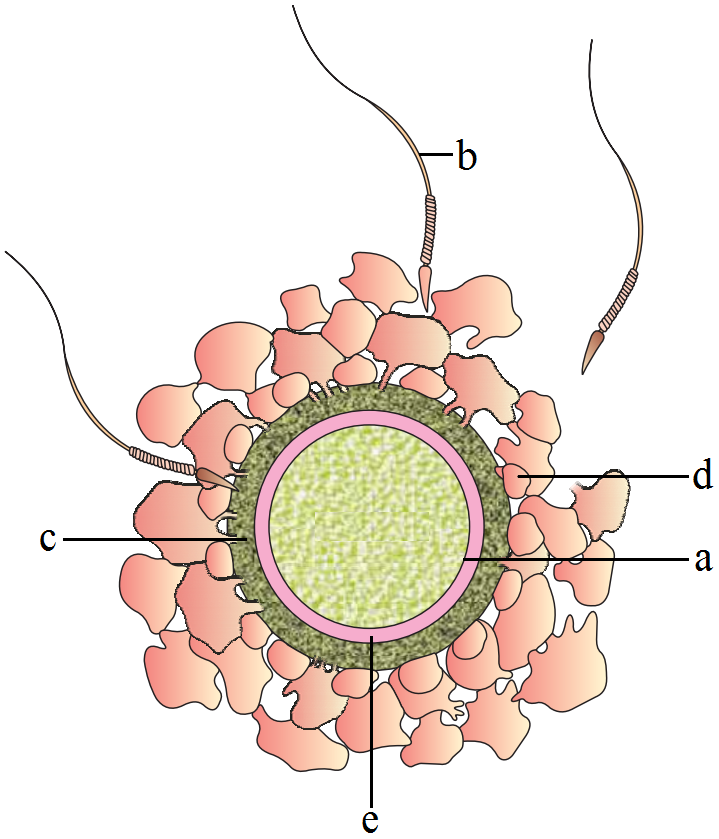
Study the illustration given and answer the questions that follow:

Identify ‘a’.

Explain the mechanism of sex determination in human being.
Define decomposition and describe the processes and products of decomposition.

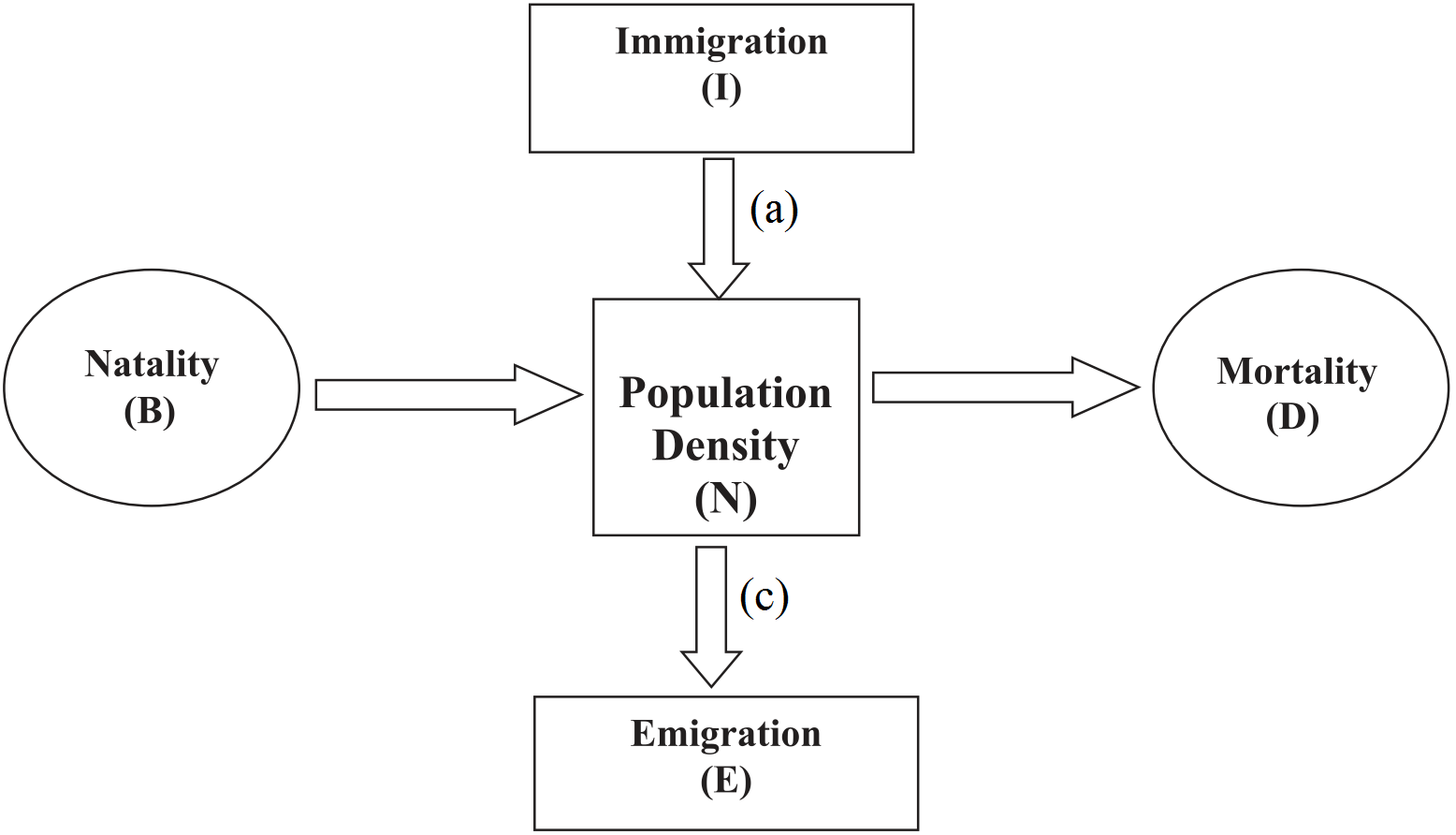
  1. Which of the above represents the increase or decrease of population?
  2. If N is the population density at time t, then what would be its density at time (t + 1)? Give the formula.
  3. In a barn there were 30 rats. 5 more rats enter the barn and 6 out of the total rats were eaten by the cats. If 8 rats were born during the time period under consideration and 7 rats left the barn, find out the resultant population at time (t + 1).
  4. If a new habitat is just being colonized, out of the four factors affecting the population growth, which factor contributes the most?
(i) Define standing crop.
(ii) Explain important steps in the process of decomposition in a terrestrial ecosystem.
Discuss in detail the contributions of Morgan and Sturvant in the area of genetics.
The zygote passes through several developmental stages till implantation, Describe each stage briefly with suitable diagrams.