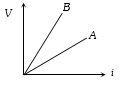
$V-i$ graphs for parallel and series combination of two identical resistors are as shown in figure. Which graph represents parallel combination
Easy


Download our appand get started for free
Experience the future of education. Simply download our apps or reach out to us for more information. Let's shape the future of learning together!No signup needed.*
Similar Questions
- 1We have a galvanometer of resistance $25\,\Omega $. It is shunted by a $2.5\,\Omega $ wire. The part of total current that flows through the galvanometer is given asView Solution
- 2View SolutionAssertion : A current continues to flow in superconducting coil even after switch is off.
Reason : Superconducting coils show Meissner effect
- 3A $60\, watt$ bulb carries a current of $0.5\, amp$. The total charge passing through it in $1$ hour is ............ $coulomb$View Solution
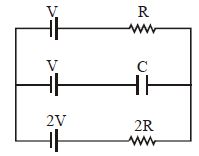
- 4View SolutionIn the given circuit, with steady current, the potential drop across the capacitor must be
- 5$n$ equal resistors are first connected in series and then connected in parallel. What is the ratio of the maximum to the minimum resistanceView Solution
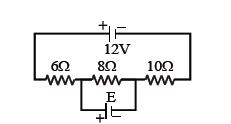
- 6In the circuit shown, the current through $8\,ohm$ issame before and after connecting $E$. The value of $E$ is .................... $\mathrm{V}$View Solution
- 7In a meter bridge experiment null point is obtained at $40\, cm$ from one end of the wire when resistance $X$ is balanced against another resistance $Y$. If $X < Y$, then the new position of the null point from the same end, if one decides to balance a resistance of $3X$ against $Y$, will be close to .............. $cm$View Solution
- 8If voltage across a bulb rated $220$ $volt-$ $100$ $watt$ drops by $2.5\%$ of its rated value, the percentage of the rated value by which the power would decrease is ............... $\%$View Solution
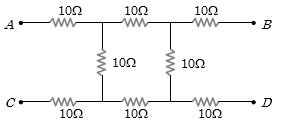
- 9What will be the equivalent resistance between the two points $A$ and $D$ ............. $\Omega$View Solution
- 10A copper wire is stretched to make it $0.5\%$ longer. The percentage change in its electric resistance if its volume remains unchanged is ................ $\%$View Solution