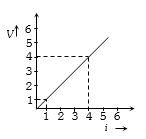
Variation of current and voltage in a conductor has been shown in the diagram below. The resistance of the conductor is. ........... $ohm$
Easy
Download our app for free and get started
Slope of $V-i$ curve $=$ resistance. Hence $R = \frac{1}{1} = 1\Omega $

Download our appand get started for free
Experience the future of education. Simply download our apps or reach out to us for more information. Let's shape the future of learning together!No signup needed.*
Similar Questions
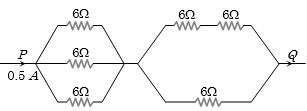
- 1Resistances of $6\, ohm$ each are connected in the manner shown in adjoining figure. With the current $0.5\,ampere$ as shown in figure, the potential difference ${V_P} - {V_Q}$ is .............. $V$View Solution
- 2A voltmeter having a resistance of $998\, ohms$ is connected to a cell of $e.m.f.$ $2\, volt$ and internal resistance $2\, ohm$. The error in the measurement of $e.m.f.$ will beView Solution
- 3$20\,\mu A$ current flows for $30$ seconds in a wire, transfer of charge will beView Solution
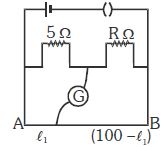
- 4Consider four conducting materials copper, tungsten, mercury and aluminium with resistivity $\rho_{ C }, \rho_{ T }, \rho_{ M }$ and $\rho_{ A }$ espectively Then:View Solution
- 5A wire when connected to $220\,V$ mains supply has power dissipation ${P_1}$. Now the wire is cut into two equal pieces which are connected in parallel to the same supply. Power dissipation in this case is ${P_2}$. Then ${P_2}:{P_1}$ isView Solution
- 6Every atom makes one free electron in copper. If $1.1$ $ampere$ current is flowing in the wire of copper having $1\, mm$ diameter, then the drift velocity (approx.) will be (Density of copper $ = 9 \times {10^3}\,kg\,{m^{ - 3}}$ and atomic weight = $63$)View Solution
- 7View SolutionTwo heater wires of equal length are first connected in series and then in parallel. The ratio of heat produced in the two cases is
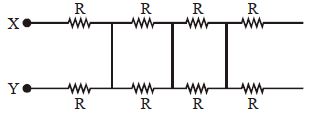
- 8Net resistance between $X$ and $Y$ isView Solution
- 9The terminal voltage across a battery of $\mathrm{emf}$ $E$ can beView Solution
- 10The resistance in the two arms of a meter bridge are $5\,\Omega $ and $R\,\Omega $, respectively. When the resistance $R$ is shunted with an equal resistance, the new balance point is at $1.6\, l_1$. The resistance $‘R’$ is ................. $\Omega$View Solution