MCQ
Velocity of water in a river is
  • A
    Same everywhere
  • More in the middle and less near its banks
  • C
    Less in the middle and more near its banks
  • D
    Increase from one bank to other bank

Answer

Correct option: B.
More in the middle and less near its banks
b
Water near to barks tend to stick to dirt, sand efc, decreasing its speed.In the middle water molemles are surrounded by same Hypc of molecules. Speed remains same

Need a full question paper?

Generate a complete, print-ready paper with questions like this in minutes — across 16+ boards, with answer keys.
Start Generating Free

Similar questions

Suppose you have taken a dilute solution of oleic acid in such a way that its concentration becomes $0.01 \,cm ^{3}$ of oleic acid per $cm ^{3}$ of the solution. Then you make a thin film of this solution (monomolecular thickness) of area $4\, cm ^{2}$ by considering $100$ spherical drops of radius $\left(\frac{3}{40 \pi}\right)^{\frac{1}{3}} \times 10^{-3}\, cm .$ Then the thickness of oleic acid layer will be $x \times 10^{-14} \,m$. Where $x$ is ...... .
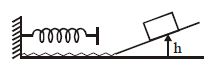
A block of mass $m$ starts at rest at height $h$ on a frictionless inclined plane. The block slides down the plane, travels across a rough horizontal surface with coefficient of kinetic friction $μ$ , and compresses a spring with force constant $k$ a distance $x$ before momentarily coming to rest. Then the spring extends and the block travels back across the rough surface, sliding up the plane. The block travels a total distance $d$ on rough horizontal surface. The correct expression for the maximum height $h’$ that the block reaches on its return is
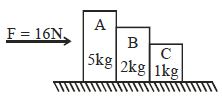
Figure shows three blocks in contact and kept on a smooth horizontal surface. What is ratio of force exerted by block $A$ on $B$ to that of $B$ on $C$
Two moles of ideal helium gas are in a rubber balloon at $30^o C$. The balloon is fully expandable and can be assumed to required no energy in its expansion. The temperature of the gas in the balloon is slowly changed to $35^o C$. The amount of heat required in raising the temperature is nearly...... $J$
(take $R$ $=$ $8.31$ $J/mol.K$)
A $2\,kg$ copper block is heated to $500^o\,C$ and then it is placed on a large block of ice  at $0^o\,C$. If the specific heat capacity of copper is $400\, J/kg/ ^o\,C$ and latent heat of  fusion of water is $3.5 \times 10^5\, J/kg$, the amount of ice, that can melt is :-
In a simple harmonic motion, when the displacement is one-half the amplitude, what fraction of the total energy is kinetic?
Two identical bodies are made of a material for which the heat capacity increases with temperature. One of these is held at a temperature of $100^{\circ} C$, while the other one is kept at $0^{\circ} C$. If the two are brought into contact, then assuming no heat loss to the environment, the final temperature that they will reach is
A body travels $200\ cm$ in the first two seconds and $220\ cm$ in the next $4$ seconds with same acceleration. The velocity of the body at the end of the $7^{th}$ second is:
The correct graph between the frequency $n$ and square root of density ($\rho$) of a wire, keeping its length, radius and tension constant, is
A particle $P$ is moving in a circle of radius $'a'$ with a uniform speed $v$ . $C$ is the centre of the circle and $AB$ is a diameter. When passing through $B$ the angular velocity of $P$ about $A$ and $C$ are in the ratio