MCQ
Vinegar obtained from sugarcane has
  • $C{H_3}COOH$
  • B
    $HCOOH$
  • C
    ${C_6}{H_5}COOH$
  • D
    $C{H_3}C{H_2}COOH$

Answer

Correct option: A.
$C{H_3}COOH$
a
(a)Acetic acid is the chief constituent of vinegar and hence its name (Latin : acetum = vinegar).

Need a full question paper?

Generate a complete, print-ready paper with questions like this in minutes — across 16+ boards, with answer keys.

Start Generating Free

Similar questions

Which of the following reaction(s) can be used for the preparation of alkyl halides ?

$(I)\,\,CH_3CH_2OH + HCl \xrightarrow{{Anh.\,\,ZnC{l_2}}}$

$(II)\,\,CH_3CH_2OH + HCl \rightarrow$

$(III)\,\,(CH_3)_3COH + HCl \rightarrow$

$(IV)\,\,(CH_3)_2CHOH + HCl \xrightarrow{{Anh.\,\,ZnC{l_2}}}$
The osmotic pressure of $ 0.4\%$  urea solution is $1.66\,atm$ and. that of a solution of suger of $3.42 \%$  is $2.46\,atm$. When both the solution are mixed then the osmotic pressure of the resultant solution will be ......... $atm$.
When $9.65$ coulombs of electricity is passed through a solution of silver nitrate (atomic weight of $Ag = 107.87$ taking as $108$) the amount of silver deposited is ............ $\mathrm{mg}$
Which is incorrect match
The half life period of a first order chemical reaction is $6. 93\,\min$. The time required for the completion of $99\%$ of the chemical reaction will be ........ $\min.$ $(\log \,2 =0.301)$
If $\Delta _0 < P,$ then what is electronic arrangement of metal atom/ion in complex with  $d^4$ configuration.
In the Claisen-Schmidt reaction to prepare $351 \mathrm{~g}$ of dibenzalacetone using $87 \mathrm{~g}$ of acetone, the amount of benzaldehyde required is . . . . . . .g. (Nearest integer)
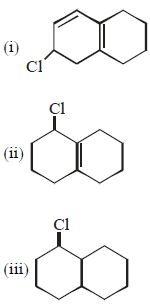
The correct reactivity order for $E_2$ reaction with alcoholic $KOH$ will be
Regarding $F^-$ and $Cl^-$ which of the following statements is/are correct ?

$(i)\,\, Cl^-$ can give up an electron more easily than $F^-$

$(ii) \,\,Cl^-$ is a better reducing agent than $F^-$

$(iii)\,\, Cl^-$ is smaller in size than $F^-$

$(iv)\,\, F^-$ can be oxidized more readily than $Cl^-$

Which one of the following compounds will be most readily dehydrated?