MCQ
Water waves are
  • A
    Longitudinal
  • B
    Transverse
  • Both longitudinal and transverse
  • D
    Neither longitudinal nor transverse

Answer

Correct option: C.
Both longitudinal and transverse
c
(c)Water waves are transverse as well as longitudinal in nature.

Need a full question paper?

Generate a complete, print-ready paper with questions like this in minutes — across 16+ boards, with answer keys.
Start Generating Free

Similar questions

Consider the diffraction pattern obtained from the sunlight incident on a pinhole of diameter $0.1\, \mu m$. If the diameter of the pinhole is slightly increased, it will affect the diffraction pattern such that :
A ball is thrown upwards and it returns to ground describing a parabolic path. Which of the following remains constant
Two polaroide $A$ and $B$ are placed in such a way that the pass-axis of polaroids are perpendicular to each other. Now, another polaroid $C$ is placed between $A$ and $B$ bisecting angle between them. If intensity of unpolarised light is $I _0$ then intensity of transmitted light after passing through polaroid $B$ will be :
Two strings $X$ and $Y$ of a sitar produce a beat frequency $4 Hz$. When the tension of the string $Y$ is slightly increased the beat frequency is found to be $2 Hz.$ If the frequency of $X$ is $300 Hz,$ then the original frequency of $Y$ was .... $Hz$
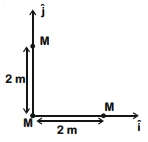
Three identical spheres, each of mass $M ,$ are placed at the corners of a right angle triangle with mutually perpendicular sides equal to $2 \;m$ (see figure). Taking the point of intersection of the two mutually perpendicular sides as the origin, find the position vector of centre of mass.
At nodes in stationary waves
At a temperature $T K,$ the pressure of $4.0\,\,g$ argon in a bulb is $p$. The bulb is put in a bath having temperature higher by $50\,\,K$ than the first one. $0.8\,\,g$ of argon gas had to be removed to maintained original pressure. The temperature $T$ is equal to ..... $K$
A capacitor of capacitance $15 \,nF$ having dielectric slab of $\varepsilon_{r}=2.5$ dielectric strength $30 \,MV / m$ and potential difference $=30\; volt$ then the area of plate is ....... $ \times 10^{-4}\; m ^{2}$
A student obtained following observations in an experiment of meter bridge to find the unknown resistance of the circuit The most accurate value of unknown resistance is ............ $\Omega$
S.No. $R$ $l$ $100-l$ $S = \left( {\frac{{100 - l}}{l}} \right)R$
$1$ $20\,\Omega $ $43$ $57$ $26.51\,\Omega $
$2$ $30\,\Omega $ $51$ $49$ $28.82\,\Omega $
$3$ $40\,\Omega $ $59$ $41$ $27.80\,\Omega $
$4$ $60\,\Omega $ $70$ $30$ $25.71\,\Omega $
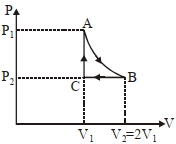
$n$ mole a perfect gas undergoes a cyclic process $ABCA$ (see figure) consisting of the following processes.

$A \rightarrow B :$ Isothermal expansion at temperature $T$ so that the volume is doubled from $V _{1}$ to $V _{2}=2 V _{1}$ and pressure changes from $P _{1}$ to $P _{2}$

$B \rightarrow C :$ Isobaric compression at pressure $P _{2}$ to initial volume $V _{1}$

$C \rightarrow A$ : Isochoric change leading to change of pressure from $P _{2}$ to $P _{1}$

Total workdone in the complete cycle $ABCA$ is