MCQ
Water waves are
  • A
    Longitudinal
  • B
    Transverse
  • Both longitudinal and transverse
  • D
    Neither longitudinal nor transverse

Answer

Correct option: C.
Both longitudinal and transverse
(c) Water waves are transverse as well as longitudinal in nature.

Need a full question paper?

Generate a complete, print-ready paper with questions like this in minutes — across 16+ boards, with answer keys.

Start Generating Free

Similar questions

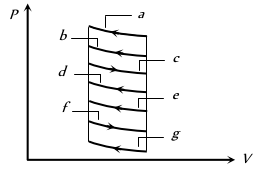
The $P-V$ diagram shows seven curved paths (connected by vertical paths) that can be followed by a gas. Which two of them should be parts of a closed cycle if the net work done by the gas is to be at its maximum value
Image
An alternating voltage $E=200 \sqrt{2} \sin (100 t)$ is connected to a 1 microfarad capacitor through an ac ammeter. The reading of the ammeter shall be
If a number of sine waves with modulation indices $n, n, n \ldots \ldots$ modulate a carrier wave, then total modulation index $(n)$ of the wave is
$n$ identical bulbs, each designed to draw a power $p$ from a certain voltage supply, are joined in series across that supply. The total power which they will draw is
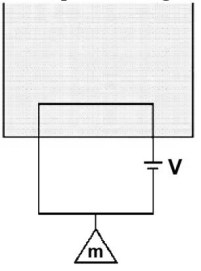
A massless square loop, of wire of resistance $10\,\Omega$. supporting a mass of $1\,g$. hangs vertically with one of its sides in a uniform magnetic field of $10^3\, G$, directed outwards in the shaded region. A dc voltage $V$ is applied to the loop. For what value of V. the magnetic force will exactly balance the weight of the supporting mass of $1\,g$ ? (If sides of the loop $=10\,cm , g =10\,ms ^{-2}$ )
The distance between two particles is decreasing at the rate of 6 $m / sec$. If these particles travel with same speeds and in the same direction, then the separation increase at the rate of $4 m / sec$. The particles have speeds as
In an elliptical orbit under gravitational force, in general
A convex mirror of focal length $f$ forms an image which is $\frac{1}{n}$ times the object. The distance of the object from the mirror is
If the temperature of a hot body is increased by $50 \%$ then the increase in the quantity of emitted heat radiation will be
The S.H.M. of a particle is given by the equation $y=3 \sin \omega t+4 \cos \omega t$. The amplitude is