Question
Wave nature of light is verified by ___________.

Answer

  1. Interference
Explanation:
Interference 
Christian Huygens verified the wave nature of light using interference.

Need a full question paper?

Generate a complete, print-ready paper with questions like this in minutes — across 16+ boards, with answer keys.
Start Generating Free

Similar questions

In a room containing air, heat can go from one place to another:
  1. By conduction only.
  2. By convection only.
  3. By radiation only.
  4. By all the three modes.
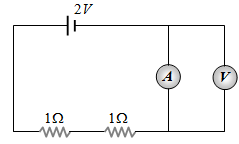
In the circuit shown, $A$ and $V$ are ideal ammeter and voltmeter respectively. Reading of the voltmeter will be
Current is flowing in two parallel good conducting wires in the same direction. They will
The critical angle between an equilateral prism and air is 45°. If the incident ray is perpendicular to the refracting surface, then(a) After deviation it will emerge from the second refracting surface(b) It is totally reflected on the second surface and emerges out perpendicularly from third surface in air(c) It is totally reflected from the second and third refracting surfaces and finally emerges out from the first surface(d) It is totally reflected from all the three sides of prism and never emerges out


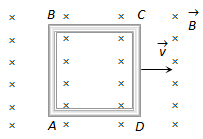
A conducting square loop of side $L$ and resistance $R$ moves in its plane with a uniform velocity $v$ perpendicular to one of its sides. A magnetic induction $B$ constant in time and space, pointing perpendicular and into the plane of the loop exists everywhere. The current induced in the loop is
The molar heat capacity of oxygen gas at STP is nearly 2.5R. As the temperature is increased, it gradually increases and approaches 3.5R. The most appropriate reason for this behaviour is that at high temperatures:
  1. Oxygen does not behave as an ideal gas.
  2. Oxygen molecules dissociate in atoms.
  3. The molecules collide more frequently.
  4. Molecular vibrations gradually become effective.
When two deuterium nuclei fuse together to form a tritium nucleus, we get a:
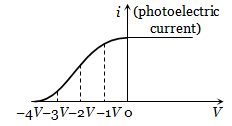
The value of stopping potential in the following diagram
A potentiometer is an accurate and versatile device to make electrical measurements of E.M.F. because the method involves:
A Daniel cell is balanced on 125 cm length of a potentiometer wire. Now the cell is short-circuited by a resistance 2 ohm and the balance is obtained at 100 cm. The internal resistance of the Daniel cell is(a) 0.5 ohm(b) 1.5 ohm(c) 1.25 ohm(d) 4/5 ohm