Question
Wavefront is a locus of points which vibratic in same phase. A ray of light is perpendicular to the wavefront. According to Huygens principle, each point of the wavefront is the source of a secondary disturbance and the wavelets connecting from these points spread out in all directions with the speed of wave.
The figure shows a surface XY separating two transparent media, medium-I and medium-2. The lines ab and cd represent wavefronts of a light wave travelling in medium- 1 and incident on XY. The lines ef and gh represent wavefronts of the light wave in medium-2 after refraction.
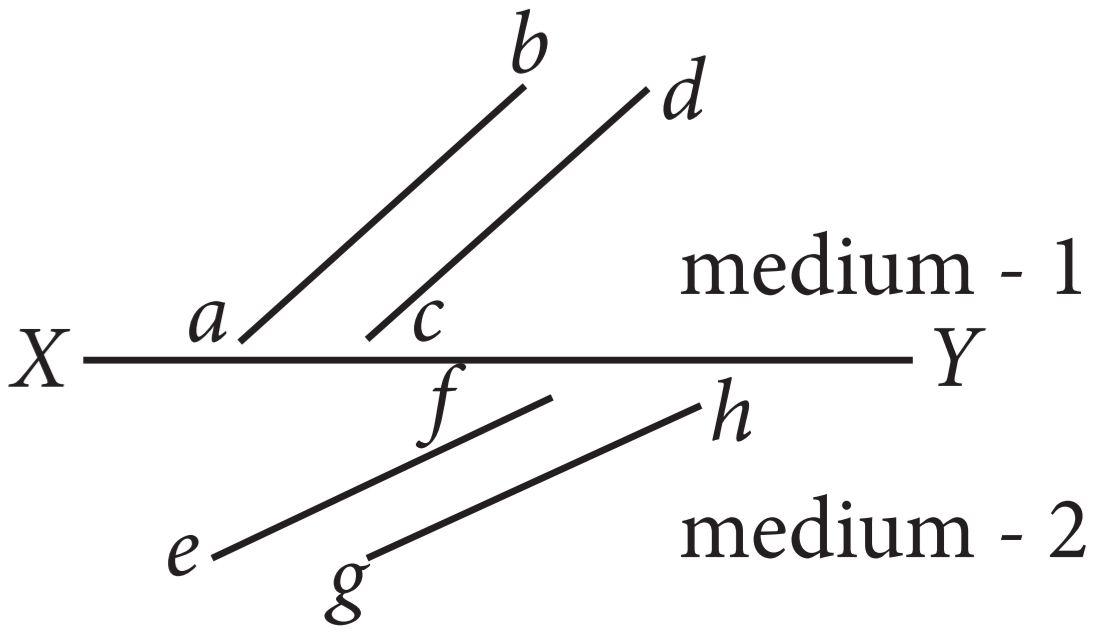
  1. Light travels as a:
  1. Parallel beam in each medium.
  2. Convergent beam in each medium.
  3. Divergent beam in each medium.
  4. Divergent beam in one medium and convergent beam in the other medium.
  1. The phases of the light wave at c, d, e and f are $\phi_\text{c},\phi_\text{d},\phi_\text{e}$ and $\phi_\text{f}$ respectively. It is given that $\phi_\text{c}\not=\phi_\text{f}$
  1. $\phi_\text{c}$ cannot be equal $\phi_\text{d}$
  2. $\phi_\text{d}$ cannot be equal $\phi_\text{e}$
  3. $(\phi_\text{d}-\phi_\text{f})$ is equal to $(\phi_\text{c}-\phi_\text{e})$
  4. $(\phi_\text{d}-\phi_\text{c})$ is not equal to $(\phi_\text{f}-\phi_\text{e})$
  1. Wavefront is the locus of all points, where the particles of the medium vibrate with the same.
  1. Phase
  2. Amplitude
  3. Frequency
  4. Period
  1. A point source that emits waves uniformly in all directions, produces wavefronts that are:
  1. Spherical
  2. Elliptical
  3. Cylindrical
  4. Planar
  1. What are the types of wavefronts?
  1. Spherical
  2. Cylindrical
  3. Plane
  4. All of these.

Answer

  1. (a) Parallel beam in each medium.

Explanation:

Since the path difference between two waveform is equal, light traves as parallel beam in each medium.

  1. (c) $(\phi_\text{d}-\phi_\text{f})$ is equal to $(\phi_\text{c}-\phi_\text{e})$

Explanation:

Since all points on the wavefront are in the same phase,

$\phi_\text{d}=\phi_\text{c}$ and $\phi_\text{f}=\phi_\text{e}$

$\therefore\phi_\text{d}-\phi_\text{f}=\phi_\text{c}-\phi_\text{e}$

  1. (a) Phase

Explanation:

Wavefront is the locus of all points, where the particles of the medium vibrate with the same phase.

  1. (a) Spherical
  1. (d) All of these.

Need a full question paper?

Generate a complete, print-ready paper with questions like this in minutes — across 16+ boards, with answer keys.

Start Generating Free

Similar questions

The weight Mg of an extended body is generally shown in a diagram to act through the centre of mass. Does it mean that the earth does not attract other particles?
No part of India is situated on the equator. Is it possible to have a geostationary satellite which always remains over New Delhi?
Explain how the image is formed by thin convex lens and derive
$-\frac{1}{u}+\frac{1}{v}=\left(n_{21}-1\right)\left[\frac{1}{R_1}-\frac{1}{ R _2}\right]$###
Derive lens maker's formula for thin convex lens.
Write difference between nuclear fission and radioactivity i.e. radioactive decay.
The radio and TV programmes, telecast at the studio, reach our antenna by wave motion. Is it a mechanical wave or nonmechanical?
Consider a coin of Example 1.20. It is electrically neutral and contains equal amounts of positive and negative charge of magnitude 34.8kC. Suppose that these equal charges were concentrated in two point charges seperated by,
  1. 1cm $\Big(\sim\frac{1}{2}\times\text{diagonalof theone paisa coin}\Big)$,
  2. 100m (~ length of a long building), and
  3. 106m (radius of the earth). Find the force on each such point charge in each of the three cases. What do you conclude from these results?
The electron beam in a colour TV is accelerated through 32kV and then strikes the screen. What is the wavelength of the most energetic X-ray photon?
An electromagnetic wave transports linear momentum as it travels through space. If an electromagnetic wave transfers a total energy U to a surface in time t, then total linear momentum delivered to the surface is $\text{p}=\frac{\text{U}}{\text{c}}.$ When an electromagnetic wave falls on a surface, it exerts pressure on the surface. ln 1903, the American scientists Nichols and Hull succeeded in measuring radiation pressures of visible light where other had failed, by making a detailed empirical analysis of the ubiquitous gas heating and ballistic effects.
  1. The pressure exerted by an electromagnetic wave of intensity I (Wm-2) on a non-reflecting surface is (c is the velocity of light). 
  1. $\text{Ic}$
  2. $\text{Ic}^2$
  3. $\frac{\text{I}}{\text{c}}$
  4. $\frac{\text{I}}{\text{c}^2}$
  1. Light with an energy flux of $18\frac{\text{W}}{\text{cm}^2}$ falls on a non-reflecting surface at normal incidence. The pressure exerted on the surface is:
  1. $3\frac{\text{N}}{\text{m}^2}$
  2. $2\times10^{-4}\frac{\text{N}}{\text{m}^2}$
  3. $6\frac{\text{N}}{\text{m}^2}$
  4. $6\times10^{-4}\frac{\text{N}}{\text{m}^2}$
  1. Radiation of intensity 0.5Wm-2 are striking a metal plate. The pressure on the plate is:
  1. 0.166 × 10⁻⁸Nm-2
  2. 0.212 × 10⁻⁸Nm-2
  3. 0.132 × 10⁻⁸Nm-2
  4. 0.083 × 10-8Nm-2
  1. A point source of electromagnetic radiation has an average power out-put of 1500W. The maximum value of electric field at a distance of 3m from this source (in Vm-1) is:
  1. $500$
  2. $100$
  3. $\frac{500}{3}$
  4. $\frac{250}{3}$
  1. The radiation pressure of the visible light is of the order of,
  1. $10^{-2}\frac{\text{N}}{\text{m}^2}$
  2. $10^{-4}\frac{\text{N}}{\text{m}}$
  3. $10^{-6}\frac{\text{N}}{\text{m}^2}$
  4. $10^{-8}\text{N}$
Write the equation of average power for $L - C - R$ series AC circuit and discuss its special cases.

Lenz's law states that the direction of induced current in a circuit is such that it opposes the change which produces it. Tims, if the magnetic flux linked with a closed circuit increases, the induced current flows in such a direction that a magnetic flux is created in the opposite direction of the original magnetic flux. If the magnetic flux linked with the closed circuit decreases, the induced current flows in such a direction so as to create a magnetic flux in the direction of the original flux.

  1. Which of the following statements is correct?
  1. The induced e.m.f is not in the direction opposing the change in magnetic flux so as to oppose the cause which produces it.
  2. The relative motion between the coil and magnet produces change in magnetic flux.
  3. Emf is induced only if the magnet is moved towards coil.
  4. Emf is induced only if the coil is moved towards magnet.
  1. The polarity of induced emf is given by:
  1. Ampere's circuital law.
  2. Biot-Savart law.
  3. Lenz's law.
  4. Fleming's right hand rule.
  1. Lenz's law is a consequence of the law of conservation of:
  1. Charge.
  2. Mass.
  3. Momentum.
  4. Energy.
  1. Near a circular loop of conducting wire as shown in the figure, an electron moves along a straight line. The direction of the induced current if any in the loop is:

  1. Variable.
  2. Clockwise.
  3. Anticlockwise.
  4. Zero.
  1. Two identical circular coils A and Bare kept in a horizontal tube side by side without touching each other. If the current in the coil A increases with time, in response, the coil B:
  1. Is attracted by A.
  2. Remains stationary.
  3. Is repelled.
  4. Rotates.