We have a galvanometer of resistance $25\,\Omega $. It is shunted by a $2.5\,\Omega $ wire. The part of total current that flows through the galvanometer is given as
Medium


Download our appand get started for free
Experience the future of education. Simply download our apps or reach out to us for more information. Let's shape the future of learning together!No signup needed.*
Similar Questions
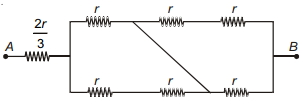
- 1The effective resistance of the network between points $A$ and $B$ isView Solution
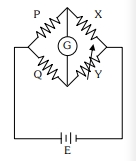
- 2A wheatstone bridge is used to determine the value of unknown resistance $X$ by adjusting the variable resistance $Y$ as shown in the figure. For the most precise measurement of $X$, the resistances $P$ and $Q$:View Solution
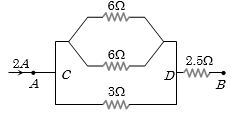
- 3The equivalent resistance and potential difference between $A$ and $B$ for the circuit is respectivelyView Solution
- 4A potentiometer consists of a wire of length $4\, m$ and resistance $10\,\Omega $. It is connected to a cell of $e.m.f.$ $2\, V$. The potential difference per unit length of the wire will be ............. $V/m$View Solution
- 5What amount of heat will be generated in a coil of resistance $R$ due to a charge $q$ passing through it if the current in the coil decreases to zero uniformly during a time interval $\Delta t$View Solution
- 6A resistance of $2 \Omega$ is comnected across one gap of a metre-bridge (the length of the wire is $100 \mathrm{~cm}$ ) and an unknown resistance, greater than $2 \Omega$, is connected across the other gap. When these resistance are interchanged, the balance point shifts by $20 \mathrm{~cm}$. Neglecting any corrections, the unknown resistance isView Solution
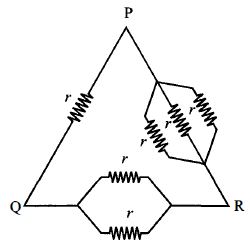
- 7Six equal resistances are connected between points $P, Q$ and $R$ as shown in figure. Then net resistance will be maximum betweenView Solution
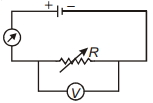
- 8A voltmeter is connected in parallel with a variable resistance $R$ which is in series with an ammeter and a cell as shown in the figure. For one value of $R$, the meters read $0.3 \,A$ and $0.9 \,V$. For another value of $R$ the readings are $0.25 \,A$ and $1.0 \,V$. What is the internal resistance of the cell is ......... $\Omega$View Solution
- 9View SolutionA steel wire has a resistance twice that of an aluminium wire. Both of them are connected with a constant voltage supply. More heat will be dissipated in
- 10Current density in a cylindrical wire of radius $R$ is given as $J =$ $\left\{ {\begin{array}{*{20}{c}}View Solution
{{J_0}\left( {\frac{x}{R} - 1} \right)\,\,for\,\,0 \leqslant x < \frac{R}{2}} \\
{{J_0}\frac{x}{R}\,\,\,\,for\,\,\,\frac{R}{2} \leqslant x \leqslant R}
\end{array}} \right.$The current flowing in the wire is: