Question
We have valence electrons and conduction electrons in a semiconductor. Do we also have 'valence holes' and 'conduction holes'?

Answer

Holes do not exist in reality. They exist only virtually. When an electron jumps from the valence band to the conduction band, a vacancy is created at the place from where the electron had jumped. This vacancy is called a hole. So, a valence or conduction hole is a virtual concept only.

Need a full question paper?

Generate a complete, print-ready paper with questions like this in minutes — across 16+ boards, with answer keys.
Start Generating Free

Similar questions

What is Malus Law ?
It is said that any charge given to a conductor comes to its surface. Should all the protons come to the surface? Should all the electrons come to the surface? Should all the free electrons come to the surface?
Explain the construction of refracting telescope by figure and obtain the equation of magnification.
Find the angular velocity of a body rotating with an acceleration of $2 \text{rev/s}^2$ as it completes the $5^{th}$ revolution after the start.
Calculate the binding energy per $^{40}_{20}\text{CA}$ nucleon nucleus.
$[$Given: $m \big(^{40}_{20}\text{Ca}\big)=39.962589\text{u}]$
$m_n($mass od a neutron$) = 1.008665u$
$m_p($mass of a proton$) =1.007825u$
$1u = 931\ MeV/c^2]$
Photoelectrons are emitted from a metal surface when illuminated with $UV$ light of wavelength $330 nm$ . The minimum amount of energy required to emit the electrons from the surface is $3.5 \times 10^{-19} J$. Calculate :
$a$. the energy of the incident radiation, and
$b$. the kinetic energy of the photoelectron.
Carbon $(Z = 6)$ with mass number $11$ decays to boron $(Z = 5)$.
  1. Is it a $\beta^+-$decay or a $\beta^--$decay?
  2. The half$-$life of the decay scheme is $20.3$ minutes. How much time will elapse before a mixture of $90\%$ carbon$-11$ and $10\%$ boron$-11\ ($by the number of atoms$)$ converts itself into a mixture of $10\%$ carbon$-11$ and $90\%$ boron$-11$?
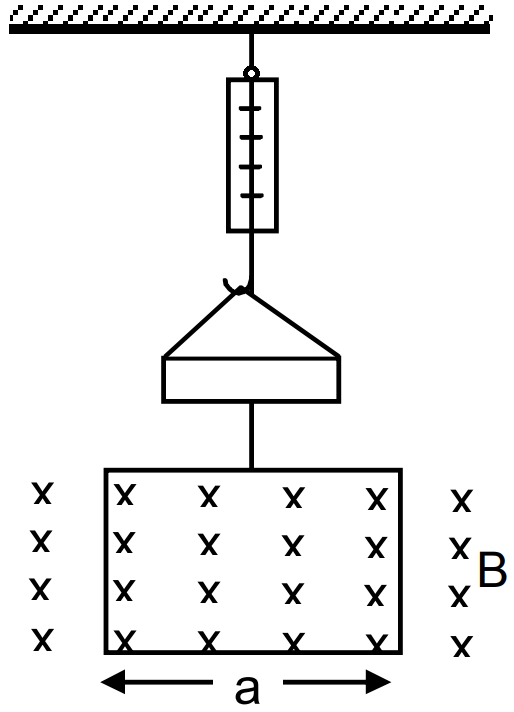
A rectangular wire loop of width a is suspended from the insulated pan of a spring balance, as shown in A current i exists in the anti-clockwise direction in the loop. A magnetic field Bexists in the lower region. Find the change in the tension of the spring if the current in the loop is reversed.
Define the terms ‘stopping potential’ and ‘threshold frequency’ in relation to photoelectric effect. How does one determine these physical quantities using Einstein’s equation?
A semicircular wire has a length $L$ and mass $M.A$ particle of mass $m$ is placed at the centre of the circle. Find the gravitational attraction on the particle due to the wire.