MCQ
Weightlessness experienced while orbiting the earth in space-ship, is the result of
  • A
    Inertia
  • B
    Acceleration
  • C
    Zero gravity
  • Free fall towards earth

Answer

Correct option: D.
Free fall towards earth
d
(d)

Need a full question paper?

Generate a complete, print-ready paper with questions like this in minutes — across 16+ boards, with answer keys.
Start Generating Free

Similar questions

The velocity of a body moving in viscous medium is given by $\text{v}=\frac{\text{A}}{\text{B}}\Big[1-\text{e}^{\frac{-\text{t}}{\text{B}}}\Big]$
A tank is filled with water of density $1\,g$ per $cm^3$ and oil of density $0.9\,g$ per $cm^3$ . The height of water layer is $100\,cm$ and of the oil layer is $400\,cm.$ If $g = 980\,cm/sec^2,$ then the velocity of efflux from an opening in the bottom of the tank is
A ball of mass $1 \,kg$ is projected with a velocity of $20 \sqrt{2}\,m / s$ from the origin of an $x y$ co-ordinate axis system at an angle $45^{\circ}$ with $x$-axis (horizontal). The angular momentum [In $SI$ units] of the ball about the point of projection after $2 \,s$ of projection is [take $g=10 \,m / s ^2$ ] ( $y$-axis is taken as vertical)
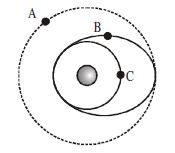
Three equal mass satellites $A, B,$ and $C$ are in coplanar orbits around a planet as shown in the figure. The magnitudes of the angular momenta of the satellites as measured about the planet are $L_A, L_B$, and $L_C$. Which of the following statements is correct?
Spot the wrong statement :The acceleration due to gravity $‘g’$ decreases if
Ultrasonic, Infrasonic and audible waves travel through a medium with speeds ${V_u},\,{V_i}$ and ${V_a}$ respectively, then
For ordinary terrestrial experiments, the observer in an inertial frame in the following cases is:
A ball hits a floor and rebounds after an inelastic collision. In this case:
An $\alpha-$particle is bombarded on ${ }^{14}\mathrm{~N}$. As a result, a ${ }^{17}\mathrm{O}$ nucleus is formed and a particle is emitted. This particle is a:
If $l_1$ and $l_2$ are the lengths of air column for the first and second resonance when a tuning fork of frequency $n$ is sounded on a resonance tube, then the distance of the displacement antinode from the top end of the resonance tube is: