MCQ
What are A and B in following reaction? $ \ \ \ \ \ \ \ \ \ \ \ \ \ \text{H}\\ \ \ \ \ \ \ \ \ \ \ \ \ \ |\\\text{H}_2\text{C}-\text{C}-\text{H}+\text{KOH}\xrightarrow{\text{Alcohol}}\text{A}\xrightarrow{\text{NaNH}_2}\text{B}\\ \ \ \ \ \ \ | \ \ \ \ \ \ |\\ \ \ \ \ \ \text{Br} \ \ \ \text{Br}$
  • A
     
    A
    B
    (a) $\text{H}_2\text{C}=\text{CH}_2$ $\text{CH}\equiv\text{CH}$
  • (b) $\text{CH}_2=\text{CHBr}$ $\text{CH}\equiv\text{CH}$
  • C
    (c) $\text{CH}_2=\text{CHBr}$ $\text{CH}_2=\text{CH}_2$
  • D
    (d) $\text{CH}_2=\text{CH}_2$ $\text{CH}\equiv\text{CBr}$
Answer

Correct option: B.
(b) $\text{CH}_2=\text{CHBr}$ $\text{CH}\equiv\text{CH}$
(b)
$\text{CH}_2=\text{CHBr}$
$\text{CH}\equiv\text{CH}$

Need a full question paper?

Generate a complete, print-ready paper with questions like this in minutes — across 16+ boards, with answer keys.

Start Generating Free

Similar questions

The density of a liquid is $1.5\, g/mL$. There are $50\, drops$ in $5\, mL$. The number  of molecules in $1\, drop$ is (molecular weight of liquid is $100$)
Number of lone pairs of electrons in the central atom of $SCl _{2}, O _{3}, ClF _{3}$ and $SF _{6}$, respectively, are
For the reaction

$C _{2} H _{6} \rightarrow C _{2} H _{4}+ H _{2}$

the reaction enthalpy $\Delta_{ r } H =...........{ kJ\, mol ^{-1}}$.

(Round off to the Nearest Integer).

[Given : Bond enthalpies in $kJ$ $mol$ $^{-1}:C-C : 347, C = C : 611 ; C - H : 414, H - H : 436]$

$1.020g$ of metallic oxide contains $0.540g$ of the metal. If the specific heat of the metal, $M$ is $0.216\ \ce{ cal deg ^{-1} g^{-1}}$. The molecular formula of its oxide is:
Which of these is least likely to act as a Lewis base?
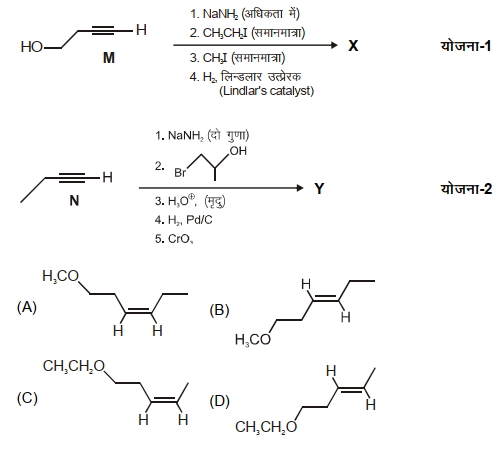
Schemes $1$ and $2$ describe sequential transformation of alkynes $M$ and $N$. Consider only the major products formed in each step for both the schemes. $Image$

$1.$ The product $X$ is

mcq $Image$

$2.$ The correct statement with respect to product $Y$ is :

$(A)$ It gives a positive Tollens test and is a functional isomer of $X$.

$(B)$ It gives a positive Tollens test and is a geometrical isomer of $X$.

$(C)$ It gives a positive iodoform test and is a functional isomer of $X$.

$(D)$ It gives a positive iodoform test and is a geometrical isomer of $X$.

Give the answer question $1$ and $2.$

$B{e^{2 + }}$ is isoelectronic with
$2CuI\, \to Cu + Cu{I_2}$, the reaction is
One mole of a non-ideal gas undergoes a change of state ($2.0\, atm$, $3.0\, L$ , $95 \,K$ ) $\rightarrow $($4.0\, atm$ , $5.0\, L$ , $245\, K )$ with a change in internal energy, $\Delta U =30.0 \,L$ $atm$. The change in enthalpy $\Delta H$ of the process in $L\,atm$ is.
When $CrI_3$ oxidises to $Cr_2O_7^{-2}$ and $IO_4^-$ , equivalent mass of $CrI_3$ will be :-