Question
What are bacterial phages? Describe their structure in detail.

Answer

Viruses which infect and destroy bacteria are called bacteriophages. The word phage is derived from the Greek word ‘phagos’ which means to feeding others. These were discovered separately by Dwart and D'Harrell. Like bacteria, bacteriophages are found in almost every type of habitat and natural conditions. From the point of view of morphology, there are huge difference between them.
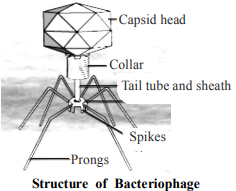
Structure of a Bacteriophage : The structure of a typical bacteriophage is similar to that of a tadpole, which is differentiated into a clear head and tail. Most bacteriophages $\left( T _2, T_6\right)$ is head prismatic while its tail is long and cylindrical, the tail remain attached to the prismatic head. With its help they attach to the bacterial cell.
Its length is approximately is equal to the length of the head. The prismatic head is made of protein molecule and its central core contains a large molecule of long DNA. There is a collar between the head and tail. At the proximal end of the tail there is a hexagonal plate attached to the collar, which is called the base plate. Six tail fibers are attached to the lower surface of the base plate with the help of which the phage remains stuck to the surface of the bacteria and the enzymes secreted by them hefp in fusion (lysis) with the bacterial wall.
Image

Need a full question paper?

Generate a complete, print-ready paper with questions like this in minutes — across 16+ boards, with answer keys.
Start Generating Free

Similar questions

Draw a neat diagram of the female reproductive system and label the parts associated with the following (a) production of gamete, (b) site of fertilisation (c) site of implantation and, (d) birth canal.
It is commonly observed that parents feel embarrassed to discuss freely with their adolescent children about sexuality and reproduction. The result of this parental inhibition is that the children go astray sometimes.
  1. Explain the reasons that you feel are behind such embarrassment amongst some parents to freely discuss such issues with their growing children.
  2. By taking one example of a local plant and animal, how would you help these parents to overcome such inhibitions about reproduction and sexuality?
Give details of different types of immune globulins in humans.
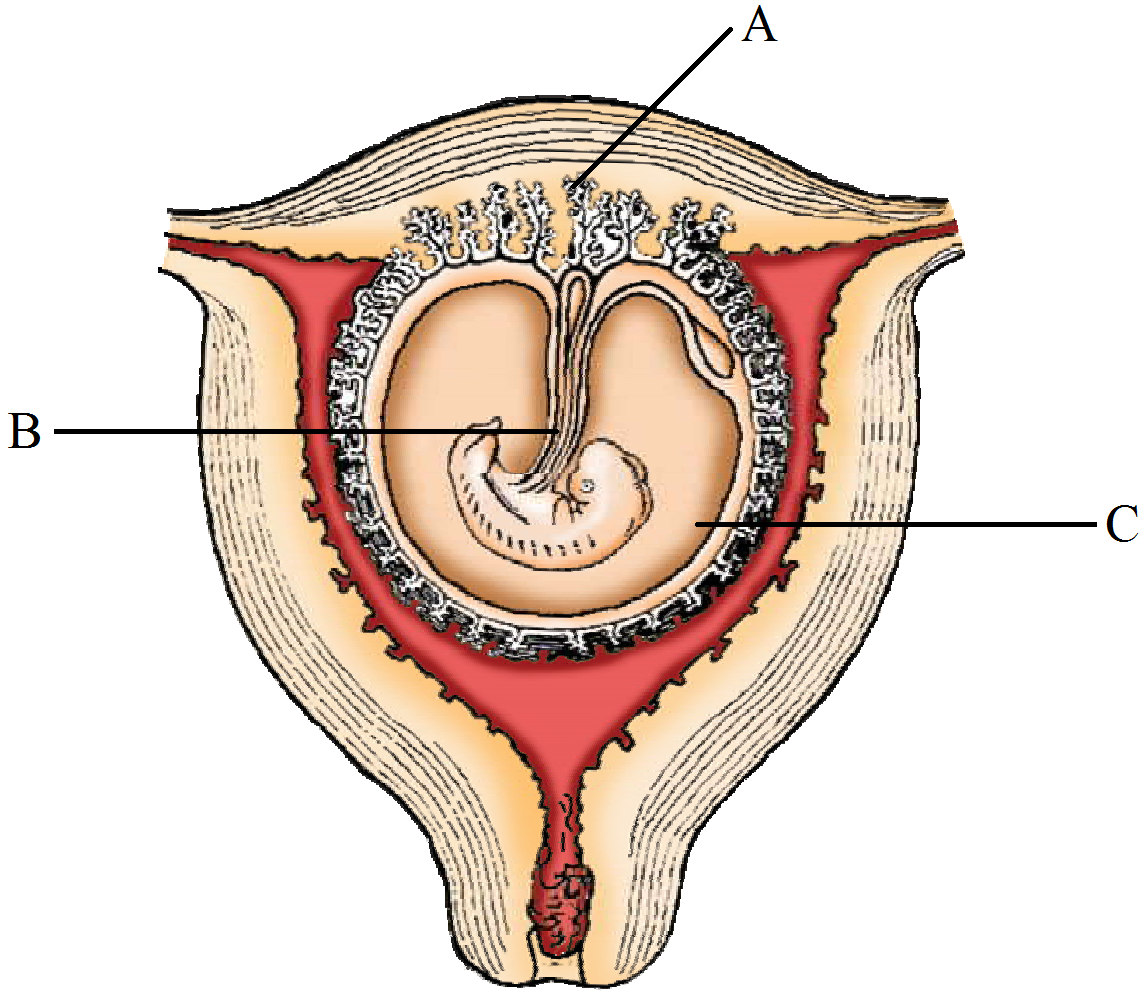
  1. Identify the parts labelled A, B and C in the diagram given.

  1. Draw a labelled diagram of a human blastocyst.
  2. What is parturition and is it induced at the end of pregnancy in a human female?
Write the causes, symptoms and prevention measures of diphtheria.
What is ecological succession? What is climax community? How is climax community established?
Describe the Lamarkism in relation to organic evolution.
How many different types of gametes could result from each of the following genotypes? What will be their genotypes?
  1. Aa.
  2. AABB.
  3. AaBb.
  4. EeCc.
  5. FFIIJj.
A flower of brinjal plant following the process of sexual reproduction produces 360 viable seeds.
Answer the following questions giving reasons:
How many microspore mother cells must have undergone reduction division prior to dehiscence of another in the above case?
  1. State the cause and symptoms of colour-blindness in humans.
  2. Statistical data has shown that 8% of the human males are colour-blind whereas only 0.4% of females are colour-blind. Explain giving reasons how is it so.