Question
What are co-ordination compounds ? Mention the differences between complex compounds and double salts.

Answer

Get the step-by-step solution for this question inside the Vidyadip app.

Get the answer in the app

Need a full question paper?

Generate a complete, print-ready paper with questions like this in minutes — across 16+ boards, with answer keys.
Start Generating Free

Similar questions

Write down the IUPAC name for each of the following complexes and indicate the oxidation state, electronic configuration, and coordination number. Also, give stereochemistry and magnetic moment of the complex:
a. $\left.K \left[ Cr \left( H _2 O \right)_2\right\}\left( C _2 O _4\right)_2\right] \cdot 3 H _2 O$
b. $\left[ Co \left( NH _3\right)_5 Cl \right] Cl _2$
c. $CrCl _3( py )_3$
d. $Cs \left[ FeCl _4\right]$
e. $K _4\left[ Mn ( CN )_6\right]$
Write the $\text{IUPAC}$ names of the following coordination compounds:
$a.\ \left[ Pt \left( NH _3\right)_2 Cl \left( NO _2\right]\right.$
$b.\ K _3\left[ Cr \left( C _2 O _4\right)_3\right]$
$c.\ \left[ CoCl _2( en )_2\right] Cl$
$d.\ \left[ Co \left( NH _3\right)_5\left( CO _3\right)\right] Cl$
$e.\ Hg \left[ Co ( SCN )_4\right]$
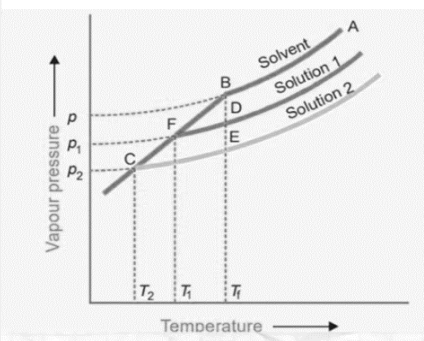
$(a).$ An experiment was carried out in the laboratory, to study depression in freezing point. $1M$ aqueous solution of $Al(NO_3)_3$ and $1\ M$ aqueous solution of glucose were taken. From the given figure identify solution $1$ and solution $2.$ Give a plausible reason for your answer
Image
$(b).$ The osmotic pressure of a solution of cane sugar was found to be $2.46$ atm at $300 K.$ If the solution was diluted five times, calculate the osmotic pressure at the same temperature.
How can the osmotic pressure of the given cane sugar solution be decreased without changing its volume? Give a reason for your answer.
  1. Define the following terms:
  1. Molarity.
  2. Molal elevation constant$(Kb).$
  1. A solution containing $15\ g$ urea $($molar mass $= 60\ g\ mol^{–1})$ per litre of solution in water has the same osmotic pressure $($isotonic$)$ as a solution of glucose $($molar mass $= 180\ g\ mol^{–1})$ in water. Calculate the mass of glucose present in one litre of its solution.
Explain the various uses of lanthanoids.
What is vapour pressure? When a non- volatile solute is dissolved in any liquid, the vapour pressure of the liquid decreases. Give reason.
Calculate the standard cell potentials of galvanic cell in which the following reactions take place :
(i) $2 Cr ( s )+3 Cd ^{2+}( aq ) \rightarrow 2 Cr ^{3+}( aq )+3 Cd ( s )$
(ii) $Fe ^{2+}$ (aq) $+ Ag ^{+}$(aq) $\rightarrow Fe ^{3+}$ (aq) + Ag (s)
Calculate the $\Delta_r G^{\circ}$ and equilibrium constant of the reactions.
  1. A $10\%$ solution $($by mass$)$ of sucrose in water has a freezing point of $269.15 K$. Calculate the freezing point of $10\%$ glucose in water if the freezing point of pure water is $273.15 K.$ Given:
$($Molar mass of sucrose $= 342\ g\ mol^{-1})$
$($Molar mass of glucose $= 180\ g\ mol^{-1})$
  1. Define the following terms:
  1. Molality $(m)$
  2. Abnormal molar mass
What are the similarities between lanthanoids and actinoids?
 Match the complex species given in Column $I$ with the possible isomerism given in Column $II$ and assign the correct code:
 
Column $I ($Complex species$)$
 
Column $II ($Isomerism$)$
$a.$ $[Co(NH_3)_4C_{l2}]^+$ $1.$
Optical
$b.$ $cis-[Co(en)_2Cl_2]^+$ $2.$
Ionisation
$c.$ $[Co(NH_3)_5 (NO_2)]Cl_2$ $3.$
Coordination
$d.$ $[Co(NH_3)_6][Cr(CN)_6]$ $4.$
Geometrical
    $5.$
Linkage
Code: