Question
Explain the various uses of lanthanoids.

Answer

self

Need a full question paper?

Generate a complete, print-ready paper with questions like this in minutes — across 16+ boards, with answer keys.

Start Generating Free

Similar questions

Derive the equation required for finding the activation energy.
A first order reaction takes 30 min for 50% completion, what would be time for its 90% completion.
Describe the common name system and IUPAC system of naming amines.
Draw the structures of optical isomers of :
(i) $\left[ Cr \left( C _2 O _4\right)_3\right]^{3-}$
(ii) $\left[ PtCl _2( en )_2\right]^{2+}$
(iii) $\left[ Cr \left( NH _3\right)_2 Cl _2( en )\right]^{+}$
Match the items of Column $I$ and Column $II.$
 
Column $I$
 
Column $II$
$i.$
Lechlanche cell
$a.$
Cell reaction $2H_2 + O_2 ⎯\rightarrow 2H_2O$
$ii.$
$Ni–Cd$ cell
$b.$
Does not involve any ion in solution and is used in hearing aids.
$iii.$
Fuel cell
$c.$
Rechargeable.
$iv.$
Mercury cell
$d.$
Reaction at anode, $Zn ⎯\rightarrow Zn^{2+} + 2e^-$
 
 
$e.$
Converts energy of combustion into electrical energy.
Answer the following questions:
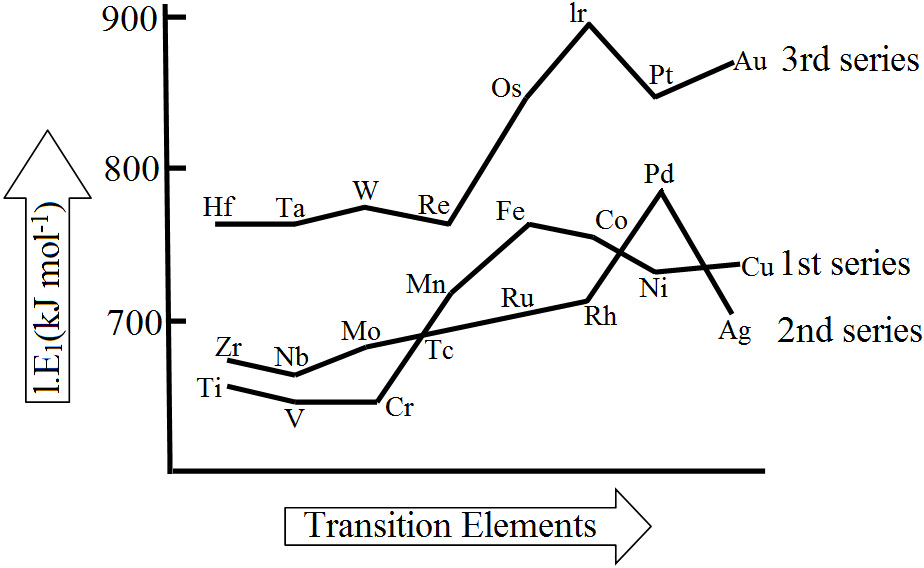
  1. The figure given alongside illustrates the first ionization enthalpies of first, second and third series of transition elements. Answer the question that follows:
  2. Which series amongst the first, second and third series of transition elements have the highest first ionization enthalpy and why?
  3. Separation of lanthanoid elements is difficult. Explain.
  4. $Sm^{2+}, Eu^{2+}$ and $Yb^{2+}$ ions in solutions are good reducing agents but an aqueous solution of $Ce^{4+}$ is a good oxidising agent. Why?
In a reaction between A and B, the inital rate of reaction (ro) was measured for different initial concentrations of A and B as given below :
$A / mol ^{-1}$0.200.200.40
$B / mol L ^{-1}$0.300.100.05
$r _0 / mol L ^{-1} s^{-1}$$5.07 \times 10^{-5}$$5.07 \times 10^{-5}$$1.43 \times 10^{-4}$
What is the order of the reaction with respect to A and B?
i. Give reasons :
a. Although $- \ce{NH2}$ group is o/p directing in electrophilic substitution reactions, yet aniline, on nitration gives good yield of $m-$nitroaniline.
b. $(\ce{CH 3)2NH}$ is more basic than $(\ce{CH3)3N}$ in an aqueous solution.
c. Ammonolysis of alkyl halides is not a good method to prepare pure primary amines.
ii. Distinguish between the following:
a. $\ce{CH 3 CH 2 NH 2}$ and $(\ce{CH 3 CH 2)2NH}$
b. Aniline and $\ce{CH3NH2}$
Write the $\text{IUPAC}$ names of the following coordination compounds:
$a.\ \left[ Pt \left( NH _3\right)_2 Cl \left( NO _2\right]\right.$
$b.\ K _3\left[ Cr \left( C _2 O _4\right)_3\right]$
$c.\ \left[ CoCl _2( en )_2\right] Cl$
$d.\ \left[ Co \left( NH _3\right)_5\left( CO _3\right)\right] Cl$
$e.\ Hg \left[ Co ( SCN )_4\right]$
Write the applications of d- and f-block elements.