Question
What are derived quantities and derived units? State two examples. State the corresponding S.L. and C.G.S. units of the examples.

Answer

  1. Derived quantities: Physical qUantities other than fundamental quantities which depend on one or more fundamental quantities for their measurements are called derived quantities.
  2. Derived units: The units of derived quantities which are expressed in terms of fundamental units for their measurements are called derived units.
  3. Examples and units:
    Derived
    quantity
    FormulaS.I.
    unit
    C.G.S.
    unit
     Velocity $\frac{\text { Unit of displacement }}{\text { Unit of time }}$ m/s cm/s
     Acceleration $\frac{\text { Unit of velocity }}{\text { Unit of time }}$ $m / s ^2$ $cm / s ^2$
     Momentum Unit of mass
    x Unit of velocity
     kg m/s g cm/s

Need a full question paper?

Generate a complete, print-ready paper with questions like this in minutes — across 16+ boards, with answer keys.
Start Generating Free

Similar questions

Locate the centre of mass of three particles of mass $m_1 = 1 \ kg, m_2 = 2 \ kg$ and $m_3 = 3 \ kg$ at the corner of an equilateral triangle of each side of $1 m.$
To understand the process of change of state:
Take some cubes of ice in a beaker. Note the temperature of ice (0 °C). Start heating it slowly on a constant heat source. Note the temperature after every minute. Continuously stir the mixture of water and ice. Observe the change in temperature. Continue heating even after the whole of ice gets converted into water. Observe the change in temperature as before till vapours start coming out. Plot the graph of temperature (along Y-axis) versus time (along X-axis). Obtain a graph of temperature versus time
State and prove parallelogram law of vector addition and determine magnitude and direction of resultant vector.
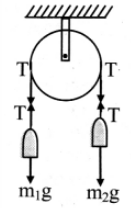
Figure shows a fixed pulley. A massless inextensible string with masses $m_1$ and $m_2 > m_1$ attached to its two ends is passing over the pulley. Such an arrangement is called an Atwood machine. Calculate accelerations of the masses and force due to the tension along the string assuming axle of the pulley to be frictionless.
Image
Describe the working of the experiment performed to measure the value of gravitational constant.
Explain Newtons formula for velocity of sound. What is its limitation?
Why is a minimum two stage rocket necessary for launching of a satellite?
A conductor has resistance of $15 \Omega$ at $10^{\circ} C$ and $18 \Omega$ at $400^{\circ} C$. Find the temperature coefficient of resistance of the material.
A charge $+ q$ exerts a force of magnitude $– 0.2 N$ on another charge $-2q$. If they are separated by $25.0\ cm$, determine the value of $q$.
Two weights 5 kg and 8 kg are suspended from a uniform rod of length 10 m and weighing 3 kg. The distances of the weights from one end are 2 m and 7 m. Find the point at which the rod balances.