Question
Figure shows a fixed pulley. A massless inextensible string with masses $m_1$ and $m_2 > m_1$ attached to its two ends is passing over the pulley. Such an arrangement is called an Atwood machine. Calculate accelerations of the masses and force due to the tension along the string assuming axle of the pulley to be frictionless.
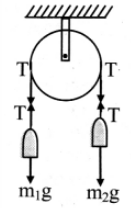
Image

Answer

Method $I:$ As $m_2 > m_1,$ mass $m_2$ is moving downwards and mass $m_1$ is moving upwards.
Net downward force $= F = (m_2) g – (m_1) g$
$= (m_2 – m_1)g$
the string being inextensible, both the masses travel the same distance in the same time. Thus, their accelerations are equal in magnitude $($one upward, other downward$).$ Let it be a.
Total mass in motion, $M = m_2 + m_1$
$\therefore a =\frac{F}{M}=\left(\frac{m_2-m_1}{m_2+m_1}\right) g$ ......(i)
For mass $m_1,$ the upward force is the force due to tension $T$ and downward force is $mg.$ It has upward acceleration
$a.$ Thus, $T – m_1g = m_1a$
$\therefore T = m_1(g + a)$
Using equation $(i),$ we get,
$T=m_1\left[g+\left(\frac{m_2-m_1}{m_2+m_1}\right) g\right]=\left(\frac{2 m_1 m_2}{m_1+m_2}\right) g$
Image
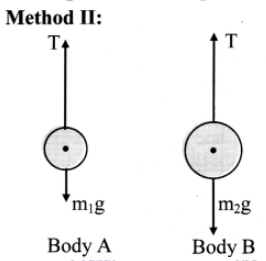
From the free body equation for the first body,
$T – m_1g = m_1a .. (i)$
From the free body equation for the second body,
$m_2g – T = m_2a … (ii)$
Adding $(i)$ and $(ii),$ we get,
$a =\left(\frac{ m _2- m _1}{m_2+ m _1}\right) g ....(iii)$
Solving equations. $(ii)$ and $(iii)$ for $T,$ we get,
$T = m _2(g- a )=\left(\frac{2 m_1 m_2}{m_1+m_2}\right) g$

Need a full question paper?

Generate a complete, print-ready paper with questions like this in minutes — across 16+ boards, with answer keys.

Start Generating Free