Question
What are interstitial compounds? Why are such compounds well known for transition metals?

Answer

Transition metals form large number of interstitial compounds. They are able to entrap small atoms of elements like H, G, N, B, etc., in their crystal lattice and even can make weak bonds with them. Due to formation of interstitial compounds, their malleability and ductility decreases and tensile. strength increases. Steel and cast iron are hard in comparison to wrought iron due to the presence of trapped carbon atoms in interstitial spaces.

Need a full question paper?

Generate a complete, print-ready paper with questions like this in minutes — across 16+ boards, with answer keys.

Start Generating Free

Similar questions

Draw the structures of polar isomers of $\left[ Co ( e )_3\right]^{3+}$
State the limitations of Valence bond theory
Why is the C-O-H bond angle in alcohols slightly less than the tetrahedral angle whereas the C-O-C bond angle in ether is slightly greater?
Write two step conversion from Benzene to Diphenyl.
Arrange the following in decreasing order of their acidic strength and give reason for your answer.
CH3CH2OH, CH3COOH, ClCH2COOH, FCH2COOH, C6H5CH2COOH
When 3-methylbutan-2-ol is treated with HBr, the following reaction takes place:

$\ \ \ \ \ \ \ \ \ \ \ \ \ \ \ \ \ \ \ \ \ \ \ \ \ \ \ \ \ \ \ \ \ \ \ \ \ \ \ \ \ \ \ \ \ \ \ \ \ \ \ \ \ \ \ \ \ \ \ \ \ \ \ \ \ \ \ \ \text{Br}\\\ \ \ \ \ \ \ \ \ \ \ \ \ \ \ \ \ \ \ \ \ \ \ \ \ \ \ \ \ \ \ \ \ \ \ \ \ \ \ \ \ \ \ \ \ \ \ \ \ \ \ \ \ \ \ \ \ \ \ \ \ \ \ \ \ \ \ \ \ |\\\text{CH}_3-\text{CH}-\text{CH}-\text{CH}_3\xrightarrow{\ \ \ \text{HBr} \ \ }\text{CH}_3-\text{C}-\text{CH}_2-\text{CH}_3\\\ \ \ \ \ \ \ \ \ \ \ \ \ \ |\ \ \ \ \ \ \ \ \ \ |\ \ \ \ \ \ \ \ \ \ \ \ \ \ \ \ \ \ \ \ \ \ \ \ \ \ \ \ \ \ \ \ \ \ \ \ \ \ \ \ \ \ \ |\\\ \ \ \ \ \ \ \ \ \ \ \ \ \text{CH}_3\ \ \ \ \text{OH}\ \ \ \ \ \ \ \ \ \ \ \ \ \ \ \ \ \ \ \ \ \ \ \ \ \ \ \ \ \ \ \ \ \ \ \ \ \ \text{CH}_3$

Give a mechanism for this reaction.

(Hint: The secondary carbocation formed in step II rearranges to a more stable tertiary carbocation by a hydride ion shift from 3rd carbon atom.)
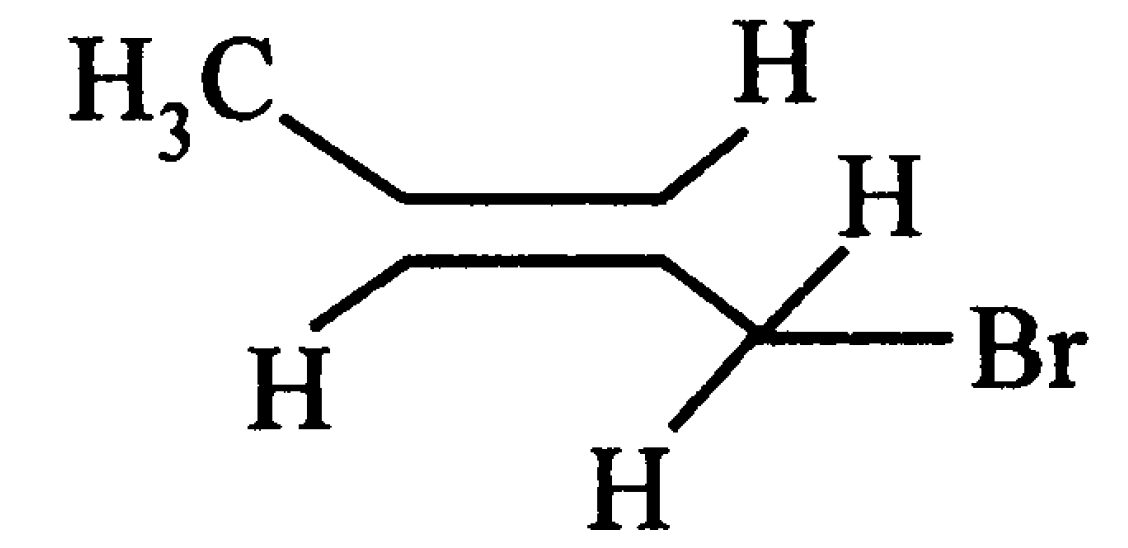
  1. State the IUPAC name of the following compound:

  1. Complete the following chemical equation:

CH3CH2CH=CH2 + HBr $\xrightarrow{\text{peroxide}}.........$

Write the equation of trimerization and tetramerization of acetaldehyde.
Write the important structural and functional differences between DNA and RNA.
What are isomers? Explain the types of isomerism.