Question
What are the different types of errors that are usually committed in recording business transaction.

Answer

According to the nature of errors committed, errors are classified into the following four categories:
  1. Errors of Commission: The errors that are committed because of wrong posting of transactions, wrong balancing of accounts, wrong casting of subsidiary books, wrong totaling or wrong recording of amount in the books are all error of commission. These errors affect the agreement of the trial balance.
  2. Errors of Omission: These errors are of two types and are committed when a transactions is partially or completely omitted to be recorded in the books.
  1. Error of complete omission: When a transaction is completely omitted to be recorded in the books of accounts or to be posted in the respective ledgers, it is an error of complete omission. Such errors do not affect the agreement of the trial balance.
  2. Error of partial omission: When a transaction is partially omitted while recording in the books or amounts or partially omitted from posting in the ledger, it is an error of partial omission. Such errors affect the agreement of the trial balance.
  1. Errors of Principle: Accounting transactions are to be recorded following certain principles. If any of the principle of accounting entries are violated or ignored and the error occurring due to such violation is called error of principle.
  2. Compensating errors: When two or more errors are committed in such a way that the net effect of these errors on the debits and credits of accounts is nil, such errors are called compensating errors.

Need a full question paper?

Generate a complete, print-ready paper with questions like this in minutes — across 16+ boards, with answer keys.

Start Generating Free

Similar questions

On Feb. 02, 2017, Verma purchased from Sharma goods for ₹ 17,500. Verma paid ₹ 2,500 immediately and for the balance gave a promissory note to Sharma payable after 60 days. Sharma immediately endorsed the promissory note in favour of his creditor. Gupta for the full settlement of a debt of ₹ 15,400. On the due date of the bill Gupta presented the bill to Verma which the latter dishonoured and Gupta paid ₹ 5,000 noting charges. On the same date Gupta informed Sharma about the dishonour of the bill. Sharma settled his debt to Gupta by cheque for ₹ 15,500 which includes noting chargesand interest. Verma settled Sharma’s claim by cheque for the same amount.
Record the necessary journal entries is the books of Sharma, Gupta and Verma for the above transaction and prepare Verma’s and Gupta’s accounts in the books of Sharma. Sharma’s account in the books of Verma. And also Sharma’s account in the books of Gupta.
Prepare the Transfer Vouchers in the books of Mangla Agencies, Faridabad, Haryana from the Source Vouchers:
2019
Particular
Jan-7
Purchased goods from M/s Eufora, New Delhi vide Bill No. 912, paid IGST @ 12%
4,700
Jan-11
Sold goods to M/s Yardley, Faridabad, Haryana vide Bill No. 31596, charged CGST and SGST @ 6% each
5,000
Jan-31
Depreciation charged on building @ 10% on ₹ 2,00,000
20,000
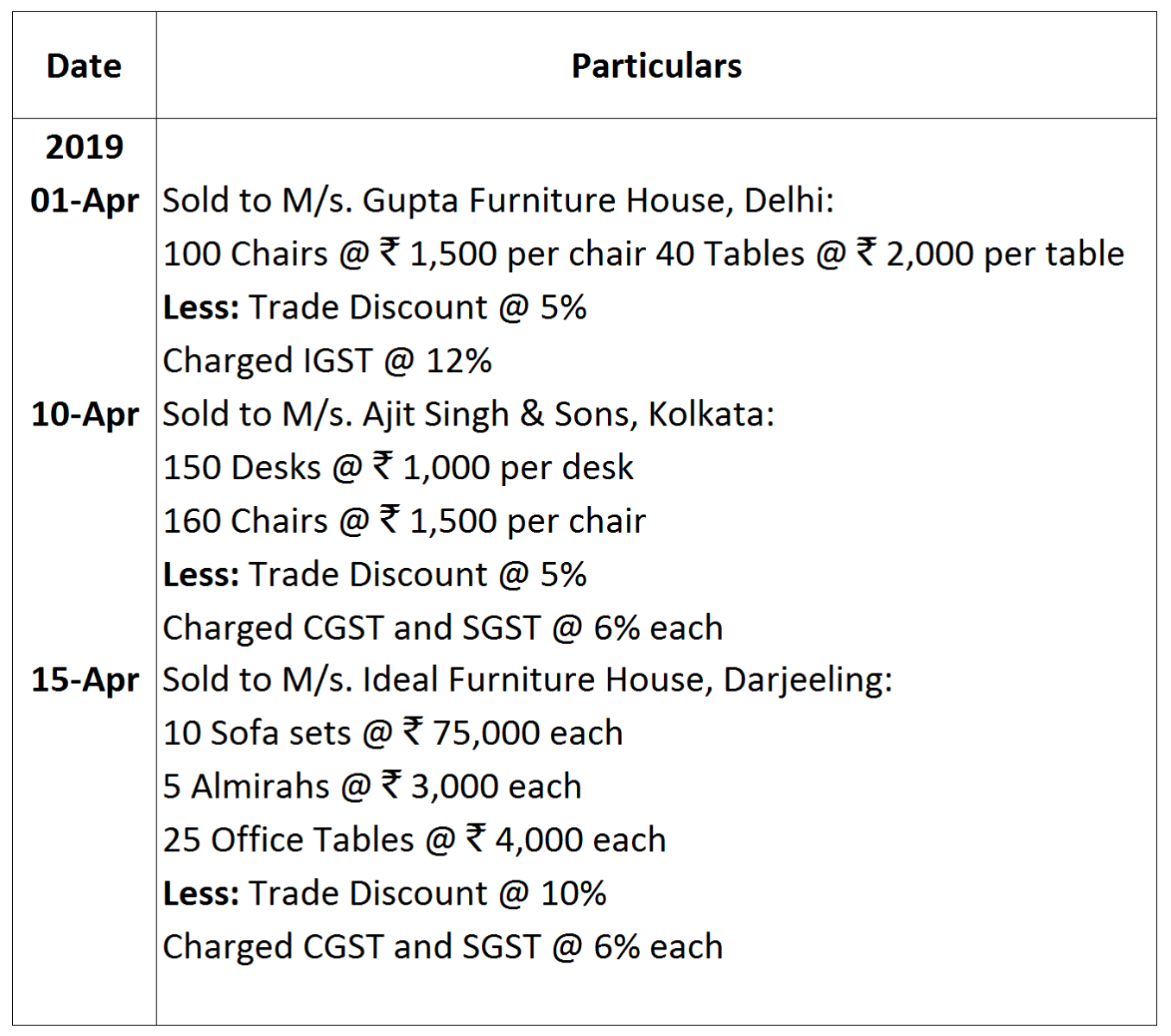
Prepare Sales Book from the following transactions of Hema Traders, Kolkata dealing in furniture. Open the Ledger Accounts also:
Rectify the following errors assuming that a suspense account was opened. Ascertain the difference in trial balance.
  1. Credit sales to Mohan ₹ 7,000 were posted to the credit of his account.
  2. Credit purchases from Rohan ₹ 9,000 were posted to the debit of his account as ₹ 6,000.
  3. Goods returned to Rakesh ₹ 4,000 were posted to the credit of his account.
  4. Goods returned from Mahesh ₹ 1,000 were posted to the debit of his account as ₹ 2,000.
  5. Cash sales ₹ 2,000 were posted to the debit of sales account as ₹ 5,000.
On 31st March, 2019, Bank Pass Book of Naresh & Co. showed an overdraft of ₹ 10,700. From the following particulars, prepare Bank Reconciliation Statement:
  1. Cheques issued before 31st March, 2019 but presented for payment after that date amounted to ₹ 900.
  2. Cheques paid into the bank but not collected and credited until 31st March, 2019 amounted to ₹ 2,200.
  3. Interest on overdraft amounting to ₹ 1,200 did not appear in the Cash Book.
  4. ₹ 5,000 being interest on investments collected by the bank and credited in the Pass Book were not shown in the Cash Book.
  5. Bank charges of ₹ 50 were not entered in the Cash Book.
  6. ₹ 800 in respect of dishonoured cheque were entered in the Pass Book but not in the Cash Book.
Mehak sold goods for ₹ 24,000 to Shally on July 31, 2017 and drew three bills for ₹ 6,000, ₹ 8,000 and ₹ 10,000 payable after two, three and four months respectively. The first bill was kept by Mehak with her till maturity date. She endorsed the second bill in favour of her creditor Kanak. The third bill was discounted on September 3, 2017 @ 12% p.a. from bank. The first and second bill were duly met on maturity but the third bill was dishonoured and the bank paid ₹ 150 as noting charges. On December 3, 2017 Shally paid ₹ 5,000 and noting charges in cash and accepted a new bill at two months after date for the balance amount plus interest ₹ 200. The new bill was met on maturity by Shally.
You are required to give the Journal Entries in the books of Mehak.
(Adjustment Entries) From the following information available on 31st March, 2019, pass the necessary Adjustment Entries in the Journal for the year ending on that date:
  1. Interest accrued ₹ 2,500.
  2. Wages for March, 2019 outstanding ₹ 10,000.
  3. Insurance prepaid ₹ 1,500.
  4. Commission due to manager 6% on net profit after charging such commission. The profit before charging such commission was ₹ 1,06,000.
  5. Interest due on loan but not paid. Loan of ₹ 1,50,000 was taken at 9% p.a. 9 months before end of the year.
Enter the following transactions in the Journal of Suresh, Delhi who trades in ready-made garments:
2019
 
April 1
Suresh paid into bank as Capital*
60,000
April 2
He bought goods and paid by cheque
24,000
April 3
Sold goods to Mukand & Co., Delhi
6,700
April 4
Sold goods for cash
10,900
April 5
Paid sundry expenses in cash*
3,000
April 8
Paid for office furniture and fittings by cheque
4,000
April 9
Bought goods from Ramesh & Bros., Faridabad (Haryana)
10,600
April 11
Returned goods to Ramesh & Bros.
1,500
April 12
Issued cheque to Ramesh & Bros. in full settlement*
9,500
April 30
Bank charged interest*
200
April 30
Borrowed from Ridhi @ 10% per annum interest*
50,000
April 30
Received from Mahendra on account*
6,000
April 30
Sold household furniture and paid the amount into business*
2,000
April 30
Sold goods costing ₹ 5,000 to Anita for cash at a profit of 20% on cost, less 20% trade discount
 
April 30
Sold goods costing ₹ 20,000 to Sunil at a profit of 20% on sale less 20% Trade Discount and paid cartage ₹ 150 (to be charged from customer).
 
CGST and SGST is levied @ 6% each on intra-state sale and purchase. IGST is levied @ 12% on inter-state sale and purchase. Out of the above, transactions marked with (*) are not subject to levy of GST.
[Hint: Household furniture is personal asset. When it is sold GST will not be levid. Since amount realised is invested in the firm, Suresh's Capital Account will be credited.}
Describe how debits and credits are used to analyse transactions.
On 1st September 2011, Gopal Ltd. purchased a plant for ₹ 10,20,000. On 1st July 2012 another plant was purchased for ₹ 6,00,000. The firm writes off depreciation @ 10% p.a. on original cost and its accounts are closed every year on 31st March. On 1st October 2014, a part of the second plant purchased on 1st July 2012 for ₹ 1,80,000 was sold for ₹ 1,10,000. On 1st December 2014, another plant was purchased for ₹ 3,00,000.
Prepare Plant Account, Provision for Depreciation Account and Plant Disposal Account.