Question
What do you know about complex tissue Classify and explain its different types in plants with suitable diagrams.
Answer

The complex tissue consists of more than one type of cells having a common origin. They are of two types:
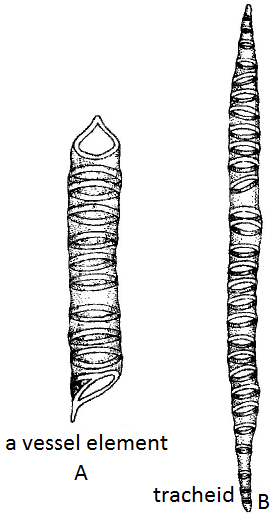
  1. Xylem: Xylem is a vascular and mechanical tissue which conducts water. Xylem is composed of cells of four different types:
  1. Tracheids.
  2. Vessels or tracheae.
  3. Xylem parenchyma.
  4. Xylem Sclerenchyma.
Except xylem parenchyma, all other xylem elements are dead and bounded by thick lignified walls. Vessels are shorter and wider than tracheids. Vessels are very long tube-like structures formed by a row of cells placed end to end. Tracheids are elongated cells with tapering ends. They also conduct water.
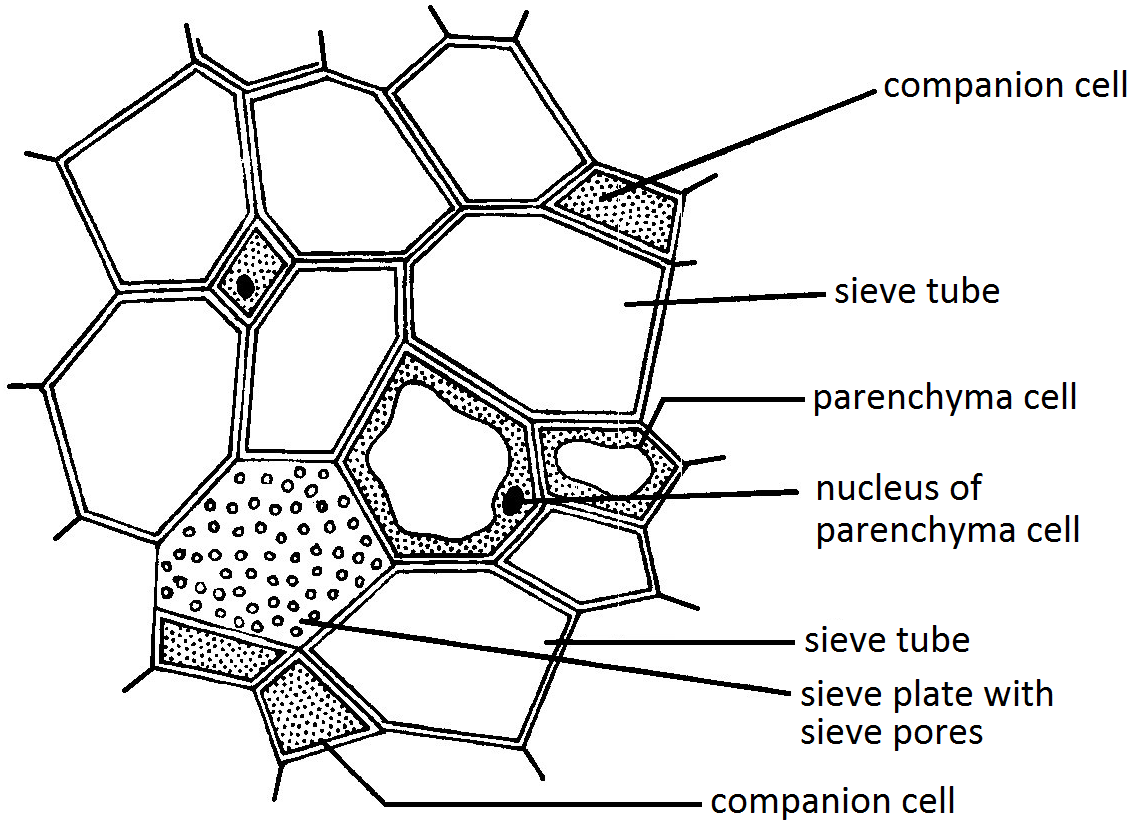
  1. Phloem: Phloem is also a vascular tissue which transports food from the leaves to the various parts of the plant. It is composed of:
  1. Sieve tubes: Sieve tubes are slender, tube-like structures composed of elongated thin-walled cells, placed end to end. Their end walls are perforated by numerous pores and are called sieve plates.
  2. Companion Cells: It is a small thin-walled cell containing dense and very active cytoplasm and large elongated nucleus.
  3. Phloem parenchyma: These are thin-walled, living cells of parenchyma of phloem. They have two functions, storage and slow lateral conduction of food.
  4. Phloem Fibres: These are thick-walled, elongated spindled shaped dead cells which posses narrow lumen. They provide mechanical strength to the tissue.

Need a full question paper?

Generate a complete, print-ready paper with questions like this in minutes — across 16+ boards, with answer keys.

Start Generating Free

Similar questions

Iron powder and sulphur powder were mixed together and divided into two parts A and B. When part A was heated strongly over a burner, then a substance C was formed. The part B was, however, not heated at all. When dilute hydrochloric acid was added to substance C, then gas D was evolved and when dilute hydrochloric acid was added to part B then gas E was evolved.
  1. What type of substance is B?
  2. What type of substance is C?
  3. Name the gas (i) D, and (ii) E?
  4. Write one characteristic property of gas D.
Describe structure and functions of bone.
Define the process of differentiation.
An automobile engine propels a $1000\ kg$ car
$(A)$ along a levelled road at a speed of $36\ km\ h^{-1}.$ Find the power if the opposing frictional force is $100N$.
Now, suppose after travelling a distance of $200m,$ this car collides with another stationary car
$(B)$ of same mass and comes to rest. Let its engine also stop at the same time. Now car $(B)$ starts moving on the same level road without getting its engine started. Find the speed of the car $(B)$ just after the collision.
You are provided with a mixture containing sand, iron filings, ammonium chloride and sodium chloride. Describe the procedures you would use to separate these constituents from the mixture?
Discuss various methods for weed control.
Double Matching:Match the columns I, II and III.
 
Column I
 
Column II
 
Column III
1.
Oil seeds
a.
Red Sindhi
i.
Sahiwal
2.
Intercropping
b.
Mustard
ii.
Sunflower
3.
Local breeds
c.
Vitamin A
iii.
Maize
4.
Poultry feed
d.
Soybean
iv.
Vitamin K
Discuss the structure and functions of mitochondria.
You are given a mixture of water, groundnut oil and common salt. How will you separate groundnut oil and common salt from it?
What is momentum? Write its $SI$ unit. Interpret force in terms of momentum. Represent the following graphically
  1. momentum versus velocity when mass is fixed.
  2. momentum versus mass when velocity is constant.