Question
What do you mean by linear and non linear correlation?

Answer

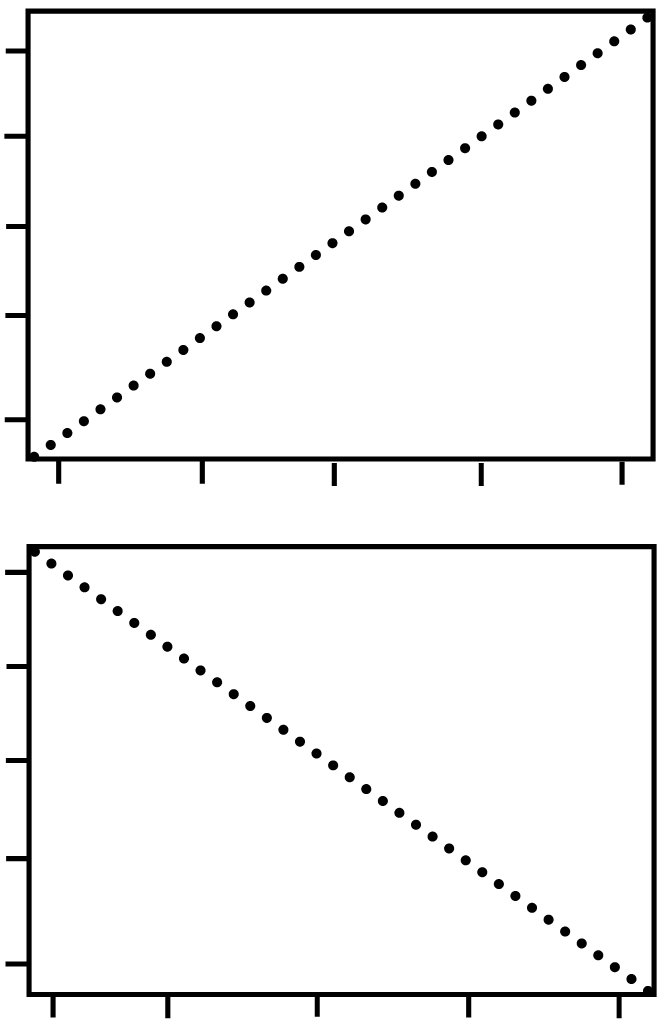
Linear Correlation: Linear correlation said to exist when the ratio of change between X and Y is stable. In other words, when X and Y change in such a way that their ratio of change remains same throughout. It can be positive linear as will as negative linear correlation. In the given table, there is linear relation because throughout the ratio of change in X and change in Y is 1:2.
X
Y
1
10
2
8
3
6
4
4
5
2
 
X
Y
1
10
2
8
3
6
4
4
5
2

Non Linear Correlation: Non linear or curvi - linear correlation said to exist when the ratio of change between X and Y is not stable. In other words, when X and Y change in such a way that their ratio of change does not remain same throughout. It can be positive non linear as will as negative non linear correlation. In the given table, there is non linear relation because t the ratio of change in X and change in Y is not constant.
X
Y
1
20
2
17
3
12
4
8
5
3
 
X
Y
1
5
2
14
3
22
4
28
5
29


Need a full question paper?

Generate a complete, print-ready paper with questions like this in minutes — across 16+ boards, with answer keys.

Start Generating Free

Similar questions

Represent the following information through a time series graph:
Years
2012
2013
2014
2015
2016
2017
2018
Exports (in crores ₹)
300
320
400
350
360
250
450
Imaports (in crores ₹)
450
300
280
375
330
450
325
Calculate Karl Pearson's coefficient of correlation for the data given below:
X
$2$
$3$
$4$
$5$
$6$
$7$
$8$
Y
$4$
$7$
$8$
$9$
$10$
$14$
$18$
Calculate Karl Pearson’s coefficient of correlation:
X
20
18
16
15
14
12
12
10
8
5
Y
12
16
10
14
12
10
9
8
7
2
Read the following case study carefully and answer the questions 1-6 on the basis of the same:
An economic system is a set of principles based on which an economy can run and make decisions about which goods and services to produce, how to produce and exchange them, how should the income from the production be distributed among the factor resources and what shall be the right balance between public sector and private sector and that between free market mechanism and regulation. Capitalism is an economic system based on certain principles, like provision of private property rights, free market economy and allowing economic agents (consumers and producers) to pursue private motives and self-interest with no or minimal government intervention. In an open economy and free trade environment, countries should produce the goods domestically in which they have comparative advantage. Comparative advantage principle states that if a country can produce a particular good at least opportunity cost comparatively than the rest of the world, then the country has comparative advantage in producing that good.

1. In _________ the degree of consumer sovereignty is highest.
(a) market economy
(b) centrally planned economy
(c) mixed economy
(d) both (a) and (c)

2. Which of the following is not a feature of centrally planned economy?
(a) Control of central authority
(b) Ownership of resources by government
(c) Consumer sovereignty
(d) Dominance over economic activity by public sector

3. Which among the following countries is not capitalistic or market driven in nature?
(a) Hong Kong
(b) Ireland
(c) Russia
(d) Canada

4._________economy is an economy in which the degree of interdependence and exchange is of a moderate degree.
(a) Simple
(b) Complex
(c) Both (a) and (b)
(d) None of these

5. Read the following statements carefully and choose the correct alternative among those given below:
Statement 1 : In a simple economy, income level of the people is low.
Statement 2 : In a complex economy, wants are multiple as well as enormous.
Alternatives:
(a) Both the statements are true
(b) Both the statements are false
(c) Statement 1 is true and Statement 2 is false
(d) Statement 2 is true and Statement 1 is false

6. In mixed economy, both public and private sectors dominate the economic activity.
Explain briefly different types of graphs.
Find the mean deviation and its coefficient from the given data.
Class lnterval Frequency (f)
17.5-22.5 2
22.5-27.5 4
27.5-32.5 6
32.5-37.5 8
37.5-42.5 6
42.5-47.5 4
47.5-52.5 2
52.5-57.5 2
Why do we need an index number?
Consider the following two data sets, where values in set A are the daily sales recorded by an ice-cream vendor; values in set B has the daily sales of a big departmental store :
Set A
500
700
1,000
Set B
10,000
12,000
13,000
  1. Analyse the data by using absolute measures of dispersion and interpret.
  2. Suggest relative counterparts of absolute measures.
What is procedure of drawing histogram in case of unequal class interval?
Calculate mean deviation from median:
X 10 20 30 40 50
Frequency 2 8 15 10 4