Question
What do you understand by the terms “balanced forces” and “unbalanced forces”? Explain with examples.

Answer

  • Balanced forces: If the resultant of all the forces acting on a body is zero, the forces are called balanced forces. These forces do not change the state of rest or of uniform motion of a body but can change the shape of the body.

For example: when a balloon is pressed between hands, then balanced forces (equal and opposite forces) act on the balloon due to which the shape of the balloon changes.

  • Unbalanced forces: If the resultant of all the forces acting on a body is not zero, the forces are called unbalanced forces. These forces change the state of rest or of uniform motion of a body.

For example: if we push a toy car lying on the ground, it starts moving due to the unbalanced force exerted by our hands.

Need a full question paper?

Generate a complete, print-ready paper with questions like this in minutes — across 16+ boards, with answer keys.
Start Generating Free

Similar questions

Give the main differences between physical changes and chemical changes.
Mention two ways by which a photosynthesing cell belonging to this group differs from a cell of your body.
A boy walks from his classroom to the bookshop along a straight corridor towards North. He covers a distance of 20m in 25 seconds to reach the bookshop. After buying a book, he travels the same distance in the same time to reach back in the classroom. Find (a) average speed, and (b) average velocity, of the boy.
How will you separate a mixture of iron filings, chalk powder an common salt?
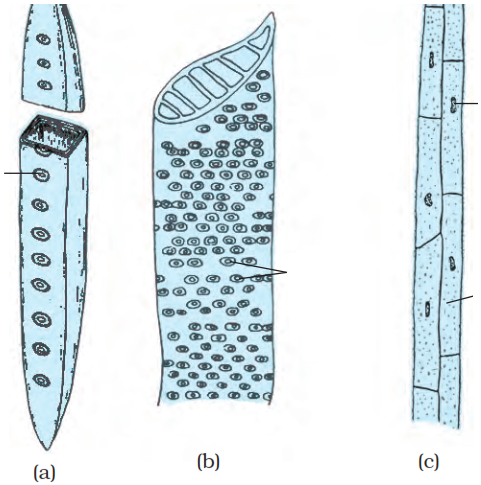
  1. Identify the structures marked below as A, B and C.
  2. Complete the labeling of each structure.
  3. Write the function of each structure.

Distinguish between longitudinal and transverse waves.
A farmer is advised to use manure instead of fertilizer in his fields. List any two advantages that the farmer will get if he accepts this advice. How is the use of manure particularly useful for clayey and sandy soil?
One of the forms of a naturally occurring solid compound P is usually used for making the floors of houses. On adding a few drops of dilute hydrochloric acid to P, brisk effervescence are produced. When 50g of reactant P was heated strongly, than 22g of a gas Q and 28g of a solid R were produced as products. Gas Q is the same which produced brisk effervescence on adding dilute HCl to P. Gas Q is said to cause global warming whereas solid R is used for white-washing.
  1. What is (i) solid P (ii) gas Q, and (iii) solid R.
  2. What is the total mass of Q and R obtained from 50g of P?
  3. How does the total mass of Q and R formed compare with the mass of P taken?
  4. What conclusion do you get from the comparison of masses of products and reactant?
  5. Which law of chemical combination is illustrated by the example given in this problem?
Using second law of motion, derive the relation between force and acceleration. A bullet of 10g strikes a sand-bag at a speed of 103m s-1 and gets embedded after travelling 5cm. Calculate
  1. The resistive force exerted by the sand on the bullet.
  2. The time taken by the bullet to come to rest.

Explain the various methods of crop improvement. Name one improved variety of Rice, Maize, Soybean, Sunflower and Mustard.