Question
What do you understand by the terms “balanced forces” and “unbalanced forces”? Explain with examples.

Answer

  • Balanced forces: If the resultant of all the forces acting on a body is zero, the forces are called balanced forces. These forces do not change the state of rest or of uniform motion of a body but can change the shape of the body.
For example: when a balloon is pressed between hands, then balanced forces (equal and opposite forces) act on the balloon due to which the shape of the balloon changes.
  • Unbalanced forces: If the resultant of all the forces acting on a body is not zero, the forces are called unbalanced forces. These forces change the state of rest or of uniform motion of a body.
For example: if we push a toy car lying on the ground, it starts moving due to the unbalanced force exerted by our hands.

Need a full question paper?

Generate a complete, print-ready paper with questions like this in minutes — across 16+ boards, with answer keys.

Start Generating Free

Similar questions

On a level road, a scooterist applies brakes to slow down from a speed of $10m/s$ to $5m/s$. If the mass of the scooterist and the scooter be $150kg$, calculate the work done by the brakes. (Neglect air resistance and friction)
Why are xylem and phloem called complex tissues? How are they different from one other?
How can reverberations in a big hall or auditotium be reduced?`
Explain what will happen if in a cultivated field only manures are supplied and in another field only fertilizers are supplied, keeping all other conditions similar.
Give two examples each of longitudinal waves and transverse waves.
Calculate the work done by the brakes of a car of mass $1000kg$ when its speed is reduced from $20m/s$ to $10m/s$?
List out some common features in cat, rat and bat.
Pragya tested the solubility of three different substances at different temperatures and collected the data as given below (results are given in the following table, as grams of substance dissolved in $100$ grams of water to form a saturated solution).
Substance Dissolved Temperature in K
283 293 313 333 353
Solubility
Potassium nitrate $21$ $32$ $62$ $106$ $167$
Sodium chloride $36$ $36$ $36$ $37$ $37$
Potassium chloride $35$ $35$ $40$ $46$ $54$
Ammonium chloride $24$ $37$ $41$ $55$
$66$
  1. What mass of potassium nitrate would be needed to produce a saturated solution of potassium nitrate in $50$ grams of water at $313\ K$?
  2. Pragya makes a saturated solution of potassium chloride in water at $353K$ and leaves the solution to cool at room temperature. What would she observe as the solution cools? Explain.
  3. Find the solubility of each salt at $293\ K$. Which salt has the highest solubility at this temperature?
  4. What is the effect of change of temperature on the solubility of a salt?
Write down the characters of bee variety suitable for bee keeping.

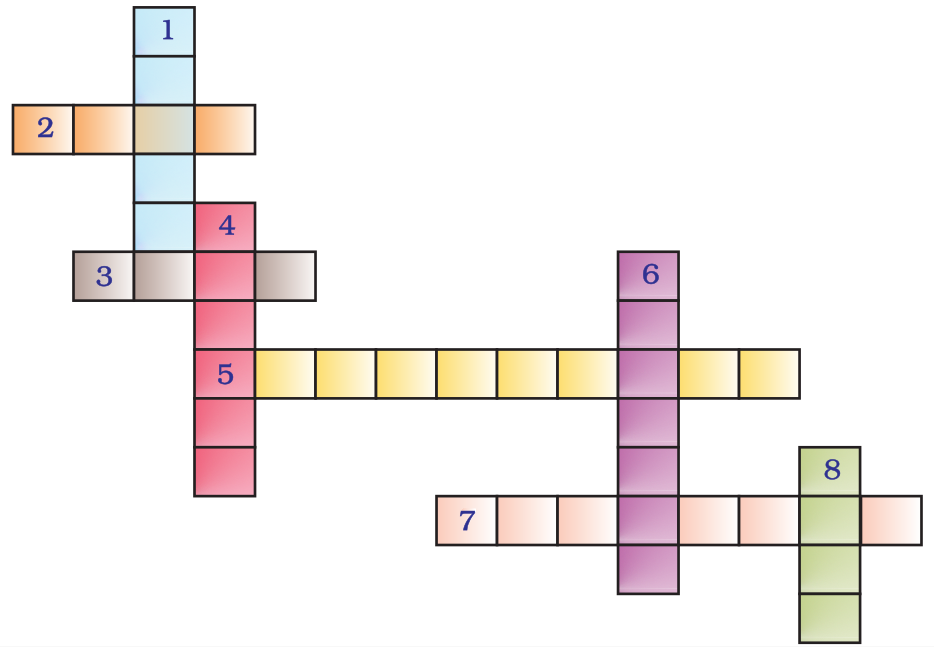
Complete the following crossword puzzle (Figure) by using the name of the chemical elements. Use the data given in the table following.
Across
Down
$2.$
The element used by Rutherford during his $\alpha$–scattering experiment.
$1.$
A white lustrous metal used for making ornaments and which tends to get tarnished black in the presence of moist air.
$3.$
An element which forms rust on exposure to moist air.
$4.$
Both brass and bronze are alloys of the element.
$5.$
A very reactive non–metal stored under water.
$6.$
The metal which exists in the liquid state at room temperature.
$7.$
Zinc metal when treated with dilute hydrochloric acid produces a gas of this element which when tested with burning splinter produces a pop sound.
$8.$
An element with symbol Pb.