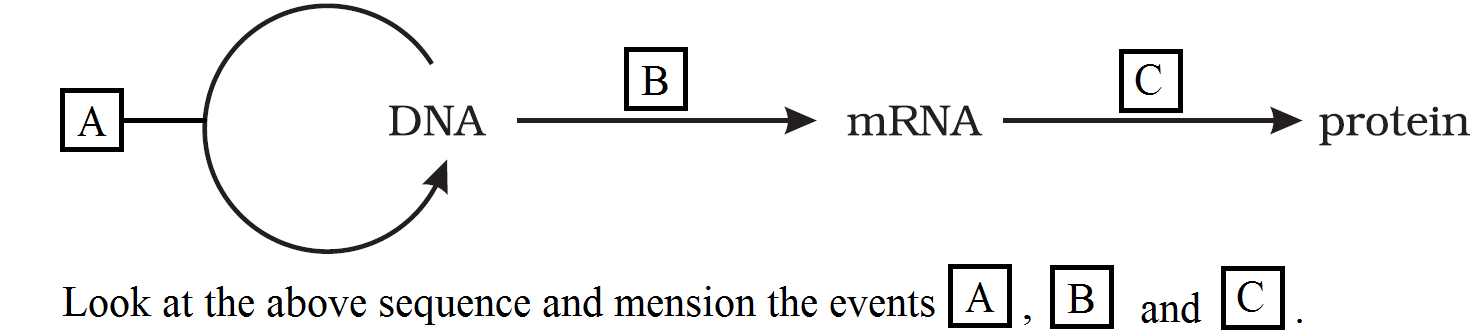
Question
  1.  
  1. What does central dogma state in molecular biology? How does it differ in some viruses?

Answer

  1.  
A - Replication of DNA.

B - Transcription.

C - Translation.
  1.  
  1. The central dogma of molecular biology states that the genetic information flows from DNA to RNA to proteins.
  2. In some viruses, the flow of information is in reverse direction, i.e. from RNA to DNA and is called reverse transcription.

Need a full question paper?

Generate a complete, print-ready paper with questions like this in minutes — across 16+ boards, with answer keys.

Start Generating Free

Similar questions

  1. Name the organism in which the vector shown is inserted to get the copies of the desired gene.
  2. Mention the area labelled in the vector responsible for controlling the copy number of the inserted gene.
  3. Name and explain the role of a selectable marker in the vector shown.
What is artificial method of vegetative propagation? Describe: (i) cutting (ii) Budding
Give reasons: Absorption of water by roots from soil is with physical processes inhibition, diffusion and osmosis.
Give the full form of CT and MRI. How are they different from each other? Where are they used?
Answer the following questions:
Why is tender coconut considered a healthy source of nutrition?
Explain different types of restriction enzymes?
A farmer while working on his farm was bitten by a poisonous snake. The workers in the farm immediately rushed him to the nearby health centre. The doctor right away gave him an injection to save his life. What did the doctor inject and why? Explain.
  1. Name the tropical sugar cane variety grown in South India. How has it helped in improving the sugar cane quality grown in North India?
  2. Identify ‘a’, ‘b’ and ‘c’ in the following table:
No. Crop Variety Insect Pests
1. Brassica Pusa Gaurav (a)
2. Flat bean Pusa Sem 2, Pusa Sem 3 (b)
3. (c) Pusa Sawani, Pusa A-4 Shoot and fruit borer
Draw a labelled diagrammatic sectional view of a human seminiferous tubule.
  1. A normal couple gave birth to one haemophilic son and two normal daughters. Work out the cross to show the genotypes of the parents and their progeny.
  2. Give the possible genotypes of the parents, who can give birth to haemophilic daughters.