Question
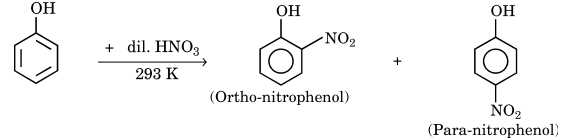
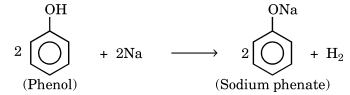
What happens when phenol reacts with: (i) Na (ii) dil. $ HNO_{3} $

Need a full question paper?

Generate a complete, print-ready paper with questions like this in minutes — across 16+ boards, with answer keys.
Start Generating Free

Similar questions

A compound (X) reacts with PCl5 to form compound Y. Compound Y reacts with ethereal solution of magnesium to form compound (Z), which on treating with propanone and further hydrolysis to give 2-Methyl propan-2-ol. What are the compounds X and Y and also give the equations of the reactions.
What happens when :
(a) Acetone is treated with $Zn ( Hg ) /$ conc. HCl .
(b) Ethanal is treated with Methylmagnesium bromide and then hydrolysed ?
(c) Who are the members of halogen family?
From the following molar conductivities at infinite dilution, calculate $\Lambda^0_{\text{m}}$ for NH4OH.
$\Lambda^0_{\text{m}}\text{ for }\text{Ba(OH)}_2=457.6\Omega^{-1}\text{cm}^2\text{mol}^{-1}$
$\Lambda^0_{\text{m}}\text{ for }\text{BaCl}_2=240.\Omega^{-1}\text{cm}^2\text{mol}^{-1}$
$\Lambda^{0}_{\text{m}}\text{ for }\text{NH}_4\text{Cl}=129.8\Omega^{-1}\text{cm}^2\text{mol}^{-1}$
What is a peptide bond or peptide chain? Elaborate on how protein compounds are formed from amino acid compounds.
Explain the acidic nature of alcohols and phenols by their reaction with metals. ### 'Alcohols and phenols are acidic in nature' verify the truth of this statement by a reaction with metals.
Vapour pressure of water at 20oC is 17.5 mm Hg. Calculate the vapour pressure of water at 20 oC when 15 g of glucose (Molar mass =180 g mol-1) is dissolved in 150 g of water.
A current of 5 ampere is flowing though a wire for 193 seconds. Calculate the number of electrons flowing through the cross section of wire for 193 seconds.
The decomposition of NH3 on platnium surface is zero order reaction. What are the rates of production of N2 and H2 if = 2.5 × 10⁻⁴ mol L-1 s-1?
Explain the variation in ionization enthalpies of transition element in 3d series.
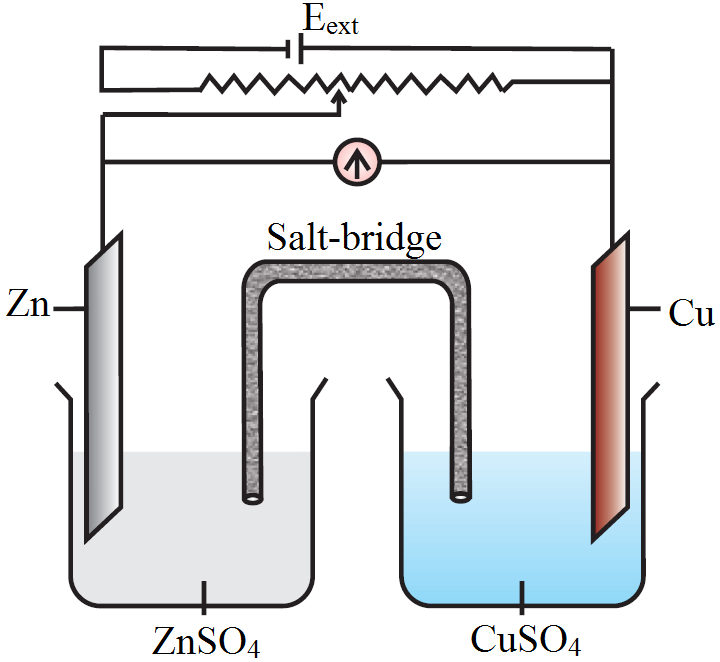
The electrochemical cell given alongside converts the chemical energy released during the redox reaction
$\text{Zn(s) + Cu}^{2+}\text{(aq)}\xrightarrow{ \ \ \ \ \ \ \ }\text{Zn}^{2+}(\text{aq) + Cu(s)}$
to electrical energy. It gives an electrical potential of 1.1V when concentration Zn2+ and Cu2+ ions is unity. State the direction of flow of current and also specify whether zinc and copper are deposited or dissolved at their respective electrodes when:
  1. An external opposite potential of less than 1.1V is applied.
  2. An external potential of 1.1V is applied.
  3. An external potential of greater than 1.1V is applied.