Questions

3 Marks Question

🎯

Test yourself on this topic

9 questions · timed · auto-graded

Question 13 Marks
What is meant by hydroboration oxidation reaction? Illustrate with an example.
Answer
The addition of diborane to alkenes to form trialkyl boranes followed by their oxidation by alkaline $H _2 O _2$ to form alcohols is called hydroboration oxidation.
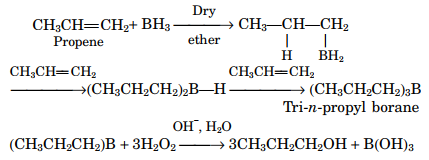
Image
View full question & answer
Question 23 Marks
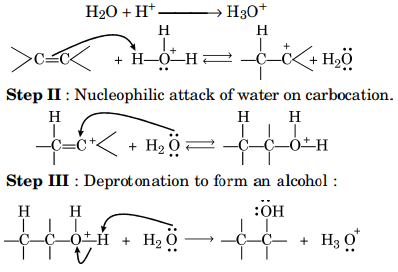
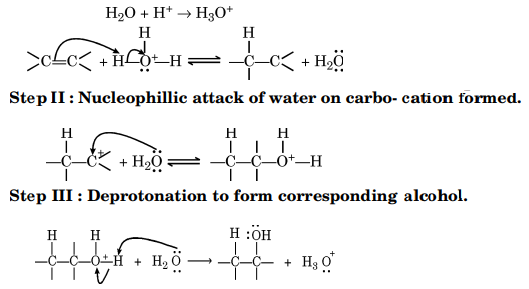
Give the mechanism for the formation of ethanol from ethene.
Answer
Step I : Protonation of alkene to form carbocation by electrophilic attack of $H _3 O ^{+}$
Image
View full question & answer
Question 33 Marks
(a) Out of t-butyl alcohol and n-butanol, which one will undergo acid catalysed dehydration faster and why?
(b) Carry out the following conversions :
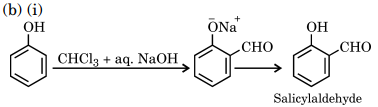
(i) Phenol to Salicylaldehyde
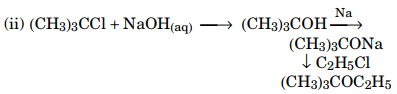
(ii) t-butylchloride to t-butyl ethyl ether
(iii) Propene to Propanol
Answer
(a) t-buty alcohol, because it forms more stable $3^{\circ}$ carbocation than $1^{\circ}$ carbocation.
Image
Image
(iii) $CH _3 CH = CH _2 \xrightarrow[ H _2 O _2 / OH ^{-}]{ B _2 H _6} CH _3 CH _2 CH _2 OH$
View full question & answer
Question 43 Marks
Write the equations involved in the following reactions:
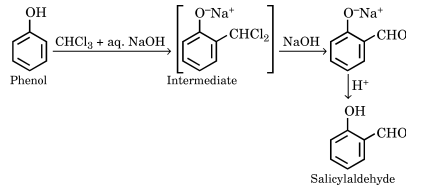
(i) Reimer-Tiemann reaction
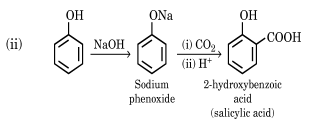
(ii) Kolbe's reaction
Answer
(i)
Image
Image
View full question & answer
Question 63 Marks
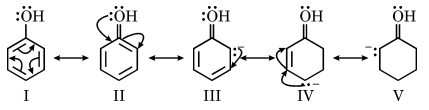
Explain how does -OH group attached to a carbon of benzene ring activate towards electrophilic substitution?
Answer
Phenol may be regarded as a resonance hybrid of following structures :
Image
Thus + R effect of the - OH group the electron density in the benzene ring increases thereby facilitating the attack by an electrophile. Thus presence of - OH group activates the benzene ring towards the electrophilic substitution reaction. Since the electron density is relatively higher at the $o$ - and $p$-position, therefore, electrophilic substitution occurs mainly at ortho and para positions.
View full question & answer
Question 73 Marks
Write the mechanism hydration of ethene to yield ethanol.
Answer
The mechanism involves three steps :
Step I: Protonation of alkene to form carbocation by electrophile attack of $H _3 O ^{+}$.
Image
View full question & answer
Question 93 Marks
Account for the following :
(i) The order of reactivity of halogen acids towards alcohols is : $\quad HI > HBr > HCl$
(ii) The order of acidity of alcohols falls in the order : primary > secondary > tertiary.
(iii) The - OH group in phenols is ortho- and para-directing.
Answer
(i) The order of reactivity of halogen acid towards alcohol is $HI > HBr > HCl$. This is because $I ^{-}$is a better nucleophile in comparison to $Br ^{-}$and $Cl ^{-}$and the reaction takes place via nucleophile substitution reaction.
(ii) The order of acidity of alcohols is primary > secondary > tertiary. The reason behind this is the increase in number of + I groups as be move from primary to tertiary. This increases the electron density on oxygen atom.
(iii) The $OH ^{-}$groups in phenols is ortho-para directing, because $OH ^{-}$is a ring activating group which increase electron density on ortho and para position.
View full question & answer
3 Marks Question - Chemistry STD 12 Science Questions - Vidyadip