Question
What is a capacitive and an inductive AC circuit? Explain.

Answer

Amplitude of electric current in an $L - C - R$ AC series circuit (Amplitude means maximum current)
$i_m=\frac{u_m}{\sqrt{ R ^2+\left( X _{ C }- X _{ L }\right)^2}}$
Phase difference between voltage and current
$\phi=\tan ^{-1}\left(\frac{ X _{ C }- X _{ L }}{ R }\right)$
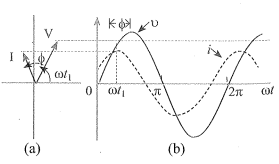
→Case-I : If $X _{ C }> X _{ L }$ phase difference $\phi$ is positive. and the circuit is predominatly capacitive. Consequently, the current in the circuit leads the source voltage.
→Case-II : If $X _{ C }< X _{ L }, \phi$ is negative and the circuit is predominantly inductive. Consequently, the current in the circuit lags the source voltage.
Image
Figure shows the phasor diagram and variation of $v$ and $i$ with $\omega t$ for the case $X _{ C }> X _{ L }$.

Need a full question paper?

Generate a complete, print-ready paper with questions like this in minutes — across 16+ boards, with answer keys.
Start Generating Free

Similar questions

Write Maxwell's equations.
White light is used in a Young's double slit experiment. Find the minimum order of the violet fringe $(\lambda=400\text{nm}),$ which overlaps with a red fringe $(\lambda=700\text{nm}).$
If an object far away from a convex mirror moves towards the mirror, the image also moves. Does it move faster, slower or at the same speed as compared to the object?
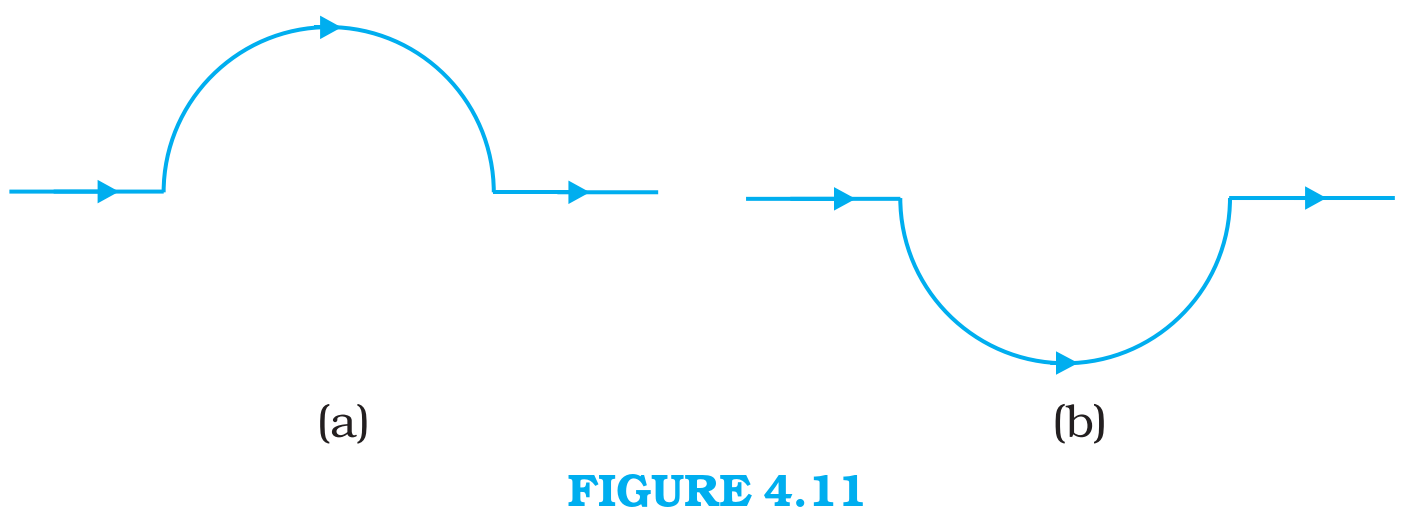
A straight wire carrying a current of $12 A$ is bent into a semi-circular arc of radius $2.0 cm$ as shown in Fig. 4.11 (a). Consider the magnetic field $B$ at the centre of the arc. (a) What is the magnetic field due to the straight segments? (b) In what way the contribution to $B$ from the semicircle differs from that of a circular loop and in what way does it resemble? (c) Would your answer be different if the wire were bent into a semi-circular arc of the same radius but in the opposite way as shown in Fig. 4.11(b)?
Image
An electron beam projected along the positive X-axis deflects along the positive Y-axis. If this deflection is caused by a magnetic field, what is the direction of the field? Can we conclude that the field is parallel to the Z-axis?
Identify the electromagnetic waves whose wavelengths lie in the range:
  1. 10–11 m < $\lambda$ < 10–14 m
  2. 10–4 m < $\lambda$ < 10–6 m
Write one use for each.
A compound microscope consists of an objective lens of focal length 1 cm , an eyepiece of focal length 2 cm and tube length is 20 cm . Find its magnification.
Explain the variation of resistivity with temperature in pure-semiconductors.
Consider two particles A and B having equal charges and placed at some distance. The particle A is slightly displaced towards B. Does the force on B increase as soon as the particle A is displaced? Does the force on the particle A increase as soon as it is displaced?
In the given figure, if the Wheatstone Bridge is balanced, then find the magnitude of unknown resistance $X$. Image