Question
What is an incompressible fluid?

Answer

An incompressible fluid is one which does not undergo change in volume for a large range of pressures. Thus, its density has a constant value throughout the fluid. In most cases, all liquids are incompressible.

Need a full question paper?

Generate a complete, print-ready paper with questions like this in minutes — across 16+ boards, with answer keys.
Start Generating Free

Similar questions

What is the difference between a musical sound and a noise?
A parallel beam of green light of wavelength $546$ nm passes through a slit of width $0.4\ mm.$ The intensity pattern of the transmitted light is seen on a screen that is $40\ cm$ away. What is the distance between the two first-order minima?
Explain what is Doppler effect, in sound and state its any 'four' applications.
Draw a neat labelled diagram illustrating spherical wavefronts corresponding to a diverging beam of light.
In Young's double$-$slit experiment, the two slits are $2\ mm$ apart. The interference fringes for light of wavelength $6000 \mathring A$ are formed on a screen $80 \ cm$ away from them.
$(i)$ How far is the second bright fringe from the central bright point?
$(ii)$ How far is the second dark fringe from the central bright point?
What is meant by thermal equilibrium ? What is meant by the expression "two systems are in thermal equilibrium" ?
With the help of neat diagrams, explain how the non-polar dielectric material is polarised in external filed of increasing intensity. Define polarisation in dielectrics.
Green light of wavelength $5100 \mathring A$ from a narrow slit is incident on a double-slit. If the overall separation of $10$ fringes on a screen $200 \ cm$ away from it is $2 \ cm$, find the slit-separation.
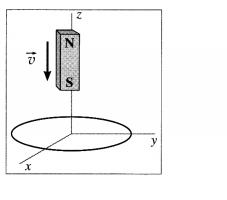
A bar magnet is dropped vertically through a thick copper ring as shown. What is the direction of the force exerted by the coil on the magnet? Explain.
Image
State the MI of a thin rectangular plate-of mass M, length l and breadth b about its transverse axis passing through its centre. Hence find its MI about a parallel axis through the midpoint of edge of length b.