Maharashtra BoardEnglish MediumSTD 12 SciencePhysicsWave Optics4 Marks
Question
What is Brewster’s law? Derive the formula for Brewster angle.
✓
Answer
Brewster's law : The tangent of the polarizing angle is equal to the refractive index of the reflecting medium with respect to the surrounding $\left({ }_1 n_2\right)$. If $\theta_B$ is the polarizing angle, $\tan \theta_{ B }={ }_1 n_2=\frac{n_2}{n_1}$
Here $n_1$ is the absolute refractive index of the surrounding and $n_2$ is that of the reflecting medium.
The angle $\theta_B$ is called the Brewster angle.
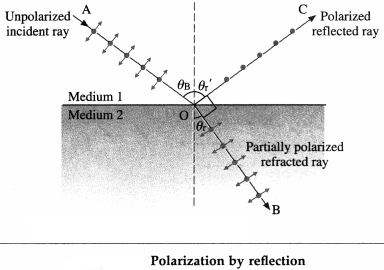
Consider a ray of unpolarized monochromatic light incident at an angle $\theta_B$ on a boundary between two transparent media as shown in below figure. Medium 1 is a rarer medium with refractive index $n_1$ and medium 2 is a denser medium with refractive index $n_2$. Part of incident light gets refracted and the rest
gets reflected. The degree of polarization of the reflected ray varies with the angle of incidence.
The electric field of the incident wave is in the plane perpendicular to the direction of propagation of incident light. This electric field can be resolved into a component parallel to the plane of the paper, shown by double arrows, and a component perpendicular to the plane of the paper shown by dots, both having equal magnitude. Generally, the reflected and refracted rays are partially polarized, i.e., the two components do not have equal magnitude.
In 1812, Sir David Brewster discovered that for a particular angle of incidence.$ \theta _B$, the reflected wave is completely plane-polarized with its electric field perpendicular to the plane of the paper while the refracted wave is partially polarized. This particular angle of incidence $(\theta _B)$ is called the Brewster angle.
For this angle of incidence, the refracted and reflected rays are perpendicular to each other.
For angle of refraction $\theta_{ r }$,
$\theta_{B}+\theta_{r}=90^{\circ}$
From Snell's law of refraction,
$\therefore n_1 \sin \theta_{B}=n_2 \sin \theta_{r} \ldots$
From Eqs. (1) and (2), we have,,
$n_1$ sin $\theta _B = n_2 \sin (90^\circ – \theta _B) = n_2 \cos \theta _B$
$\therefore \frac{n_2}{n_1}=\frac{\sin \theta_{ B }}{\cos \theta_{ B }}=\tan \theta_{ B }$
$\therefore \theta_{ B }=\tan ^{-1}\left(\frac{n_2}{n_1}\right)$
This is called Brewster's law.
Need a full question paper?
Generate a complete, print-ready paper with questions like this in minutes — across 16+ boards, with answer keys.