Question
What is called a battery? Explain its characteristics and describe dry cell and mercury cell.

Answer

self

Need a full question paper?

Generate a complete, print-ready paper with questions like this in minutes — across 16+ boards, with answer keys.

Start Generating Free

Similar questions

Attempt any five of the following:
(a) What is the structural feature characterising reducing sugars?
(b) What type of linkage is present in polysaccharides?
(c) Give examples of fat soluble vitamins.
(d) The two strands in DNA are not identical but are complementary. Explain.
(e) Write uses of B-Complex.
(f) Name the disaccharide which on hydrolysis gives two molecules of glucose.
(g) Name purines present in DNA?
Giving an example for each describe the following reactions:
i. Hofmann bromamide reaction.
ii. Gattermann reaction.
iii. Coupling reaction.
Graphically explain the effect of temperature on the rate constant of reaction. How can this temperature effect on rate constant be represented quantitatively?
Match the complex ions given in Column $I$ with the colours given in Column $II$ and assign the correct code:
 
Column $I ($Complex ion$)$
 
Column $II ($Colour$)$
$a.$ $[Co(NH_3)_6]^{3+}$ $1.$
Violet
$b.$ $[Ti(H_2O)_6]^{3+}$ $2.$
Green
$c.$ $[Ni(H_2O)_6]^{2+}$ $3.$
Pale blue
$d.$ $[Ni(H_2O)_4(en)]^{2+} (aq)$ $4.$
Yellowish orange
 
 
$5.$
Blue
Code:
Match the catalysts given in Column $I$ with the processes given in Column $II.$
 
Column $I ($Catalyst$)$
 
Column $II ($Process$)$
$(i)$
Ni in the presence of hydrogen
$(a)$
Zieglar Natta catalyst
$(ii)$ $Cu_2Cl_2$ $(b)$
Contact process
$(iii)$ $V_2O_5$ $(c)$
Vegetable oil to ghee
$(iv)$
Finely divided iron
$(d)$
Sandmeyer reaction
$(v)$ $TiCl_4 + Al (CH_3)_3$ $(e)$
Haber’s Process
 
 
$(f)$
Decomposition of $KClO_3$
Explain the following reactions of phenol :
(i) Nitration
(ii) Gatterman aldehyde synthesis
(iii) Fries rearrangement
(iv) Reaction with mercuric acetate.
How does nitric acid react with the following ? Give equations.
(i) Copper
(ii) Iron
(a) (i) Write the disproportionation reaction of $H _3 PO _3$.
(ii) Draw the structure of $XeF _4$.
(b) Account for the following:
(i) Although fluorine has less negative electron gain enthalpy yet $F_2$ is a strong oxidizing agent.
(ii) Acidic character decreases from $N _2 O _3$ to $Bi _2 O _3$ in group 15.
(c) Write a chemical reaction to test Sulphur dioxide gas. Write the chemical equation involved.
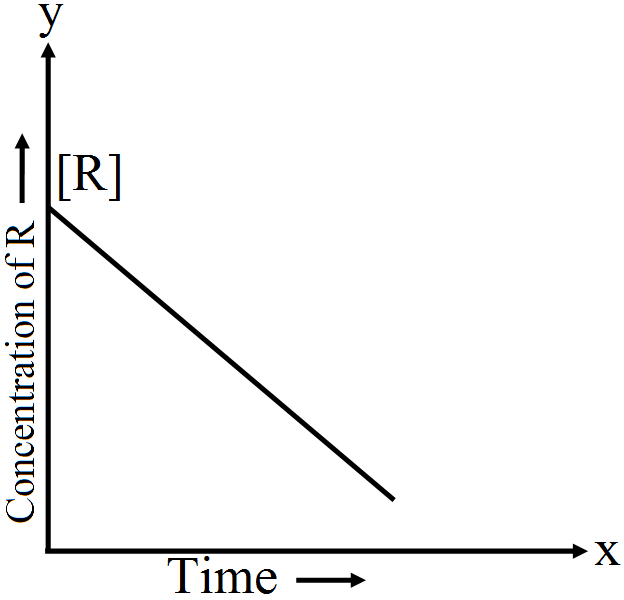
In the reaction
$Q + R \rightarrow$ Products
The time taken for $99\%$ reaction of $Q$ is twice the time taken for $90\%$ reaction of $R.$ The concentration of $R$ varies with time as shown in the figure given alongside.

What is the overall order of the reaction? Give the units of the rate constant for the same. Write the rate expression for the above reaction.
Account for the following :
(i) $p K _b$ of aniline is more than that of methylamine.
(ii) Ethylamine is soluble in water whereas aniline is not.
(iii) Methylamine in water reacts with ferric chloride to precipitate hydrated ferric oxide.
(iv) Aniline does not undergo Friedel-Crafts reaction.
(v) Diazonium salts of aromatic amines are more stable than those of aliphatic amines.