Question
What is called extrinsic semiconductor? Explain doping process.

Answer

Extrinsic semiconductor : The conductivity of intrinsic semiconductors is very low at room temperature. Therefore, to increase the conductivity, a small amount of certain element of the third or fifth group is added to the semiconductor. The semiconductor obtained in this way is called impurity semiconductor or extrinsic semiconductor.
Doping : The process of introducing impurity atoms into a intrinsic semiconductor is called doping.
To obtain extrinsic semiconductor, approximately from $(10)^6$ to $(10)^{10}$ atoms are one atom is of impurity element in intrinsic semiconductor.

Need a full question paper?

Generate a complete, print-ready paper with questions like this in minutes — across 16+ boards, with answer keys.
Start Generating Free

Similar questions

An electron and a photon each have a wavelength 1.00 nm. Find.
  1. Their momenta,
  2. The energy of the photon and,
  3. The kinetic energy of electron.
Magnetic moment of a small bar magnet is 0.24 newton metre tesla ${ }^{-1}$. Calculate magnetising field of the magnet at a distance of 10 cm from the centre of the magnet on its axis.
A 12 pF capacitor is connected to a 50 V battery. How much electrostatic energy is stored in the capacitor? If another capacitor of 6 pF is connected in series with it with the same battery connected across the combination, find the charge stored and potential difference across each capacitor.
Assume that each atom in a copper wire contributes one free electron. Estimate the number of free electrons in a copper wire having a mass of $6.4g$ (take the atomic weight of copper to be $64g$ mol$^{-1}.$
Plot a graph showing the variation of binding energy per nucleon as a function of mass number. Which property of nuclear force explains the approximate constancy of binding energy in the range 30 < A < 170? How does one explain the release of energy in both the processes of nuclear fission and fusion from the graph?
  1. Why are coherent sources necessary to produce a sustained interference pattern?
  2. In Young's double slit experiment using monochromatic light of wavelength$\lambda,$ the intensity of light at a point on the screen where path difference is$\lambda,$ is K units. Find out the intensity of light at a point where path difference is $\lambda/3.$
The average translational kinetic energy of air molecules is $0.040eV (1eV = 1.6 \times 10^{-19}J)$. Calculate the temperature of the air. Boltzmann constant $k = 1.38 \times 10^{-23}JK^{-1}.$
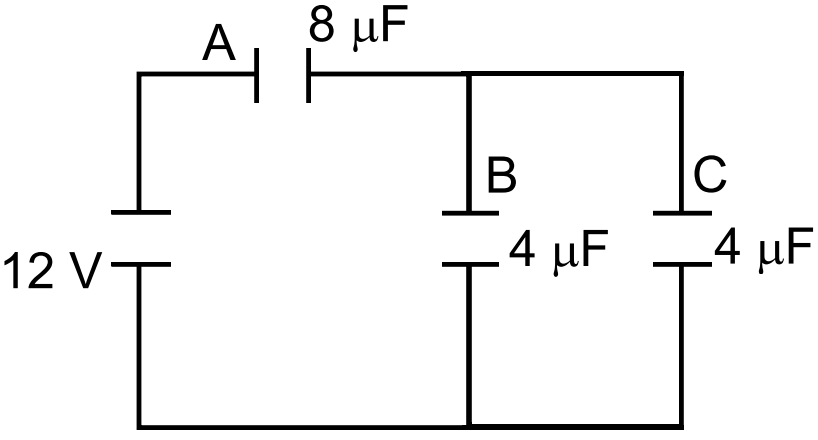
Find the charge appearing on each of the three capacitors shown in figure.
In a silicon transistor, the base current is changed by $20\mu\text{A}.$ This results in a change of 0.02V in base to emitter voltage and a change of 2mA in the collector current.
  1. Find the input resistance, $\beta-$ac and trans conductance of the transistor.
  2. This transistor is used as an amplifier in CE configuration with a load resistance $5\text{k}\Omega$ What is the voltage gain of the amplifier?
A coil of inductance 5.0mH and negligible resistance is connected to the oscillator of the previous problem. Find the peak currents in the circuit for $\omega=100\text{s}^{-1},500\text{s}^{-1},1000\text{s}^{-1}.$