Question
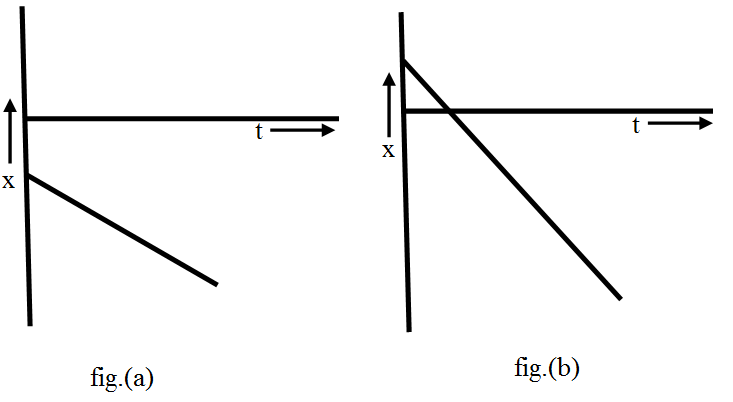
What is common between the two graphs shown in Figs. (a) and (b)?

Answer

Both represent negative velocity.

Need a full question paper?

Generate a complete, print-ready paper with questions like this in minutes — across 16+ boards, with answer keys.
Start Generating Free

Similar questions

A shell explodes while at rest. Discuss the momentum and energy conservation in the explosion.
Even when no heat is exchanged by the contents of a thermos flask, the contents get heated up by constant shaking. Why?
Show that the internal energy of the air (treated as an ideal gas) contained in a room remains constant as the temperature changes between day and night. Assume that the atmospheric pressure around remains constant and the air in the room maintains this pressure by communicating with the surrounding through the windows, doors, etc.
It is heard sometime that mercury is used in defining the temperature scale because it expands uniformly with temperature. If the temperature scale is not yet defined, is it logical to say that a substance expands uniformly with temperature?
Is nuclear mass density dependent on the mass number? $(\text{Given}: \text{r} = \text{r}_0 \text{A}^{\frac{1}{3}})$
The shapes and thickness of the walls of two containers made of different metals are similar in all respects. If equal quantities of ice filled in both the containers melt completely in 10 minute and 25 minutes respectively, then find the ratio of the coefficient thermal conductivity of the materials of the containers.
Give the magnitude and direction of the net force acting on a stone of mass 0.1kg, (Neglect air resistance throughout.)
Lying on the floor of a train which is accelerating with 1ms-2, the stone being at rest relative to the train.
In a double slit interference experiment, the separation between the slits is 1.0mm, the wavelength of light used is 5.0 × 10⁻⁷m and the distance of the screen from the slits is 1.0m.
  1. Find the distance of the centre of the first minimum from the centre of the central maximum.
  2. How many bright fringes are formed in one centimeter width on the screen?
A layer of ice of 20 cm thickness accumulates on the surface of the water of a pond. The temperature of air is $-10^{\circ} C$. The thickness of the ice layer is 0.1 cm, how long will the increase take? The conductivity of ice is $2.1 \text {Joule}~ \text {sec} ^{-1} m^{-1} k ^{-1}$, latent heat $3.36 \times 10^5 \text {Joule}~\text {kg} ^{-1}$ and density $10^3$.
An astronaut inside a small spaceship orbiting around the earth cannot detect gravity. If the space station orbiting around the earth has a large size, can he hope to detect gravity?