Question
What is common ion effect? Explain with examples.

Answer

SELF

Need a full question paper?

Generate a complete, print-ready paper with questions like this in minutes — across 16+ boards, with answer keys.

Start Generating Free

Similar questions

Which of the following reactions involve homogeneous equilibria and which involve heterogeneous equilibria?
  1. $2\text{N}_2\text{O(g)}\rightleftharpoons2\text{N}_2(\text{g})+\text{O}_2\text{(g)}$
  2. $2\text{NH}_3\text{(g)}\rightleftharpoons\text{N}_2(\text{g})+3\text{H}_2\text{(g)}$
  3. $2\text{Cu}(\text{NO}_3)_2(\text{s})\rightleftharpoons2\text{CuO(s)}+4\text{NO}_2(\text{g})+\text{O}_2(\text{g})$
  4. $\text{CH}_3\text{COOC}_2\text{H}_5(\text{aq})+\text{H}_2\text{O}\text{l}\\\rightleftharpoons\text{CH}_3\text{COOH(aq)}+\text{C}_2\text{H}_5\text{OH(aq)}$
  5. $\text{Fe}^{3+}(\text{aq})+\text{3OH}^-\text{(aq)}\rightleftharpoons\text{Fe(OH)}_3(\text{s})$
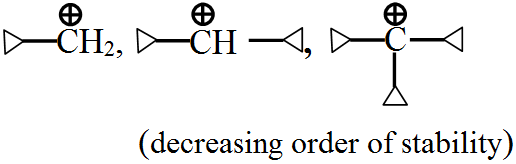
  1. Arrange the following according to given property

$\text{CH}_3\stackrel{\oplus \ \ \ }{\text{CH}}_2,\text{C}_6\text{H}_5-\stackrel{\oplus\ \ \ \ }{\text{CH}}_2,(\text{CH}_3)_3\stackrel{\oplus \ \ \ \ }{\text{CH}},$

$\text{CH}_2=\text{CH}-\stackrel{\oplus\ \ \ \ }{\text{CH}}_2$ (decreasing order of stability)

  1. $\text{HC}\equiv\text{C}^{\ominus},\text{Ch}_2=\stackrel{\ominus\ \ \ \ \ \ }{\text{CH}_2},\text{CH}_3-\stackrel{\ominus\ \ \ \ \ }{\text{CH}_2},\stackrel{\ominus \ \ \ \ \ }{\text{CH}_3}$ (increasing order of stabillity)

  2. $\text{C}_6\text{H}_5\stackrel{\bf. \ \ \ \ }{\text{CHCH}_3},\text{C}_6\text{H}_5\text{CH}_2\stackrel{\bf.\ \ \ \ \ }{\text{CH}_2},\text{C}_6\text{H}_5\stackrel{\bf.}{\text{C}}_3(\text{CH}_3)_2$ (increasing order of stabillity)

  3. $\text{CH}_3-\stackrel{\oplus \ \ \ \ }{\text{CH}}-\text{O}-\text{CH}_3,\text{CH}_3-\stackrel{\oplus \ \ \ \ }{\text{CH}},-\text{OCH}_3,$

${\ \ \ \ \ \ \ \ \ \ \ \ \ \ \ \ \ \ \ \ \text{O}}\\{\ \ \ \ \ \ \ \\ \ \ \ \ \ \ \ \ \ \ \ \ \ \\ \|}\\\ \text{CH}_3-\stackrel{\oplus \ \ \ \ }{\text{CH}}\text{C}-\text{OCH}_3$ (decreasing order of stability)
  1.  

Explain IUPAC system of nomenclature of elements with example.
The first ionization enthalpy values (in kJ mol–1) of group 13 elements are:
B Al Ga In Tl
801 577 579 558 589
How would you explain this deviation from the general trend?
Explain geometrical isomerism with the help of suitable example.
What do you meant by oxidation number or oxidation state? Give the rules to calculate the oxidation number.
What are Lewis acids and Lewis bases? Explain with different types of examples.
How would you explain the fact that the first ionization enthalpy of sodium is lower than that of magnesium but its second ionization enthalpy is higher than that of magnesium?
Attempt any five of the following:
1. Why are Alkenes called olefins?
2. Convert 1-bromopropane to 2-bromopropane.
3. If Qc < Kc, when we continuously remove the product, what would be the direction of the reaction?
4. Convert methane into ethane.
5. What are cycloalkanes?
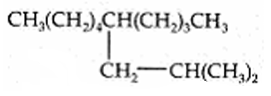
6. Write IUPAC name of following:
Image
7. How will you convert ethanoic acid into ethene?
S. No
Column I
Column II
1.
[Mn(CO)5]-
+6
2.
[Mn2(CO)10]
+2
3.
K4[Mn(CN)6]
0
4.
K2MnO4
-1