Question
What is de-Broglie wave? Write an expression for its wavelength.

Answer

de-Broglie Wavelength : The wave associated with the particle in motion with high speed is called deBroglie wave. The wavelength of this wave is called deBroglie wavelength.
Expression for de-Broglie wavelength :
$ \lambda=\frac{h}{p}; $ or $ \lambda=\frac{h}{mv} $ or $ \lambda=\frac{h}{\sqrt{2mK}} $ or $ \lambda=\frac{h}{\sqrt{2mqV}} $
where = $h$ Planck's constant and $p$ linear momentum of the particle in motion.
$m$ = mass of the particle,
$v$ = speed of the particle,
K = kinetic energy of the particle.
If the particle is charged having charge $q$, and the kinetic energy K is obtained by it when it is accelerated through potential difference V, then K = qV.

Need a full question paper?

Generate a complete, print-ready paper with questions like this in minutes — across 16+ boards, with answer keys.
Start Generating Free

Similar questions

Explain with example, whether the neutron-proton ratio in a nucleus increases or decreases due to $\beta-$decay.
The potential difference across a resistor $‘r\ ’$ carrying current $‘I\ ’$ is $Ir.$
  1. Now if the potential difference across $‘r\ ’$ is measured using a voltmeter of resistance $‘RV\ ’,$ show that the reading of voltmeter is less than the true value
  2. Find the percentage error in measuring the potential difference by a voltmeter.
  3. At what value of $RV,$ does the voltmeter measures the true potential difference?
  1. Define self inductance. Write its $S.I. $units.
  2. Derive an expression for self inductance of a long, solenoid of length $l, $cross sectional area $A$ having $N$ number of turns.
An experimenter's diary reads as follows: "A charged particle is projected in a magnetic field of $(7.0\vec{\text{i}}-3.0\vec{\text{j}})\times10^{-3}\text{T}.$ The acceleration of the particle is found to be $(\vec{\text{i}}+7.0\vec{\text{j}})\times10\text{m/s}^{2\text{n}}.$ The number to the left of $\vec{\text{i}}$ in the last expression was not readable. What can this number be?
Can normal force do a nonzero work on an object. If yes, give an example. If no, give reason.
The normal body-temperature of a person is $97^\circ F$. Calculate the rate at which heat is flowing out of his body through the clothes assuming the following values. Room temperature $= 47^\circ F$, surface of the body under clothes$= 1.6m^2$, conductivity of the cloth $= 0.04\text{Js}^{-1}\text{m}^{-1}{^{\circ}}\text{C}^{-1},$ thickness of the cloth $= 0.5\ cm.$
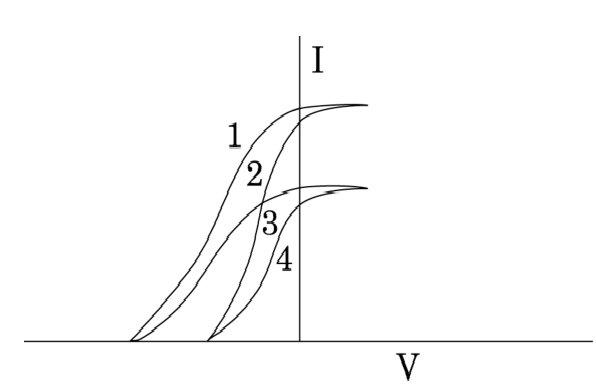
The given graph shows the variation of photo-electric currently) with the applied voltage(V) for two different materials and for two different intensities of the incident radiations. Identify and explain using Einstein's photo electric equation the pair of curves that correspond to (i) different materials but same intensity of incident radiation (ii) different intensities but same materials.
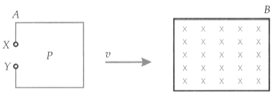
A rectangular coil P is moved from a point A to another point B with uniform velocity 'v' through a region of a uniform magnetic field acting normally inwards as shown in the figure. Show graphically (i) the variation of magnetic flux associated with the coil with time, (ii) the variation of induced emf across points X and Y of the coil with time. 
Image

Explain the nature of variation in magnetic flux as represented by the graph in the first case.
A uniform square plate of mass 2.0kg and edge 10cm rotates about one of its diagonals under the action of a constant torque of 0.10N-m. Calculate the angular momentum and the kinetic energy of the plate at the end of the fifth second after the start.
A current$-$carrying circular coil of $100$ turns and radius $5.0\ cm$ produces a magnetic field of $6.0 \times 10^{-5}T$ at its centre. Find the value of the current.