Question
The potential difference across a resistor $‘r\ ’$ carrying current $‘I\ ’$ is $Ir.$
  1. Now if the potential difference across $‘r\ ’$ is measured using a voltmeter of resistance $‘RV\ ’,$ show that the reading of voltmeter is less than the true value
  2. Find the percentage error in measuring the potential difference by a voltmeter.
  3. At what value of $RV,$ does the voltmeter measures the true potential difference?
Answer

  1. $V = lr ($without voltmeter $R_V)$
  1. $\Big(\frac{\text{V}-\text{V}'}{\text{V}}\Big)\times100=\Big(\frac{\text{r}}{\text{r}+\text{R}_\text{V}}\Big)\times100$
  2. $\text{R}_\text{V}\xrightarrow{\ \ \ \ \ \ }\infty,\text{V}'=\text{lr}=\text{V}$
  3. $\text{V}'=\frac{\text{lrR}_\text{V}}{\text{r}+\text{R}_\text{V}}=\frac{\text{Ir}}{1+\frac{\text{r}}{\text{R}_\text{V}}}$
    $\text{V}'<\text{V}$
  4. Percentage error,

Need a full question paper?

Generate a complete, print-ready paper with questions like this in minutes — across 16+ boards, with answer keys.

Start Generating Free

Similar questions

A straight, long wire carries a current of $20A$. Another wire carrying equal current is placed parallel to it. If the. force acting on a length of $10\ cm$ of the second wire is $2 \times 10^{-5}N,$ what is the separation between them?
How does a charge oscillating with any frequency produces electromagnetic waves? Draw a schematic diagram by showing electric and magnetic fields for an electromagnetic wave transmitting along Z-axis.
Two charged particles, having equal charges of $2.0 \times 10^{-5}C$ each, are brought from infinity to within a separation of $10\ cm$. Find the increase in the electric potential energy during the process.
A monochromatic light source of power $5\ mW$ emits $8 \times 10^{15}$ photons per second. This light ejects photo electrons from a metal surface. The stopping potential for this set up is $2V$. Calculate the work function of the metal.
Establish the relation between critical angle and refractive index.
Pick up (i) Isotones, (ii) Isotopes, (iii) Isobars among the following:
$ {}_{6}^{12}C, {}_{2}^{3}He, {}_{80}^{198}Hg, {}_{1}^{3}H, {}_{79}^{197}Au, {}_{6}^{14}C $.
Draw the energy band diagrams $($at $T >$ 0K$)$ for $n-$type and $p-$type semiconductors. Using diagram, explain why in $n-$type semiconductor the conduction band has most electrons from the donor impurities.
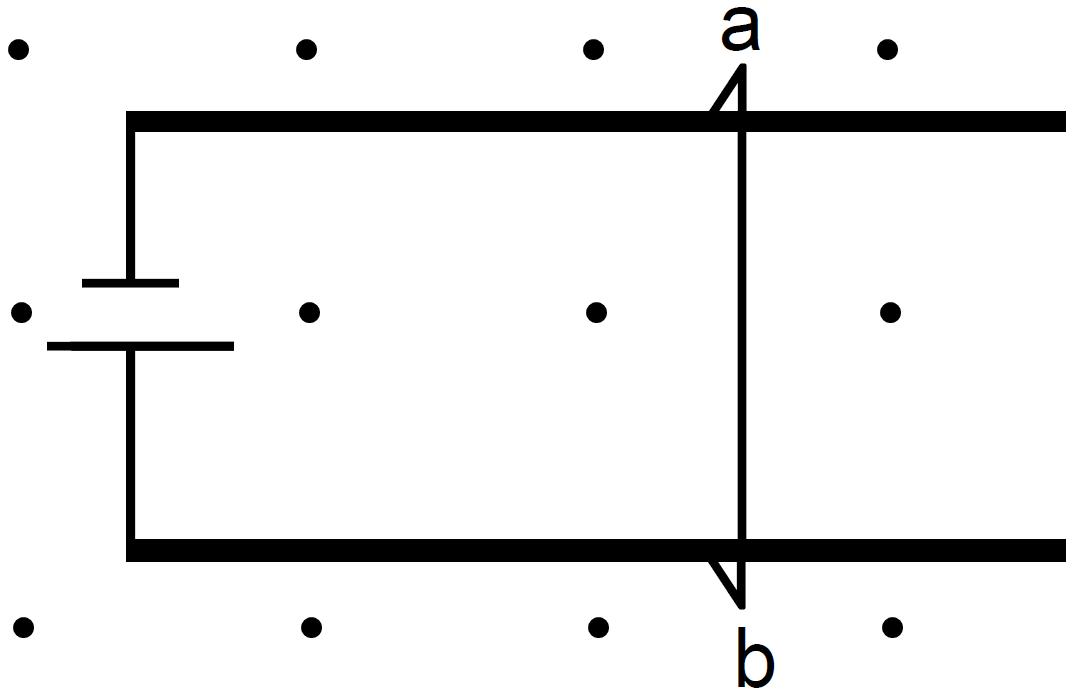
Figure shows a smooth pair of thick metallic rails connected across a battery of emf $\epsilon$ having a negligible internal resistance. A wire ab of length l and resistance r can slide smoothly on the rails. The entire system lies in a horizontal plane and is immersed in a uniform vertical magnetic field B. At an instant t, the wire is given a small velocity u towards right.
  1. Find the current in it at this instant. What is the direction of the current?
  2. What is the force acting on the wire at this instant?
  3. Show that after some time the wire ab will slide with a constant velocity. Find this velocity.
Calculate the ratio of the angular momentum of the earth about its axis due to its spinning motion to that about the sun due to its orbital motion. Radius of the earth $= 6400\ km$ and radius of the orbit of the earth about the sun $= 1.5 \times 10^8\ km.$
A steel wire of length $64\ cm$ weighs $5g$. If it is stretched by a force of $8N$, what would be the speed of a transverse wave passing on it?