Question
What is genetic engineering? List the steps involved in rDNA technology.

Answer

Genetic engineering is a manipulation of genetic material in vitro. It involves the techniques to alter the chemistry of genetic material (DNA and RNA), to introduce the host organisms and thereby change the phenotype of the host organism.
Steps of DNA technology are:
  1. Isolation of DNA.
  2. Fragmentation of DNA by restriction endonucleases.
  3. Isolation of the desired DNA fragments.
  4. Amplification of the gene of interest.
  5. Ligation of the DNA fragment into the vector using DNA ligase.
  6. Transfer of the recombinant DNA into the host.
  7. Culturing the host cell on a suitable medium on a large scale.
  8. Extraction of the desired product.
  9. Downstream processing of the products as finished products.

Need a full question paper?

Generate a complete, print-ready paper with questions like this in minutes — across 16+ boards, with answer keys.

Start Generating Free

Similar questions

Complete the given table.
Name of the organism Product/ Enzyme/ Bioactive male cule
Aspergillus niger (i)
(ii) Ethanol
(iii) Cyclosporin-A
(iv) Acetic acid
Monascus purpureus (v)
Streptococcus (vi)
Study the 3 representative figures of age pyramid relating to human population given below and answer the following question:

  1. Mention the names given to the 3 kinds of age profiles (i), (ii), and (iii).
  2. Which one of them is ideal for a population and why?
  3. How do such age-profile studies help policy makers get concerned about our growing population and prepare for future planning? (say for example: for the year 2022.)
[Hint. The age profile you would name as stable was prepared on the data available on January 2007].
Observe the representation of genes involved in the lac operon given below:

  1. Identify the region where the repressor protein will attach normally.
  2. Under certain conditions repressor is unable to attach at this site. Explain.
  3. If repressor fails to attach to the said site what products will be formed by z, y and a?
  4. Analyse why this kind of regulation is called negative regulation.
  1. Why should we conserve biodiversity? How can we do it?
  2. Explain the importance of biodiversity hot-spots and sacred groves.
Answer the following questions:
Name the organs where gametogenesis gets completed in human male and female, respectively.
What is called nucleosome? Explain the packaging of DNA coil. Draw a labelled diagram of a nucleosome.
The biology teacher asked her students to verify the experiment on transformation principle in bacteria to establish DNA as genetic material. The class was divided into two groups. The teacher asked them to submit the reports. Group 2 did not use mouse and did not repeat Griffith's experiment. The teacher praised them.
  1. Which experiment did they perform?
  2. Explain the experiment in brief.
  3. Who and when performed the transformation principle experiment?
  4. What values did students of group 2 exhibit?
Read the following and answer any four questions from (i) to (v) given below:

Gene therapy is the technique of genetic engineering to replace a faulty gene by a normal healthy functional gene. It is a way of treating genetic disease by introducing a piece of DNA into the cells of an affected individual. Liposomes can be used for gene therapy as they target the cells affected by a genetic disease.

  1. A patient suffers from adenosine deaminase (ADA) deficiency, an autosomal recessive immune deficiency in which bone marrow lymphoblasts cannot replicate to generate immuno-competent lymphocytes. The treatment option that would cure the patient is:
  1. Germ-line gene therapy to replace one ADA gene copy.
  2. Germ-line gene therapy to replace both ADA gene copies.
  3. Somatic cell gene therapy to replace both ADA gene copies in circulating lymphocytes.
  4. Somatic cell gene therapy to replace one ADA gene copy in bone marrow lymphoblasts.
  1. Which type of gene therapy is least effective in transferring DNA to the nucleus?
  1. Adenoviruses.
  2. DNA attached to a ligand.
  3. Liposomes.
  4. Retroviruses.
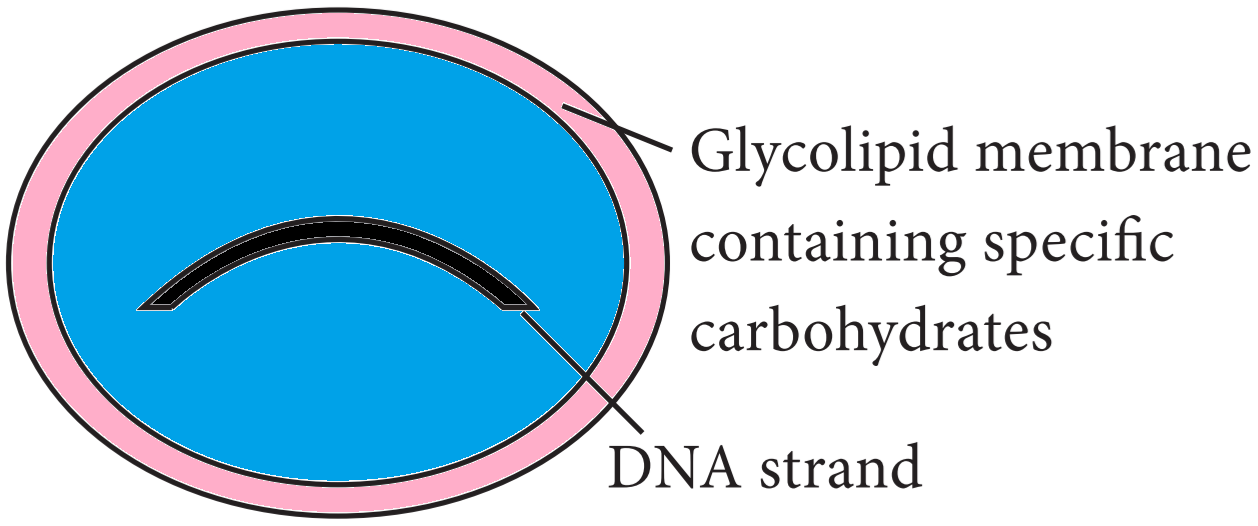
  1. Liposomes can be used for gene therapy as they target the cells affected by a genetic disease. The diagram shows the structure of a liposome.

What feature of a cell surface membrane allows the liposome to target cells affected by a genetic disease? 

  1. Carrier molecules.
  2. Phosphate groups.
  3. Protein channels.
  4. Receptor molecules.
  1. Which of the following disorders would gene therapy be least effective?
  1. Cystic fibrosis.
  2. Huntington's disease.
  3. Sickle cell anaemia.
  4. Type II diabetes.
  1. Following are some reasons explaining why gene therapy is not yet fully an effective treatment for genetic diseases.
  1. Lack of knowledge of DNA sequences.
  2. Lack of efficient and safe gene delivery system.
  3. Cost of the technology.
  4. Some diseases involve multiple genes.
  5. Problems with appropriate gene regulation.

Select the correct option. 

  1. I, III and V only
  2. II, IV and V only
  3. Ill, IV and V only
  4. I, III and IV only
Describe the roles of pituitary and ovarian hormones during the menstrual cycle in a human female.
Answer the following questions:
Draw a diagrammatic sectional view of the female reproductive system of human and label the parts:
  1. Where the secondary oocytes develop.
  2. Which helps in collection of ovum after ovulation.
  3. Where fertilisation occurs.
  4. Here implantation of embryo occurs.