Question
What is Global Positioning System? Explain its working principle in brief.

Answer

Global Positioning System is method of identifying location or position of any point or a person on earth using a system of 24 satellites, which are continuously orbiting, observing, monitoring and mapping the earth.
Working Principle:
  1. The unique location of GPS user is determined by measuring its distance from at least three GPS satellites.
  2. Using these values of distances, obtained from three satellites, a microprocessor, fitted in GPS device, determines the exact location.

Need a full question paper?

Generate a complete, print-ready paper with questions like this in minutes — across 16+ boards, with answer keys.
Start Generating Free

Similar questions

Write down the Coulomb's law and get the vector form of it.
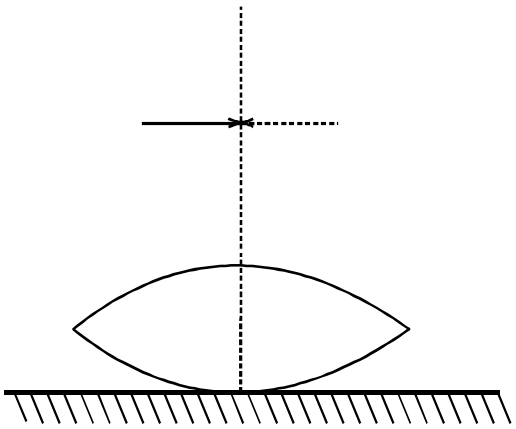
A symmetric biconvex lens of radius of curvature R and made of glass of refractive index 1·5, is placed on a layer of liquid placed on top of a plane mirror as shown in the figure. An optical needle with its tip on the principal axis of the lens is moved along the axis until its real, inverted image coincides with the needle itself. The distance of the needle from the lens is measured to be x. On removing the liquid layer and repeating the experiment, the distance is found to be y. Obtain the expression for the refractive index of the liquid in terms of x and y.

A wire carries an alternating current $\text{i}=\text{i}_0\sin\omega\text{t}.$ Is there an electric field in the vicinity of the wire?
Can two equipotential surfaces cut each other?
The spectrum of a star in the visible and the ultraviolet region was observed and the wavelength of some of the lines that could be identified were found to be:
$824\mathring{\text{A}},970\mathring{\text{A}},1120\mathring{\text{A}},2504\mathring{\text{A}},5173\mathring{\text{A}},6100\mathring{\text{A}}$
Which of these lines cannot belong to hydrogen atom spectrum? (Given Rydberg constant $\text{R}=1.03\times10^7\text{m}^{-1}$ and $\frac{1}{\text{R}}=970\mathring{\text{A}}$ Support your answer with suitable calculations.
When a photon is emitted by a hydrogen atom, the photon carries a momentum with it. (a) Calculate the momentum carries by the photon when a hydrogen atom emits light of wavelength 656.3nm. (b) With what speed does the atom recoil during this transition? Take the mass of the hydrogen atom = 1.67 × 10⁻²⁷kg. (c) Find the kinetic energy of recoil of the atom.
Draw a plot showing the variation of binding energy per nucleon versus the mass number A. Explain with the help of this plot the release of energy in the processes of nuclear fission and fusion.
What are the advantages of the null-point method in a Wheatstone bridge? What additional measurements would be required to calculate Runknown by any other method?
The radius of innertmost orbit of hydrogen atom is $5.3 \times 10^{-11} m$. What is the radius of second excited state?
Compare and explain three distinguishing features observed in Young’s double slit interference pattern with those seen for a coherently illuminated single slit producing diffraction pattern.