MCQ
What is increased in step-down transformer
  • A
    Voltage
  • Current
  • C
    Power
  • D
    Current density

Answer

Correct option: B.
Current
b
(b)We know that for step down transformer

${V_p} > {V_s}$ but $\frac{{{V_p}}}{{{V_s}}} = \frac{{{i_s}}}{{{i_p}}};\;\;\Rightarrow  {i_s} > {i_p}$

Current in the secondary coil is greater than the primary.

Need a full question paper?

Generate a complete, print-ready paper with questions like this in minutes — across 16+ boards, with answer keys.
Start Generating Free

Similar questions

The aperture of a telescope is made large, because
The resistance of a wire is $R\; ohm$. If it is melted and stretched to $'n'$ times its original length, its new resistance will be
The conductivity of a semiconductor increases with increase in temperature because:
The length of a given cylindrical wire is increased by 100 %. Due to the consequent decrease in diameter the change in the resistance of the wire will be
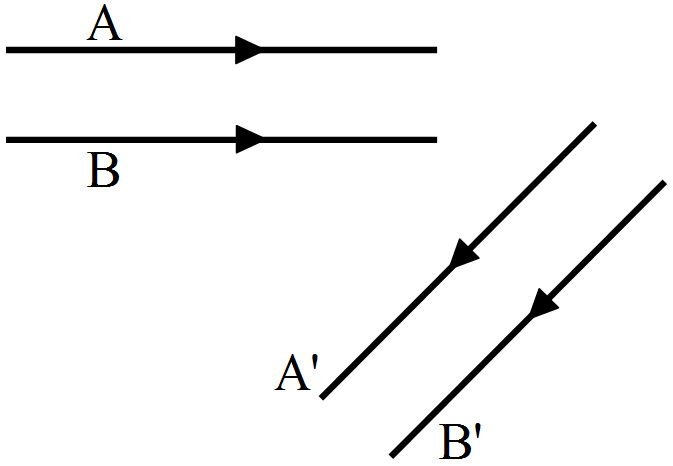
Two rays A and B being reflected by a mirror and going as A' and B'. The mirror:
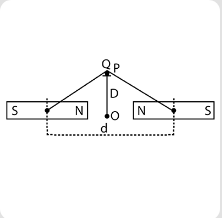
Two identical bar magnets are fixed with their centres at a distance d apart. A stationary charge $Q$ is placed at $P$ in between the gap of the two magnets at a distance $D$ from the centre $O$ as shown in the figure. The force on the charge $Q$ is:
A diatomic molecule is made of two masses $m_1$ and $m_2$ which are separated by a distance $r$ . If we calculate its rotational energy by applying Bohr's rule of angular momentum quantization, its energy will be given by: ($n$ is an integer)
Two lithium nuclei in a lithium vapour at room temperature do not combine to form a carbon nucleus because:
A galvanometer together with an unknown resistance in series is connected to two identical batteries each of $1.5\, V$. When the batteries are connected in series, the  galvanometer records a current of $1\,A$, and when batteries are in parallel the current is $0.6\,A$.  What is the internal resistance of the battery ?
A particular hydrogen like ion emits radiation of frequency $2.92 \times 10^{15}\, {Hz}$ when it makes transition from ${n}=3$ to ${n}=1 .$ The frequency in ${Hz}$ of radiation emitted in transition from ${n}=2$ to ${n}=1$ will be : (in $\,\times 10^{15}$)