Question
What is innate immunity? Describe the obstacles found in it.

Answer

Innate immunity is a type of nonspecific defense that is present at birth. This immunity is achieved by erecting various types of barriers against the entry of external factorsn our body. There are four types of barriers in innate immunity. Like :
(1) Physiological barrier : In the stomach Acid, saliva in the mouth, tears in the eyes, all these prevent bacterial growth.
(2) Physical Barrier : Skin is the main barrier on our body which prevents the entry of microorganisms. The mucus coating of the epithelium lining the respiratory, gastrointestinal and genitourinary tracts also helps prevent pathogens from entering the body.
(3) Cellular barrier : In the blood of our body, some types of leukocytes like polymorphonuclear leukocytes (PMNL, neutrophils) and monocytes (monocytes) and natural, killer lymphocytes and Macrophages in tissues. (Macrophages) eat and destroy germs.
(4) Cytokine resistance : Virus-infected cells secrete proteins called interferons which protect uninfected cells from further viral infection.
Need a full question paper?

Generate a complete, print-ready paper with questions like this in minutes — across 16+ boards, with answer keys.

Start Generating Free

Similar questions

Explain the double fertilization and triple fusion. Write there importance in angiosperm plant.
Mention some transgenic plants and their potential applications.
When are polar bodies formed in female ovary?
Explain the role(s) of the following in Biotechnology:
  1. Restriction endonuclease.
  2. Gel – electrophoresis.
  3. Selectable markers in pBR322.
Represent schematically the decomposition cycle in a terrestrial ecosystem.
Explain PCR technique which used to multiply genes.
Ram saw a farmer spraying some chemicals on flowers. On asking farmer, he came to know that this act will lead to the formation of fruits without fertilisation. Ram thought that fruits developed in this way are not good to eat as chemicals are sprayed on it.
Next day, he asked his biology teacher about it, who explained him everything.
  1. What chemicals were sprayed by the farmer?
  2. Give difference between such a spray and usual pesticide spray?
  3. What is parthenocarpy? Give its types.
  4. What values are shown by Ram?
Fertilisation is essential for production of seed, but in some angiosperms, seeds develop without fertilisation.
  1. Give an example of an angiosperm that produces seeds without fertilisation Name the process.
  2. Explain the two ways by which seeds develop without fertilisation.

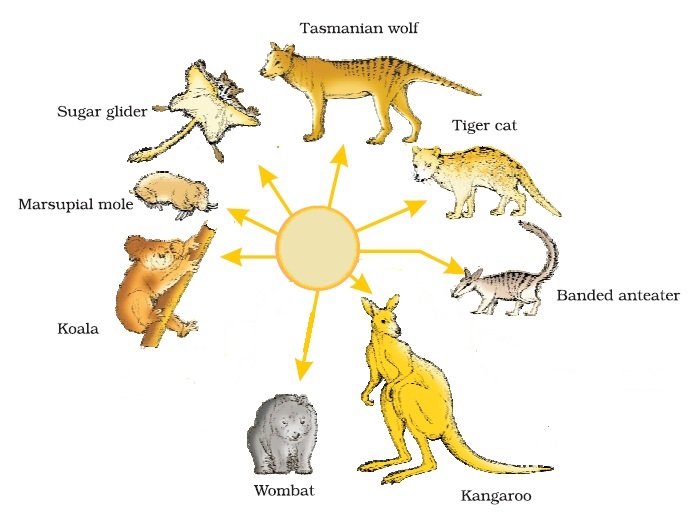
  1. Mention the specific geographical region where these organisms are found.
  2. Name and explain the phenomenon that has resulted in the evolution of such diverse species in the region.
  3. Explain giving reasons the existence of placental wolf and Tasmanian wolf sharing the same habitat.
Draw a well labelled diagram of mature graafian follicle.