Question
Write the properties of diamagnetic, paramagnetic and ferromagnetic materials.

Answer

Properties of Diamagnetic Materials :
(i) When a bar of diamagnetic material is suspended freely between two magnetic poles of a magnet then it turns to become perpendicular to the magnetic field and the poles produced on the two sides of the bar are similar to the nearer magnetic poles.
(ii) When a diamagnetic material is placed in a strong uniform external magnetising field, the field lines prefer to pass through the surrounding air than to pass through the material itself i.e. field lines get repelled or expelled. Consequently, the magnetic induction 'B' inside material becomes less than magnetising field H. Thus permeability for diamagnetic substance is less but never negative.
(iii) In a non-uniform field a diamagnetic substance moves from stronger to the weaker parts of the field. For instance, if a diamagnetic liquid is placed in a watch glass resting on the pole pieces not more than 2 mm apart, the liquid accumulates on the sides where the field is weaker and creates depression in the middle. The reverse is the effect when the poles are far apart because now the field is stronger near the poles.
(iv) If a diamagnetic solution is poured into a U-tube and one arm of this U-tube is placed between the poles of a strong magnet, the level of the solution in that arm is depressed.
(v) A diamagnetic gas when allowed to ascend in between the poles of a magnet spreads across the field.
(vi) The susceptibility of a diamagnetic substance is independent of temperature and has a negative value e.g. for lead it is $-1.7 \times 10^5$.
Properties of Paramagnetic Materials :
(i) When a rod of a paramagnetic materials is suspen-ded freely between two magnetic poles of a magnet then it rotates until its axis becomes parallel to the magnetising field. The poles produced at the ends of the rod are opposite to the nearer magnetic poles of the magnet.
(ii) When a rod of paramagnetic substance is placed in a strong external magnetising field, the field lines prefer to pass through it than through the surrounding air, i.e. these field lines get slightly more concentrated inside the material. Consequently, the magnetic induction B inside the paramagnetic substance becomes slightly greater than the magnetising field H. Thus permeability for paramagnetic substance is greater than 1, but increase is very small, about I part in $10^5$. For Al and platinum the value of $\chi$ is 1.76 x $10^{-6}$ and 2.88 × $10^{6}$ respectively.
(iii) In a non-uniform field they experience an attractive force towards the stronger part of the field. For example, if a paramagnetic liquid be placed in a watch glass resting on the pole pieces not more than 2 mm apart, the liquid accumulates in the middle where the field is strongest. If the pole-pieces are far apart say, 2 cm or so, the field is strongest near the poles, then the liquid moves away from the centre producing a depression in the middle.
(iv) If the solution of paramagnetic substance is poured in a U-tube and one-arm of the U-tube is placed between two strong poles the level of the solution in that arm rises.
(v) When paramagnetic gases (like traces of ammonia and hydrogen chloride) are allowed to ascend between the poles of a magnet they spread along the field.
(vi) The susceptibility $\chi$ for paramagnetic susbtances is positive and mall e.g. for A l it is $1.76 \times 10^{-6}$ and for platnium it is 2.88 × 10⁻⁶.
(vii) $\chi$ and $\mu$ for paramagnetic substances do not change with variation in magnetising field H. $\chi$ varies inversely with the absolute temperature. At some high temperature becomes negative and substance become diamagnetic.
(viii) A paramagnetic substance acts like a diamagnetic substance if it is surrounded by a medium which is more paramagnetic than itself.
Properties of Ferromagnetic Materials
(i) The dipole moment of atoms is permanent and exists in domains.
(ii) The alignment of atomic dipoles and external magnetic fields are in the same direction.
(iii) There is a significant strength of magnetic dipole moment.
(iv) The magnetisation intensity varies linearly with the magnetising field. Moreover, the magnetisation intensity is quite high and positive.
(v) Magnetic susceptibility is relatively high and positive.
(vi) The magnetic flux density is also high and positive. The magnetic field lines inside ferromagnetic materials are dense.
(vii) The relative permeability is also relatively high. It varies linearly with the magnetic field. The magnetic field inside the material is substantially more vital than outside the material. They tend to pull in many force lines from the material.
(viii) The field aggressively attracts ferromagnetic materials. They tend to adhere to the poles where the field is more potent in a non-uniform field.
(ix) Because the field is more vital at poles, if the ferromagnetic powder is placed in a watch glass between two properly faraway poles, powder accumulates on the sides, and the centre is depressed.
(x) At high temperatures, a ferromagnetic substance loses its ferromagnetic characteristics.

Need a full question paper?

Generate a complete, print-ready paper with questions like this in minutes — across 16+ boards, with answer keys.
Start Generating Free

Similar questions

Solve the previous problem if the coefficient of restitution is e. Use $\theta=45^\circ,\ \text{e}=\frac{3}{4}$ and h = 5m
A neutron initially at rest, decays into a proton, an electron and an antineutrino. The ejected electron has a momentum of $1.4 \times 10^{-26}kg-m/s$ and the antineutrino $6.4 \times 10^{-27}kg-m/s$. Find the recoil speed of the proton:
  1. If the electron and the antineutrino are ejected along the same direction.
  2. If they are ejected along perpendicular directions.
  3. Mass of the proton $= 1.67 \times 10^{-27}kg$.
The short-wavelength limit shifts by 26pm when the operating voltage in an X-ray tube is increased to 1.5 times the original value. What was the original value of the operating voltage?
Derive an expression for the gravitational field due to a uniform rod of length L and mass M at a point on its perpendicular bisector at a distance d from the centre.
An icebox almost completely filled with ice at $0^\circ C$ is dipped into a large volume of water at $20^\circ C.$ The box has walls of surface area $2400\ cm^2,$ thickness $2.0mm$ and thermal conductivity $0.06\text{Wm}^{-1}{^{\circ}}\text{C}^{-1}.$ Calculate the rate at which the ice melts in the box. Latent heat of fusion of ice $= 3.4\times10^5\text{Jkg}^{-1}.$
A parallel$-$plate capacitor has plate area $100\ cm^2$ and plate separation $1.0\ cm.$ A glass plate $($dielectric constant $6.0)$ of thickness $6.0\ mm$ and an ebonite plate $($dielectric constant $4.0)$ are inserted one over the other to fill the space between the plates of the capacitor. Find the new capacitance.
  1. Using Biot-Savart’s law, derive an expression for the magnetic field at the centre of a circular coil of radius R, number of turns N, carrying current i.
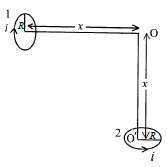
  2. Two small identical circular coils marked 1, 2 carry equal currents and are placed with their geometric axes perpendicular to each other as shown in the figure. Derive an expression for the resultant magnetic field at O.
 
The force of buoyancy exerted by the atmosphere on a balloon is B in the upward direction and remains constant. The force of air resistance on the balloon acts opposite to the direction of velocity and is proportional to it. The balloon carries a mass M and is found to fall down near the earth's surface with a constant velocity v. How much mass should be removed from the balloon so that it may rise with a constant velocity v?
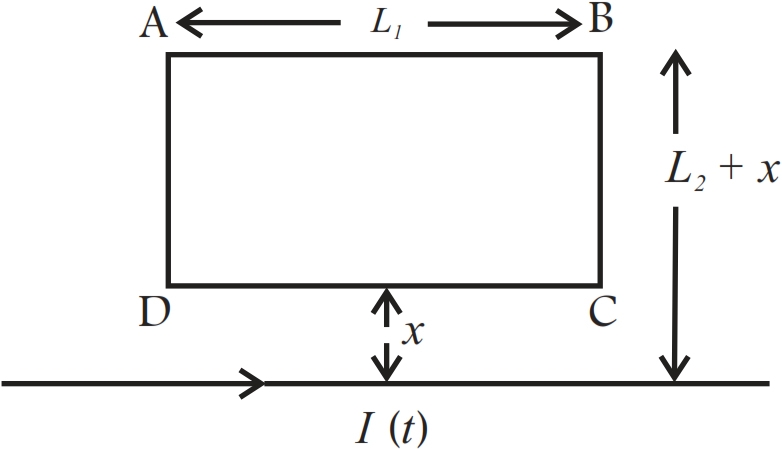
A rectangular loop of wire ABCD is kept close to an infinitely long wire carrying a current $\text{I}(\text{t})=\text{I}_0\Big(1-\frac{\text{t}}{\text{T}}\Big)$ for 0 and I(0) = 0 for t > T (Fig). Find the total charge passing through a given point in the loop, in time T. The resistance of the loop is R.
Verify the Ampere's law for magnetic field of a point dipole of dipole moment $\text{m}=\text{m}\hat{\text{k}}$. Take C as the closed curve running clockwise along:
  1. The z-axis from z = a > 0 to z = R.
  2. Along the quarter circle of radius R and centre at the origin, in the first quadrant of x-z plane.
  3. Along the x-axis from x = R to x = a.
  4. Along the quarter circle of radius a and centre at the origin in the first quadrant of x-z plane.