Question
What is meant by a ‘Share’? Give any two differences between ‘Preference Shares’ and ‘Equity Shares’.

Answer

A company is an entity incorporated by a group of persons through the process of law and has a share capital divided into shares, the owners of which are referred to as members or shareholders. Share here refers to a unit into which the share capital of a company is divided. It includes the stock of the company and represents ownership claims on business.
Basis of Difference
Preference Shares
Equity Shares
Voting Rights
Preference shareholders have voting rights only in special circumstances.
Equity shareholders have voting rights in all the circumstances.
Rate of Dividend
Fixed rate of dividend is received.
Rate of dividend is decided by the board every year and is approved by the shareholders.

Need a full question paper?

Generate a complete, print-ready paper with questions like this in minutes — across 16+ boards, with answer keys.
Start Generating Free

Similar questions

From the following information, calculate Inventory Turnover Ratio:
Revenue from Operations (Sales) ₹ 4,00,000, Average Inventory: ₹ 55,000. The rate of Gross Loss on Revenue from Operations was 10%.
Calculate Cost Of Revenue From Oprations from the following information:
Revenue from Operation ₹ 12,00,000; Oprating Ratio 75% Operating Expenses ₹ 1,00,000.
On 1.1.2005 Fast Computers Ltd. issued 20,00,000, 6% debentures of ₹ 100 each at a discount of 4%, redeemable at a premium of 5% after three years.
The amount was payable as follows:
On application ₹ 50 per debenture, Balance on allotment,
Record the necessary journal entries for issue of debentures.
Explain how financial statements are useful to the various parties who are interested in the affairs of an undertaking?
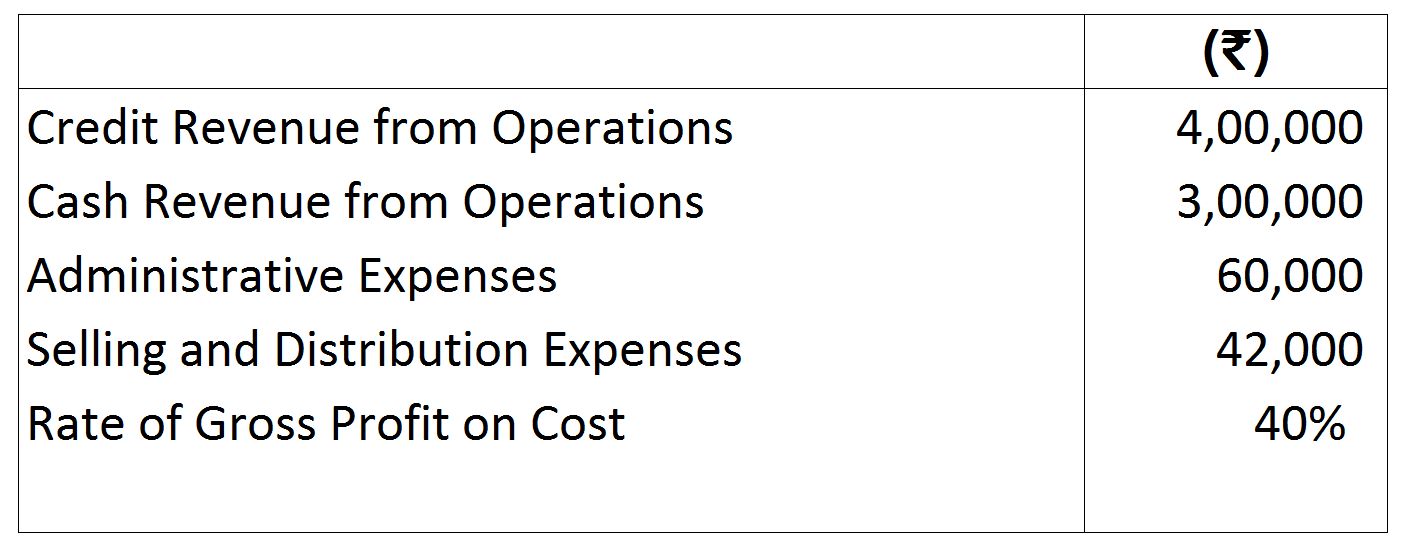
From the following information, calculate Operating Ratio:
On 1st April, 2014, Blue Heaven Ltd. was formed with an authorised capital of ₹ 20,00,000 divided into 2,00,000 equity shares of ₹ 10 each. The company issued prospectus. inviting applications for 1,50,000 equity shares the company received applications for 1,40,000 equity shares. During the first year, ₹ 7 per share were called. Arun holding 4,000 shares and Varun holding 3,000 shares did not pay the first call of ₹ 2 per share. Varun's shares were forfeited after the first call and later on 1,800 of the forfeited shares were re-issued at ₹ 5 per share, ₹ 7 called up.
Show the following:
  1. Share Capital in the Balance Sheet of the company, as per Schedule III Part I of the Companies Act, 2013.
  2. Also prepare 'Notes to Accounts' for the same.
The authorised capital of ₹ 16,00,000 of XYZ Ltd. is divide into 1,60,000 Equity Shares of ₹ 10 each. Out of these shares, 80,000 Equity Shares were issued at par to public for subscription. The full nominal value is payable on application. All the shares were subscribed by the public and total amount was paid for. Pass necessary journal entries in the books of the company.
Journalise the following:
Y Ltd. forfeited 700 shares of ₹ 100 each, issued at a premium of, 5 per share for non-payment of allotment money of ₹ 35 per share (including premium) and first call of ₹ 20 per share. The second and final call of ₹ 20 has not yet been called 500 of these shares were re-issued as ₹ 80 paid-up for ₹ 92 per share.
Under which major sub-headings will the following items be placed in the Balance Sheet of a company as per Schedule III Part-I of the Companies Act, 2013:
  1. Capital Reserve.
  2. Bonds.
  3. Loans repayable on demand.
  4. Vehicles.
  5. Goodwill.
  6. Loose tools.
T. Ltd. offered 2,00,000, 8% Debenture of ₹ 500 each on June 30, 2002 at a premium of 10% payable as ₹ 200 on application (including premium) and balance on allotment, redeemable at par after 8 years. But application are received for 3,00,000 debenture and the allotment is made on pro-rata basis. All the money due on application and allotment is received. Record necessary entries regarding issue of debenture.