Questions · Page 1 of 3

3 Marks Question

🎯

Test yourself on this topic

50 questions · timed · auto-graded

Question 13 Marks
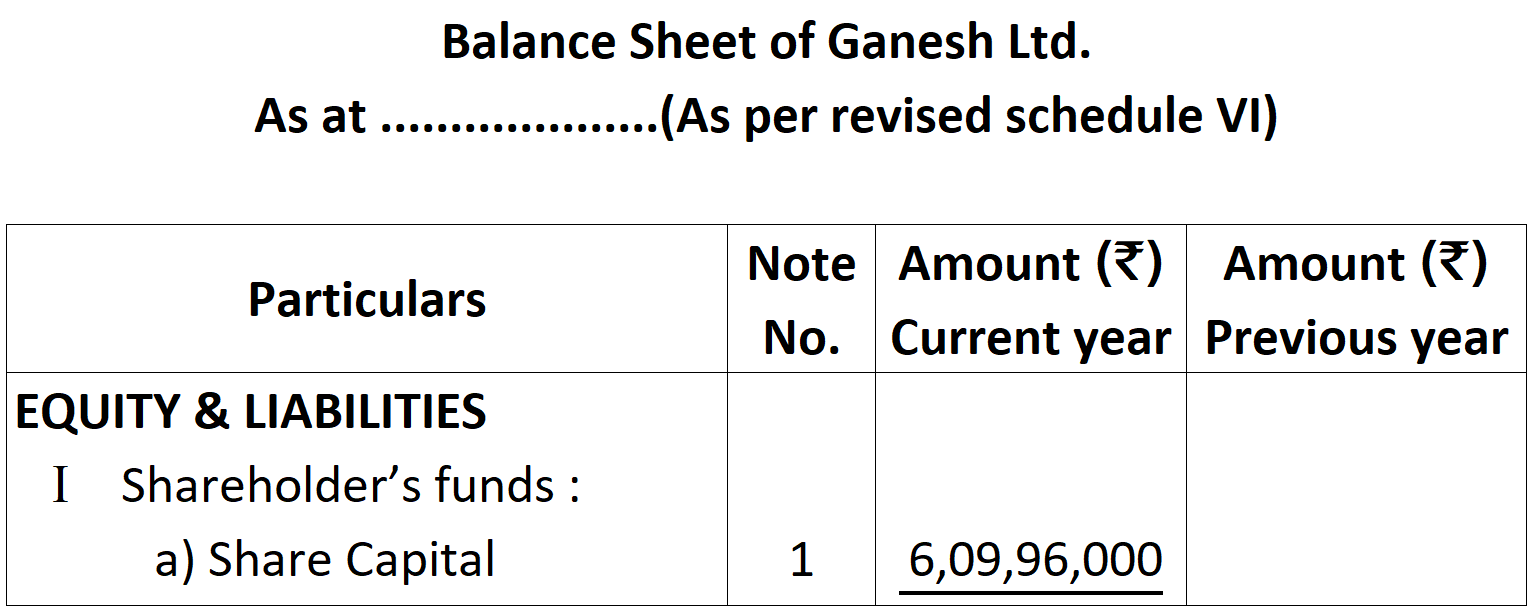
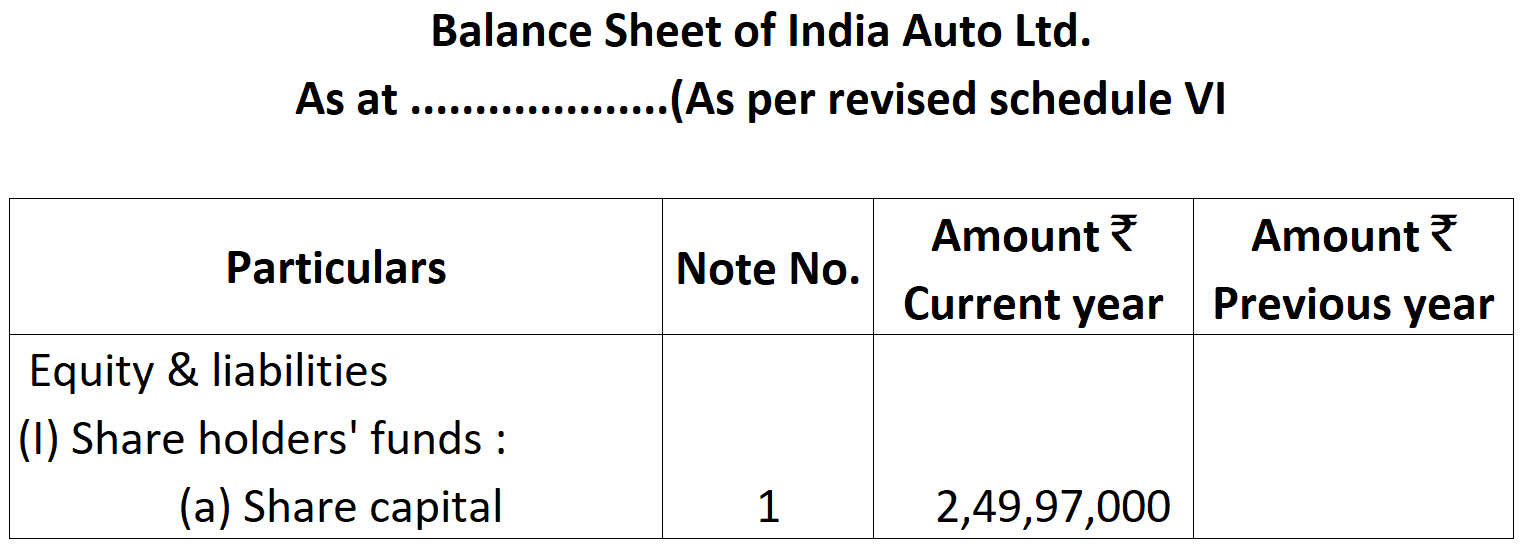
Ganesh Ltd. is registered with an authorised capital of ₹ 10,00,00,000 divided into equity shares of ₹ 10 each. Subscribed and fully paid up capital of the company was ₹ 6,00,00,000. For providing employment to the local youth and for the development of the tribal areas of Arunachal Pradesh the company decided to set up a hydro power plant there. The company also decided to open skill development centres in Itanagar, Pasighat and Tawang. To meet its new financial requirements, the company decided to issue 1,00,000 equity shares of ₹ 10 each and 1,00,000, 9% debentures of ₹ 100 each. The debentures were redeemable after five years at par. The issue of shares and debentures was fully subscribed. A shareholder holding 2,000 shares failed to pay the final call of ₹ 2 per share.
Show the share capital in the Balance Sheet of the company as per the provisions of Schedule III of the Companies Act, 2013. Also identify any two values that the company wishes to propagate.
Answer
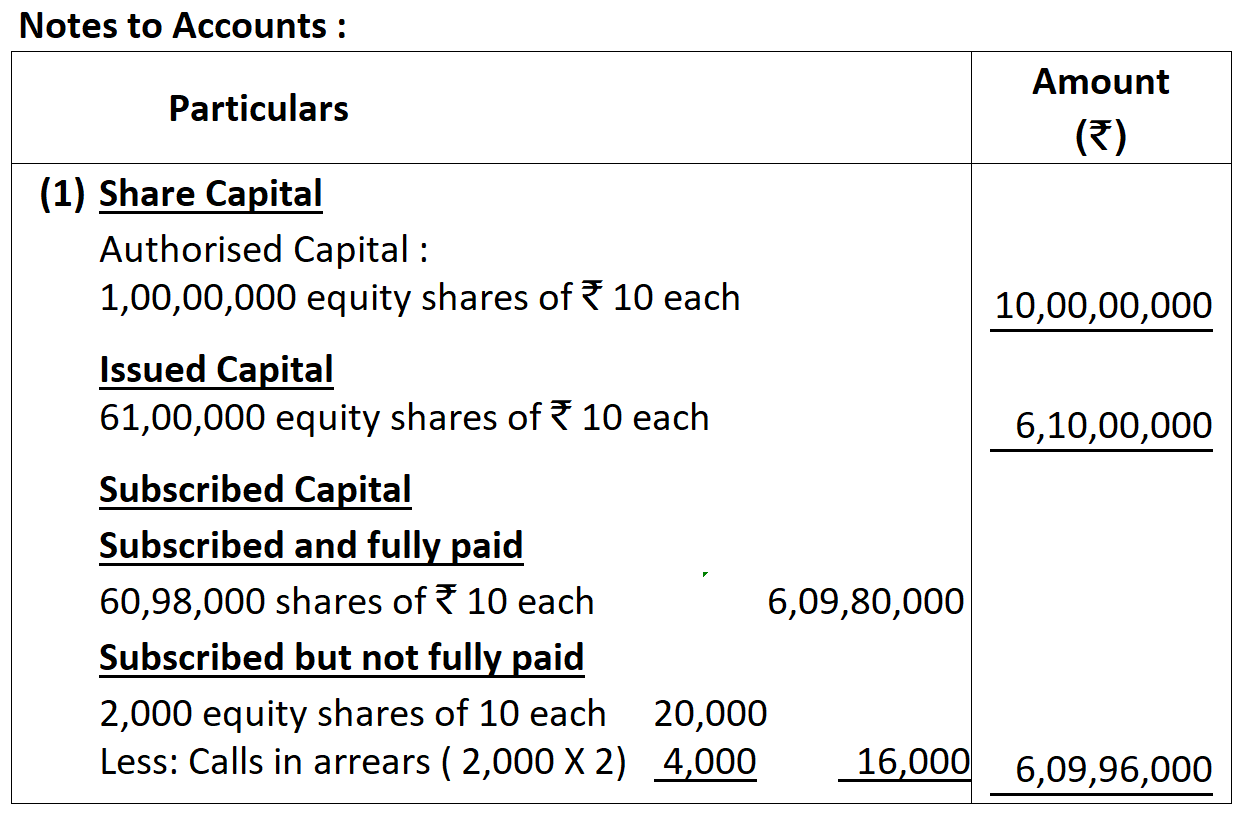

Values:
  • Providing employment opportunities to the local youth.
  • Promotion of development in tribal areas.
  • Promotion of skill development in Arunachal Pradesh.
  • Paying attention towards regions of social unrest.
View full question & answer
Question 23 Marks
K Ltd. took over the assets of ₹ 15,00,000 and liabilities of ₹ 5,00,000 of P Ltd. for a purchase consideration of ₹ 13,68,500. ₹ 25,500 were paid by issuing a promissory note in favour of P Ltd. payable after two months and the balance was paid by issue of equity shares of ₹ 100 each at a premium of 25%.
Pass necessary journal entries for the above transactions in the books of K Ltd.
View full question & answer
Question 33 Marks
For issuing shares at discount a company has to fulfil many conditions. State any three such conditions.
Answer
Shares can be issued at discount subject to the following conditions:
  1. The shares must belong to a class already issued.
  2. The issue must be authorised by a resolution passed by the company in general meeting and sanctioned by the central government.
  3. The resolution specifies the maximum rate of discount at which shares are to be issued.
  4. One year must have passed since the date at which the company was entitled to commence business.
  5. The issue of such shares must take place within two months of the date on which the issue was sanctioned by the central government or within such extended time as the central government may allow.
View full question & answer
Question 43 Marks
‘David Ltd.’ issued ₹ 40,00,000 equity shares of ₹ 10 each out of its registered capital of ₹ 10,00,00,000. The amount payable on these shares was as follows:
On application – ₹ 1 per share
On allotment – ₹ 2 per share
On first call – ₹ 3 per share
On second and final call – ₹ 4 per share
All calls were made and were duly received, except the second and final call on 1,000 shares held by Vipul. These shares were forfeited.
Present the ‘Share Capital’ in the Balance Sheet of the company as per Schedule VI Part I of the Companies Act, 1956. Also prepare ‘Notes to Accounts’.
View full question & answer
Question 53 Marks
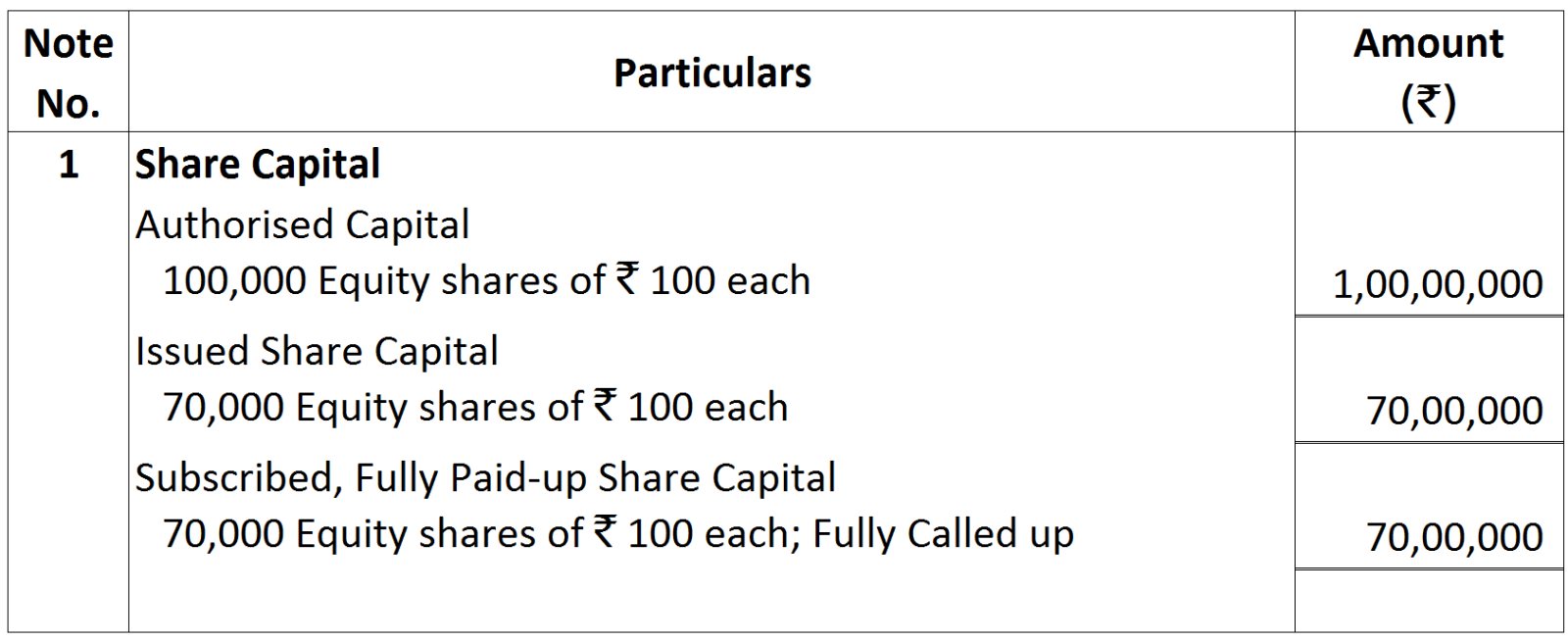
‘India Auto Ltd.’ is registered with an authorised capital of ₹ 7,00,00,000 divided into 7,00,000 shares of ₹ 100 each. The company issued 50,000 shares to the vendor for building purchased and 2,00,000 shares were issued to the public. The amount was payable as follows:
On application and allotment – ₹ 20 per share
On first call – ₹ 50 per share
On second and final call – The balance
All calls were made and were duly received except on 100 shares held by Rajani, who failed to pay the second and final call. Her shares were forfeited.
Present the ‘Share Capital’ in the Balance Sheet of the company as per Schedule VI Part I of the Companies Act, 1956. Also prepare ‘Notes to Accounts’.
Answer


Note: 50,000 equity shares of ₹ 100 each issued to vendors.
View full question & answer
Question 63 Marks
State any three purposes other than ‘issue of bonus shares’ for which securities premium can be utilized.
Answer
Securities premium can be utilized for the following purposes:
  1. In purchasing its own shares.
  2. Writing off preliminary expenses of the company.
  3. Writing off the expenses of, Or the commission paid or discount allowed on any issue of securities or debentures of the company.
  4. Providing for the premium payable on the redemption of any redeemable Preference shares or of any Debenture of the company.
View full question & answer
Question 73 Marks
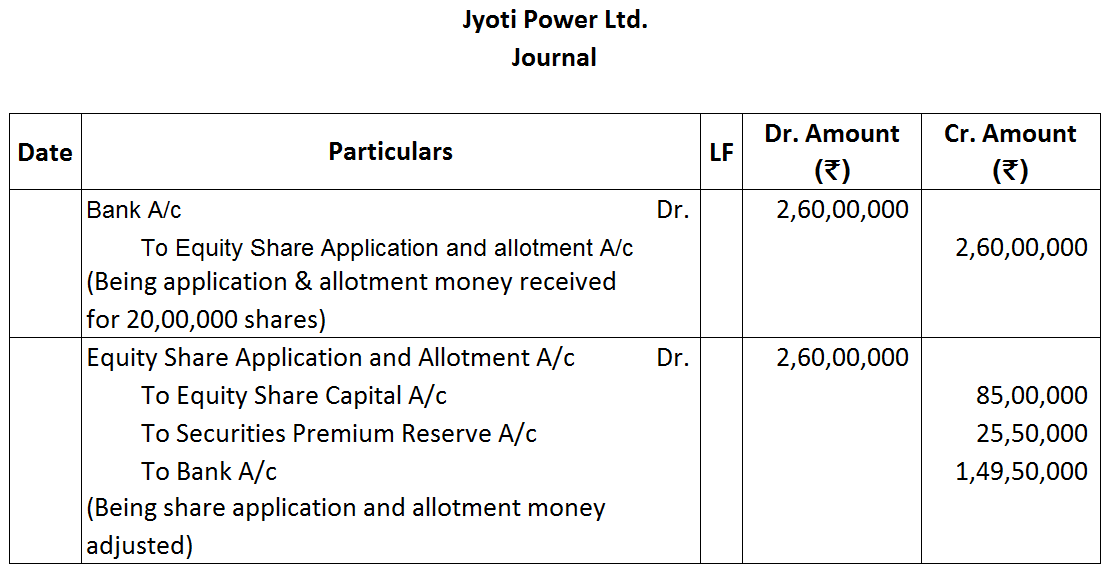
To provide employment to the youth and to develop Baramula district of Jammu and Kashmir, Jyoti Power Ltd. decided to setup a power plant. For raising funds the company decided to issue 8,50,000 equity shares of ₹ 10 each at a premium of ₹ 3 per share. The whole amount was payable on application. Applications for 20,00,000 shares were received. Applications for 3,00,000 shares were rejected and shares were alloted to the remaining applicants on pro-rate basis.

Pass necessary journal entries for the above transactions in the books of the company and identify any two values which the company wants to propagate.
Answer
Values:
  1. Providing employment opportunities
  2. Development of backward areas
  3. Helping the young people to undertake developmental activities and promoting peace and harmony.
View full question & answer
Question 83 Marks
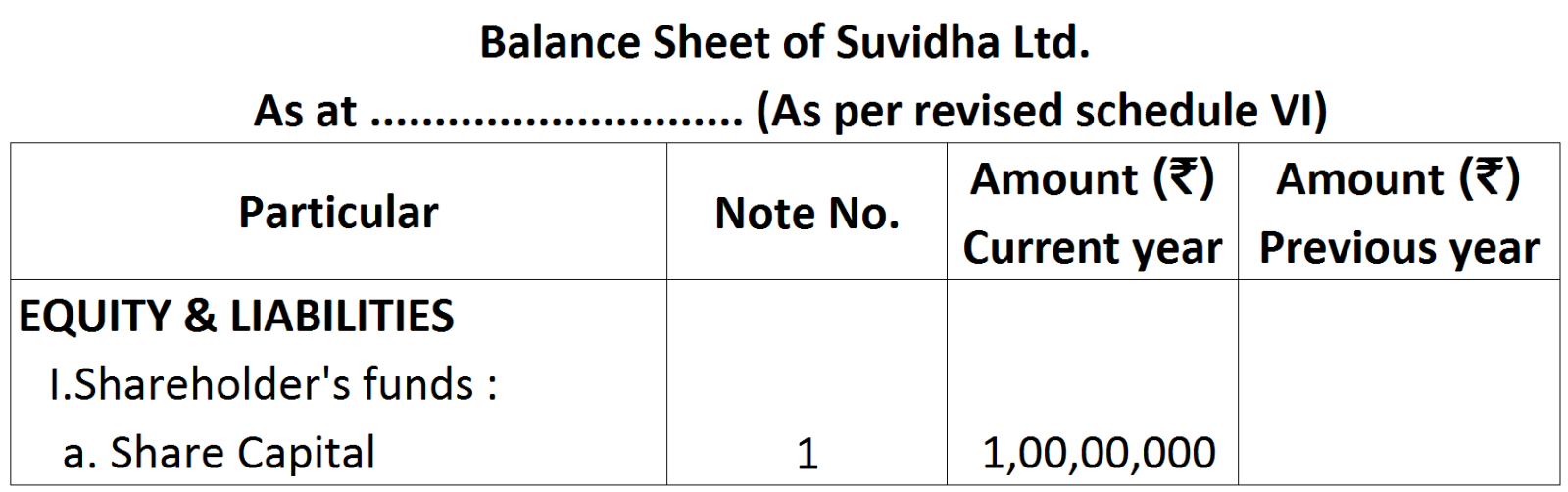
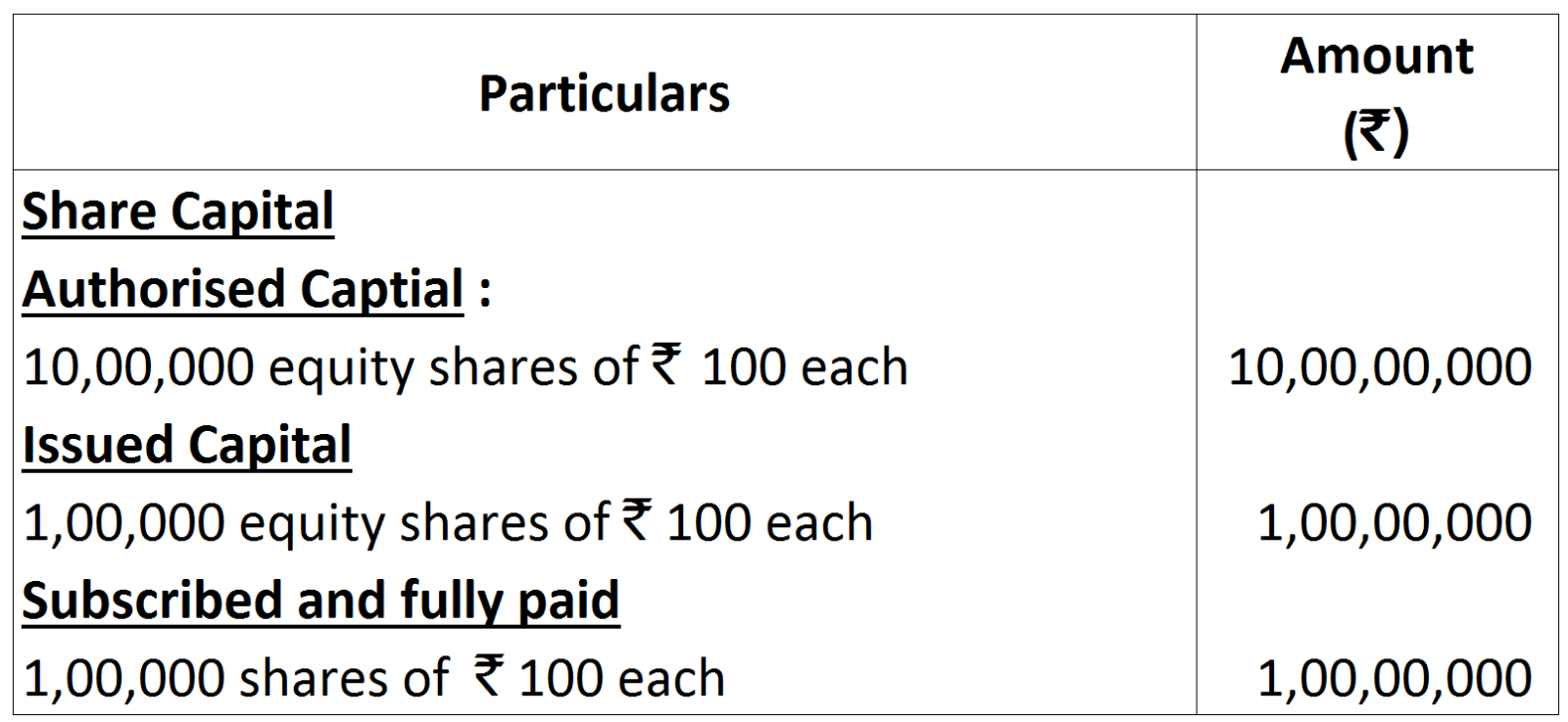
'Suvidha Ltd.' is registered with an authorised capital of ₹ 10,00,00,000 divided into 10,00,000 equity shares of ₹ 100 each. The company issued 1,00,000 shares for public subscription. A shareholder holding 100 shares, failed to pay the final call of ₹ 20 per share. His shares were forfeited. The forfeited shares were re-issued at ₹ 90 per share as fully paid up.
Present the 'Share Capital' in the Balance Sheet of the company as per Schedule VI Part I of the Companies Act, 1956. Also prepare 'Notes to Accounts'.
Answer

Notes to Accounts:
View full question & answer
Question 93 Marks
Guru Ltd. invited applications for issuing 5,00,000 equity shares of ₹ 10 each at a premium of ₹ 5 per share. Because of favourable market conditions, the issue was over-subscribed, and applications for 15,00,000 shares were received.
Suggest the alternatives available to the Board of Directors for the allotment of shares.
Answer
Alternatives available to the Board of directors are:
  • Excess applications may be rejected and shares may be allotted to the remaining applicants as full.
  • Shares may be allotted to all the applicants on pro rata basis.
  • Some of the applications may be rejected & shares may be allotted to the remaining applicants on pro rata basis.
View full question & answer
Question 103 Marks
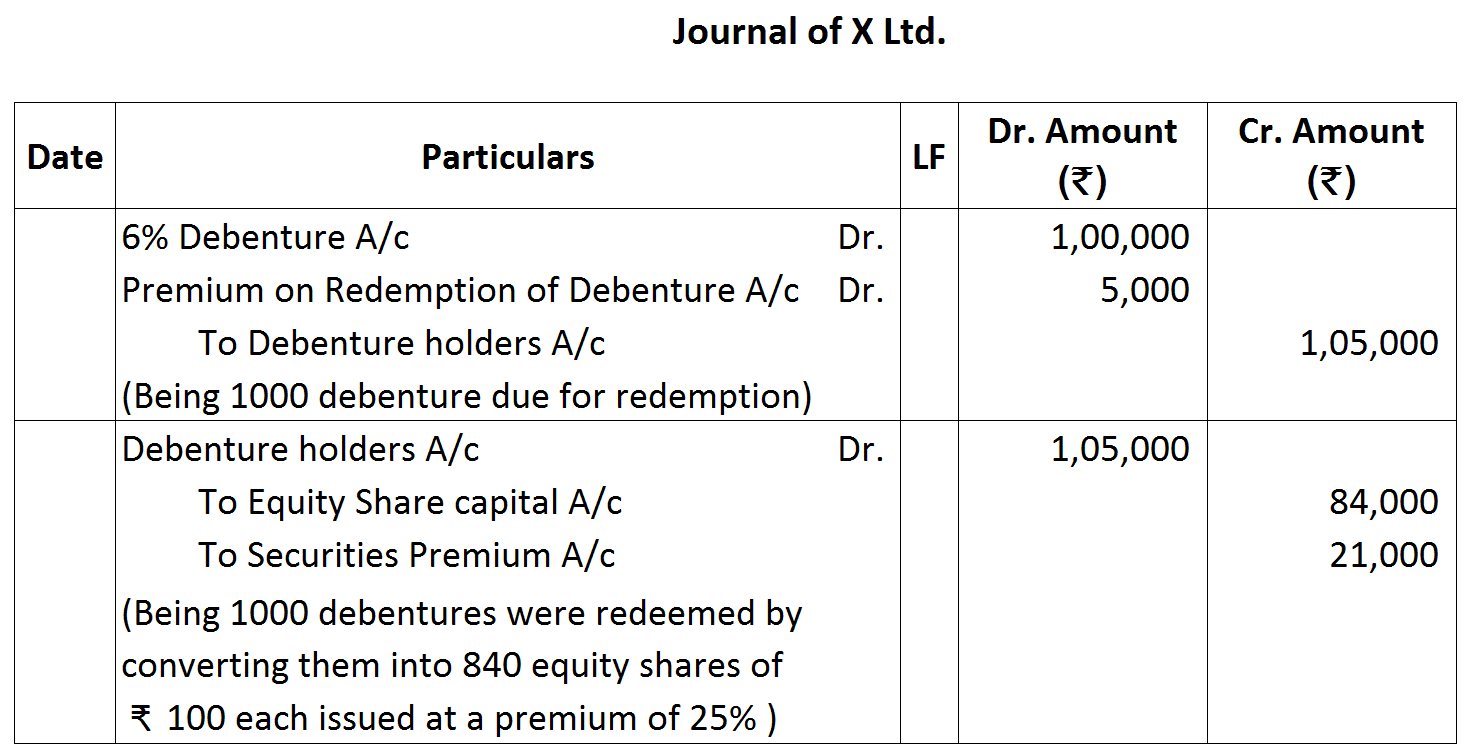
X Ltd. redeemed 1000, 6% Debentures of ₹ 100 each by converting them into Equity shares of ₹ 100 each. The 6% Debentures were redeemable at a premium of 5% for which the Equity shares were issued at a premium of 25%. Pass the necessary journal entries for the redemption of the above mentioned Debentures in the books of X Ltd.
Answer

Working note:
$\text{Number of Equity Shares to be issued}=\frac{\text{Amount Payable}}{\text{Issue Price per share}}$
$=\frac{1, 05,000}{125}=\text{840 Equity Share}$.
View full question & answer
Question 113 Marks
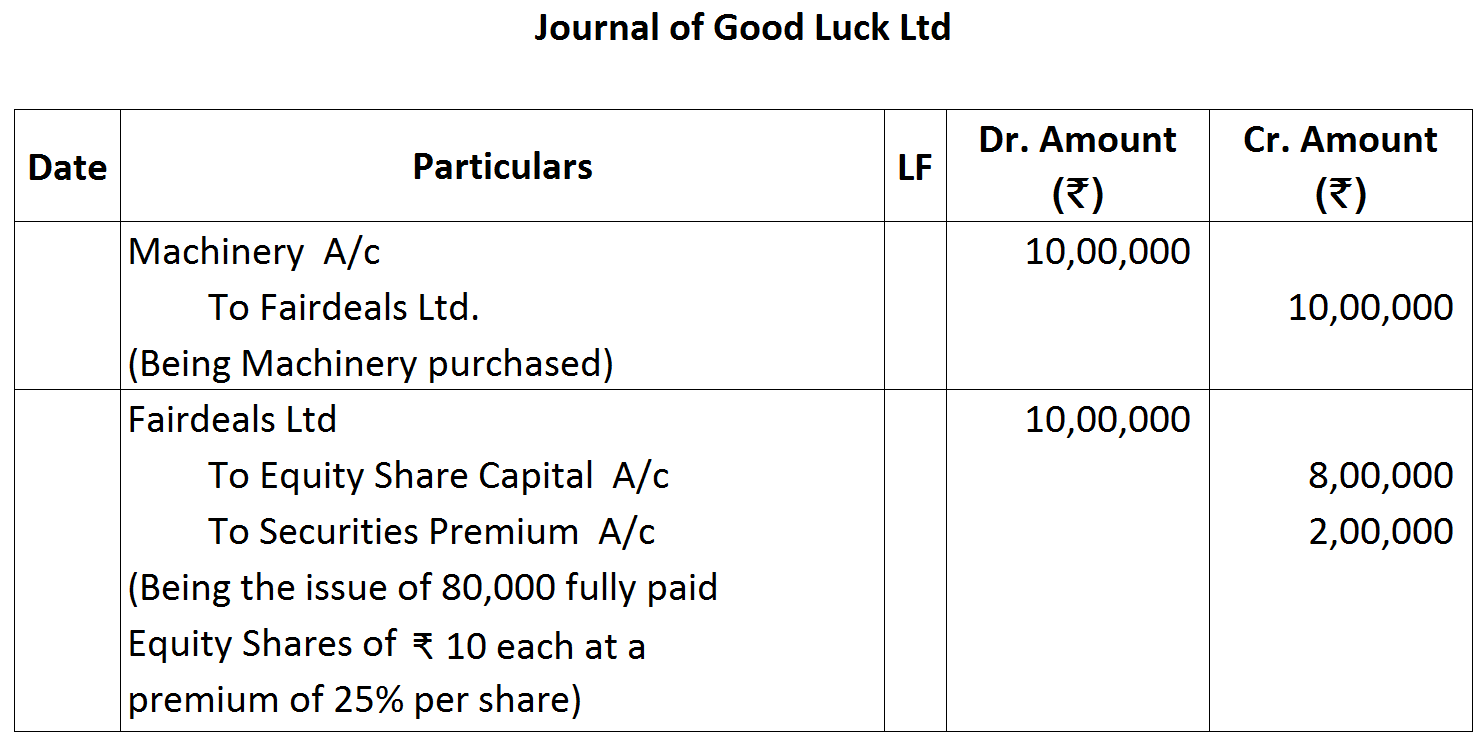
Goodluck Ltd. purchased machinery costing ₹ 10,00,000 from Fair Deals Ltd. The company paid the price by issue of Equity shares of ₹ 10 each at a premium of 25%.
Pass necessary journal entries for the above transactions in the books of Goodluck Ltd.
Answer

Working note:
Number of Equity Shares to be issued = purchase price / issue price per share = 1000000 / 12.5 = 80000 shares.
View full question & answer
Question 123 Marks
DN Ltd. issued 50,000 shares of ₹ 10 each at a discount of 10% payable as ₹ 2 per share on application, ₹ 3 on allotment and ₹ 2 each on first and final call. Applications were received for 70,000 shares. It was decided that
  1. refuse allotment to the applicants of 10,000 shares,
  2. allot 10,000 shares to Mohan who had applied for a similar number, and
  3. allot the remaining shares on a pro-rata basis.
Mohan failed to pay the allotment money and Sohan who belonged to category(c) and was allotted 3,000 shares, paid both the calls with allotment. Calculate the
amount received on allotment.
Answer
Applications Received
70,000 shares
Allotted
Rejected
10,000 shares
-
Mohan
10,000 (Applied)
10,000 (Allotted)
Others
50,000 (Applied)
40,000 (5:4) (Allotted)
 
Allotment Money due
(50,000 x 3)
1,50,000
Less recd. In advance (pro rata issue)
(10,000 x 2)
20000
Less Calls in arrears (Mohan)
(10,000 x 3)
30, 000
Add Calls in advance
(3,000 x4)
12,000
Money received on allotment
 
1,12,000
View full question & answer
Question 133 Marks
X Ltd. obtained a loan of ₹ 4,00,000 from IDBI Bank. The company issued 5000, 9% Debentures of ₹ 100 each as a collateral security for the same. Show how these items will be presented in the Balance Sheet of the company.
View full question & answer
Question 143 Marks
Meena Ltd. issued 30,000 shares of ₹ 10 each at a premium of ₹ 2 per share payable as ₹ 3 on application, ₹ 5 (including premium) on allotment and the balance on first and final call. Applications were received for 42,000 shares. The directors resolved to allot as follows:
A.
Applicants of 20,000 shares
10,000 shares
B.
Applicants of 20,000 shares
20,000 shares
C.
Applicants of 2,000 shares
Nil
Balu who had applied for 1,000 shares in category A and Ganesh who was allotted 600 shares in category B failed to pay the allotment money. Calculate the amount received on allotment.
Answer
Amount received on allotment(including premium)

= 1,50,000 – 30,000 – 1,000 – 3,000 = ₹ 1,16,000

Working Notes:

Category A:
Shares Applied = 20,000
Shares allotted = 10,000
Excess money received = 10,000 X 3 = 30,000/-
$\text{Balu’s allotted shares} = \frac{10,000}{20,000} \times 1,000 = 500$

Therefore, Shares Applied = 1,000
Shares allotted = 500
Excess money received = 500 X 3 = 1,500/-
Amount due on allotment = 500 X 5 = 2,500/-
Amount unpaid = 2,500 – 1,500 = 1,000/-
Category B:
Shares Applied = 20,000
Shares allotted = 20,000
Ganesh’s allotted shares = 600
Amount due on allotment = 600 X 5 = 3,000/-
View full question & answer
Question 153 Marks
The Directors of a Company forfeited 500 shares of ₹ 10 each issued at a premium of ₹ 3 per share, for the, non-payment of the first call money of ₹ 3 per share. The final call of ₹ 2 per share has not been made. Half the forfeited shares were reissued at ₹ 2,500 fully paid. Record the journal entries for the forfeiture and reissue of shares.
View full question & answer
Question 163 Marks
Samta Ltd. forfeited 800 equity shares of Rs. 100 each for the non-payment of first call of Rs. 30 per share. The final - call of Rs. 20 per share was not yet made. Out of the forfeited shares 400 were re-issued at the rate of Rs. 105 per share fully paid up.
Pass necessary journal entries in the books of Samta Ltd. for the above transactions.
View full question & answer
Question 173 Marks
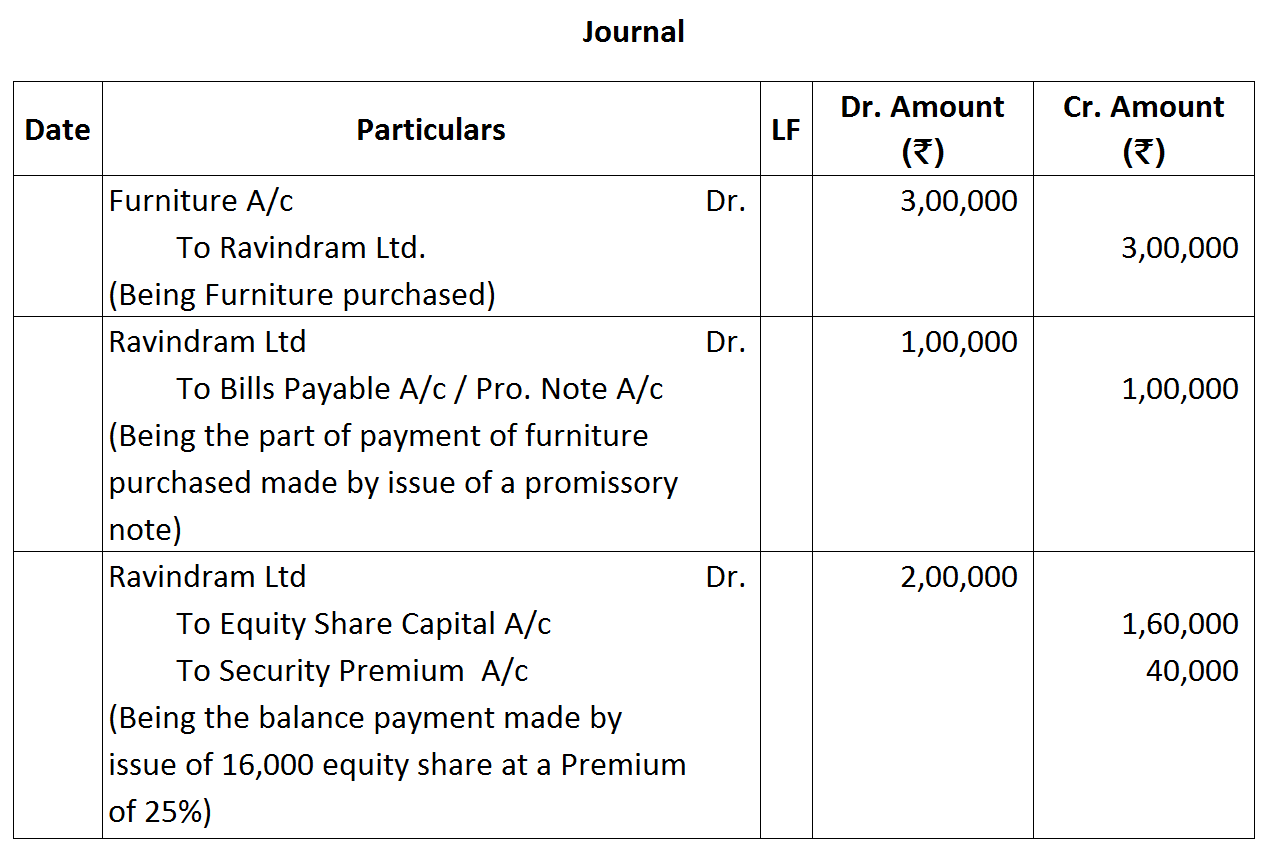
Sundram Ltd. purchased Furniture for ₹ 3,00,000 from Ravindram Ltd. ₹ 1,00,000 were paid by drawing a. Promissory Note in favour of Ravindram Ltd. The balance was paid by issue of Equity Shares of ₹ 10 each at a Premium of 25%.
Pass necessary Journal entriesin the books of Sundram Ltd.
Answer

Working Note:
$\text{No.of Shares}=\frac{\text{Purchase price (Balance)}}{\text{Issue price per share}} $
$=\frac{\text{2,00,000}}{\text{12.5}}=\text{16,000 Shares} $
View full question & answer
Question 183 Marks
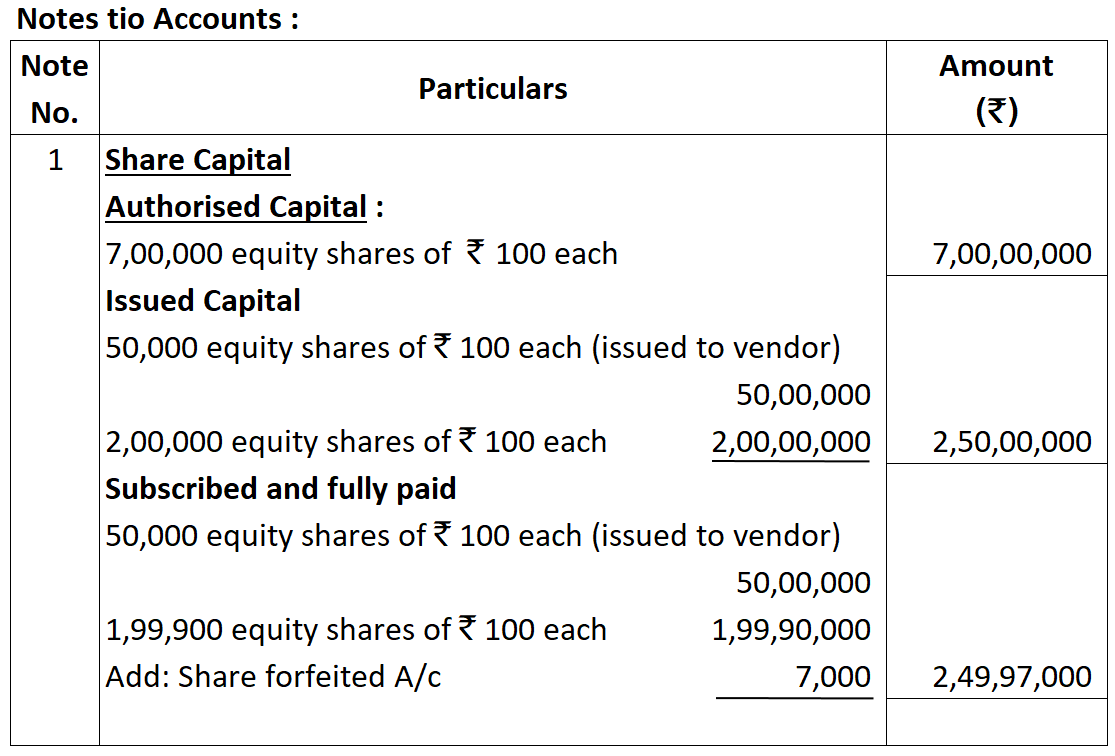
Gagan Ltd. is registered with an authorised capital of ₹ 15,00,00,000 divided into 1,50,00,000 equity shares of ₹ 10 each. Subscribed and fully paid up share capital of the company was ₹ 5,00,00,000. For providing employment to the local youth and for the development of rural areas of Jharkhand State, the company decided to set up a food processing unit in Hazaribagh. The company also decided to set up skill development centres at Ranchi, Hazaribagh and Ramgarh. To meet its new financial requirements the company decided to issue 2,00,000 equity shares of ₹ 10 each and 2000, 12% debentures of ₹ 1,000 each. The issue of shares and debentures was fully subscribed. A shareholder holding 500 shares failed to pay the final call of ₹ 3 per share.
Show the share capital in the Balance Sheet of the company as per the provisions of Schedule III of the Companies Act, 2013. Also, identify any two values that the company wants to propagate.
Answer


Values:
  • Providing employment opportunities to the local youth.
  • Promotion of rural development.
  • Promotion of skill development in the state of Jharkhand.
  • Paying attention towards regions of social unrest.
View full question & answer
Question 193 Marks
‘B’ Ltd. took over the assets of ₹ 14,00,000 and liabilities of ₹ 4,00,000 of C Ltd. for a purchase consideration of ₹ 9,19,000. ₹ 17,000 were paid by a bank draft in favour of C Ltd. and the balance was paid by issue of equity shares of ₹ 10 each at a premium of 10% in favour of C Ltd. Pass necessary journal entries for the above transactions in the books of B Ltd.Pass necessary journal entries for the above transactions in the books of B Ltd.
View full question & answer
Question 203 Marks
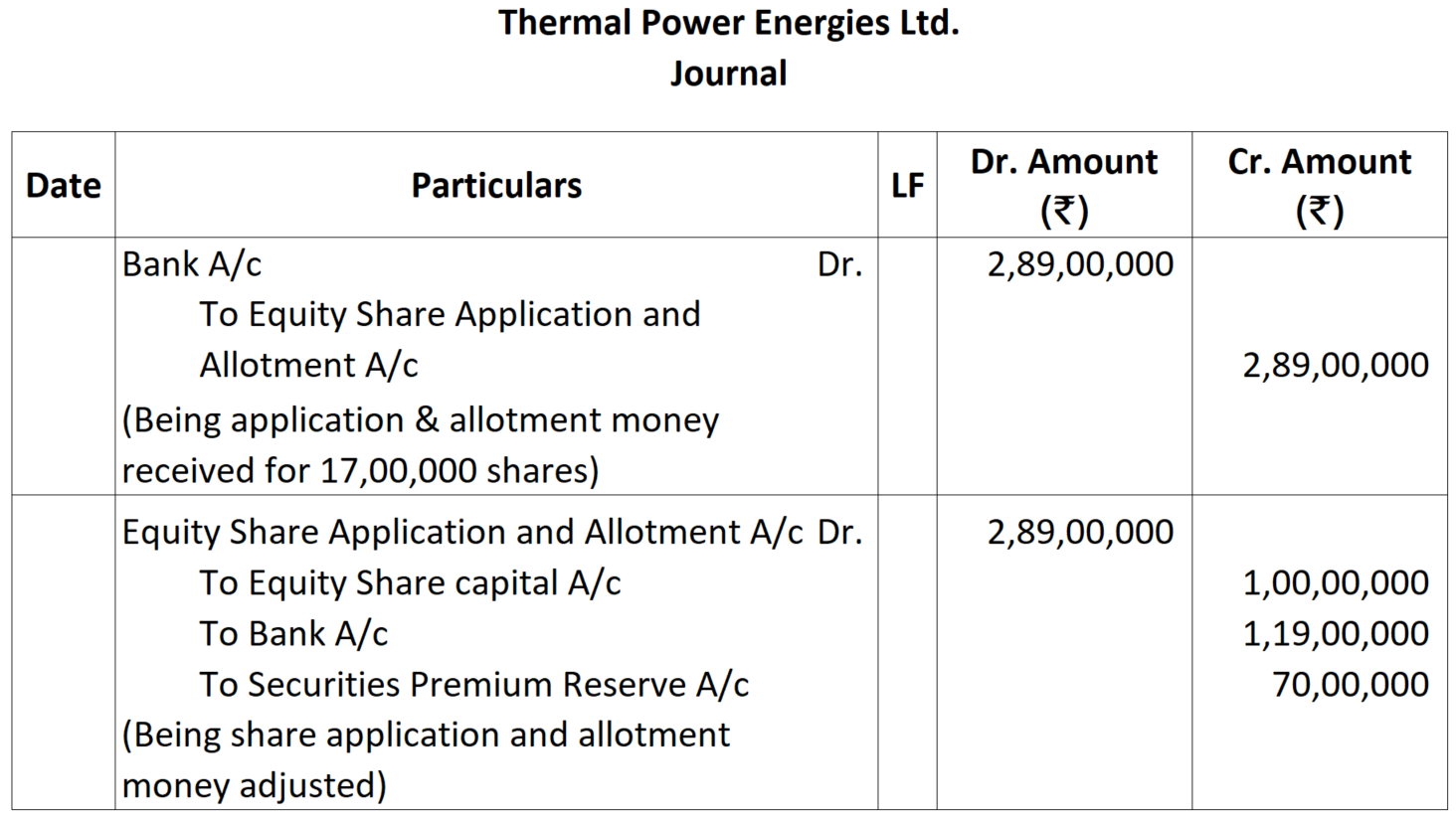
To provide employment to the youth and to develop a backward area of Jharkhand which is near one of the coal mines, Thermal Power Energies Ltd. decided to set-up a Thermal Power Plant of 500 mega watt capacity. The company decided to issue 10,00,000 equity shares of ₹ 10 each at a premium of 70% to finance the project. Applications for 17,00,000 shares were received. Applications for 5,00,000 shares were rejected and money refunded. Shares were allotted on pro-rata basis to the remaining applicants. The whole of share money was payable on application.Pass necessary journal entries for the above transactions in the books of the company and identify any two values which the company wants to convey to the society.
Answer

Values:
  1. Providing employment opportunities.
  2. Development of backward areas.
  3. Helping the young people to undertake developmental.
  4. Promoting peace and harmony in the society.
View full question & answer
Question 213 Marks
‘B’ Ltd. took over the assets of ₹ 14,00,000 and liabilities of ₹ 4,00,000 of C Ltd. for a purchase consideration of ₹ 9,19,000. ₹ 17,000 were paid by a bank draft in favour of C Ltd. and the balance was paid by issue of equity shares of ₹ 10 each at a premium of 10% in favour of C Ltd.Pass necessary journal entries for the above transactions in the books of B Ltd.
View full question & answer
Question 223 Marks
Sandesh Ltd. took over the assets of ₹ 7,00,000 and liabilities of ₹ 2,00,000 from Sanchar Ltd. for a purchase consideration of ₹ 4,59,500. ₹ 8,500 were paid by accepting a draft in favour of Sanchar Ltd. payable after three months and the balance was paid by issue of equity shares of 10 each at a premium of 10% in favour of Sanchar Ltd.
Pass necessary journal entries for the above transactions in the books of Sandesh Ltd.
View full question & answer
Question 233 Marks
Sun Pharma Ltd. is registered with an authorized capital of ₹ 1,00,00,000 divided into 1,00,000 equity shares of ₹ 100 each. The company issued 50,000 shares at a premium of ₹ 40 per shares. A shareholder holding 500 shares did not pay the final call of ₹ 20 per share. His shares were forfeited.
Present the ‘Share Capital’ in the Balance Sheet of the Company as per Schedule VI Part I of the Companies Act, 1956. Also prepare notes to accounts.
View full question & answer
Question 243 Marks
Securities premium can also be utilized for three other purposes besides (i) ‘Issuing fully paid bonus shares’ and (ii) ‘Buy back of shares’. State those purposes.
Answer
The amount received as securities premium can be used other than ‘issue of bonus shares’ and ‘buy back of shares’ for the following purposes:
  • In writing off the preliminary expenses of the company.
  • For writing off the expenses, commission or discount allowed on issue of shares or debentures of the company.
  • For providing the premium payable on redemption of redeemable preference shares or debentures of the company.
View full question & answer
Question 253 Marks
Samachar India Ltd. took over the assets of ₹ 14,00,000 and liabilities of ₹ 4,00,000 from News Ltd. for a purchase consideration of ₹ 9,19,000. Samachar India Ltd. issued a promissory note of ₹ 17,000 payable after 60 days in favour of News Ltd. and the balance amount was paid by issue of equity shares of ₹ 100 each at a premium of ₹ 25 per share.
View full question & answer
Question 263 Marks
To provide employment to the youth and to develop the Naxal affected backward areas of Chattisgarh. X Ltd. decided to set-up a power plant. For raising funds the company decided to issue 7,50,000 equity shares of ₹ 10 each at a premium of 50%. The whole amount was payable on application. Applications for 20,00,000 shares were received. Applications for 50,000 shares were rejected and shares were allotted to the remaining applicants on pro-rata basis.
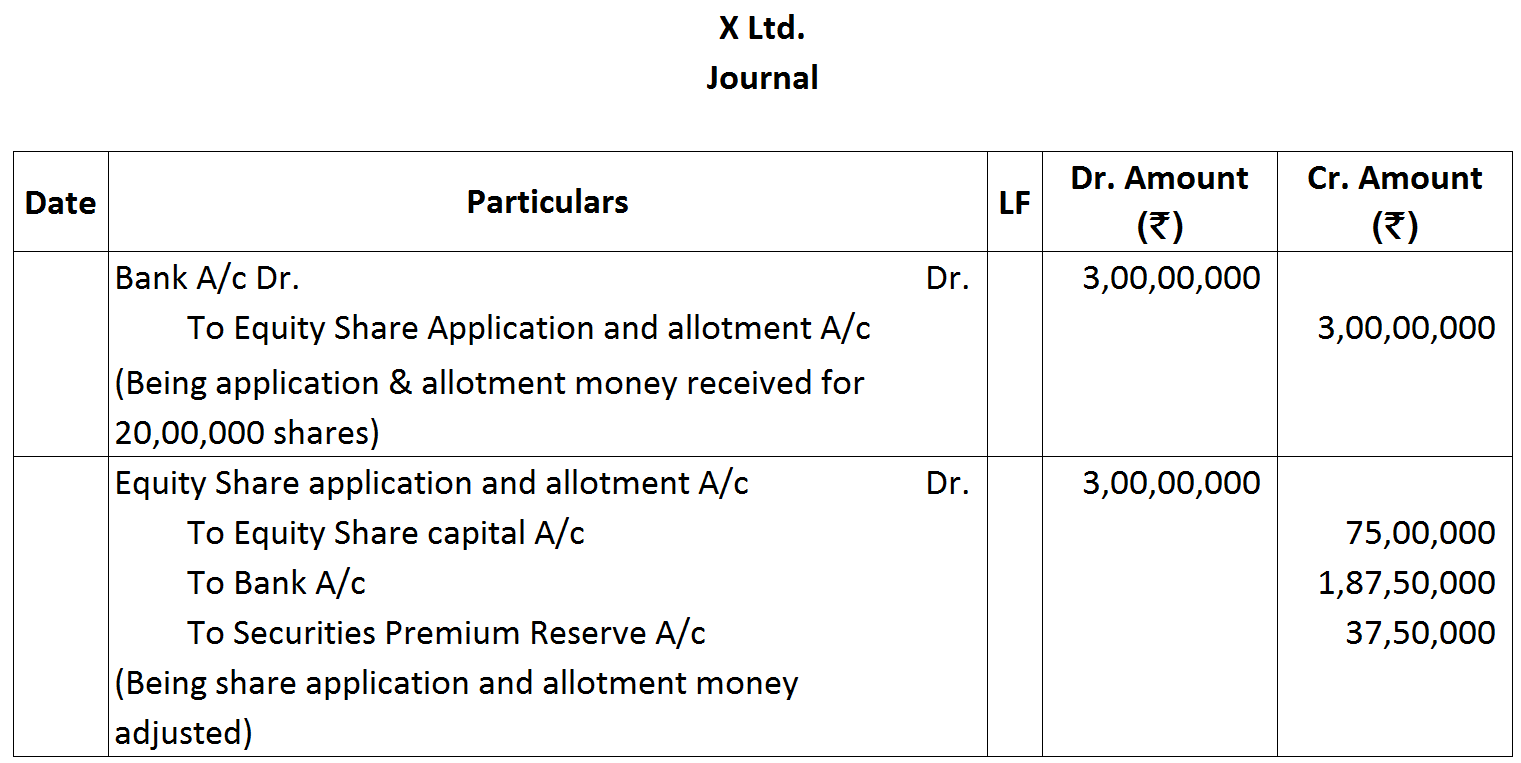
Pass necessary journal entries for the above transactions in the books of the company and identify any two values which X Ltd. wants to propagate.
Answer
Values:
  1. Providing employment opportunities.
  2. Development of backward areas.
  3. Helping the young people to undertake developmental activities.
  4. Promoting peace and harmony in the society.
View full question & answer
Question 273 Marks
State any three purposes other than ‘buy back of shares’ for which securities premium can be utilized.
Answer
The amount received as securities premium can be used other than ‘buy back of shares’ for the following purposes:
  • In writing off the preliminary expenses of the company
  • For writing off the expenses, commission or discount allowed on issue of shares or debentures of the company.
  • For providing the premium payable on redemption of redeemable preference shares or debentures of the company.
  • For issuing Bonus Shares.
View full question & answer
Question 283 Marks
‘Scooters India Ltd.’ is registered with an authorized capital of ₹ $50,00,000$, divided into $5,00,000$ shares of ₹ $10$ each. The company issued $1,00,000$ shares for subscriptions to the public at par. The amount was payable as follows:
On application and allotment – ₹ $3$ per share.
On $1^{st}$ call – ₹ $2$ per share.
On $2^{nd}$ and final call – ₹ $5$ per share.
The issue was fully subscribed. All calls were made and were duly received except the $2^{nd}$ and final call on $1,000$ shares held by Rohan. His shares were forfeited and afterwards re-issued at ₹ $8$ per share as fully paid up.
Present ‘Share Capital’ in the Balance Sheet of the company as per Schedule VI Part I of the Companies Act, $1956$. Also prepare Notes to accounts for the same.
View full question & answer
Question 293 Marks
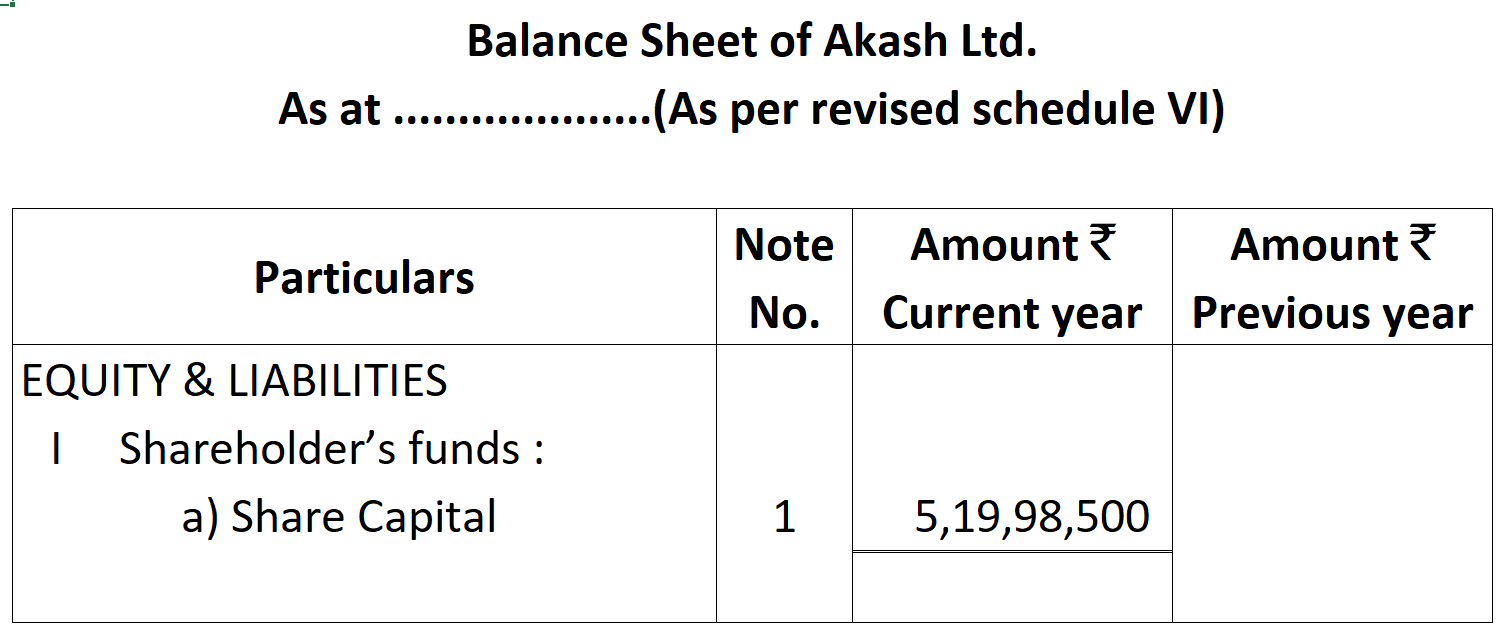
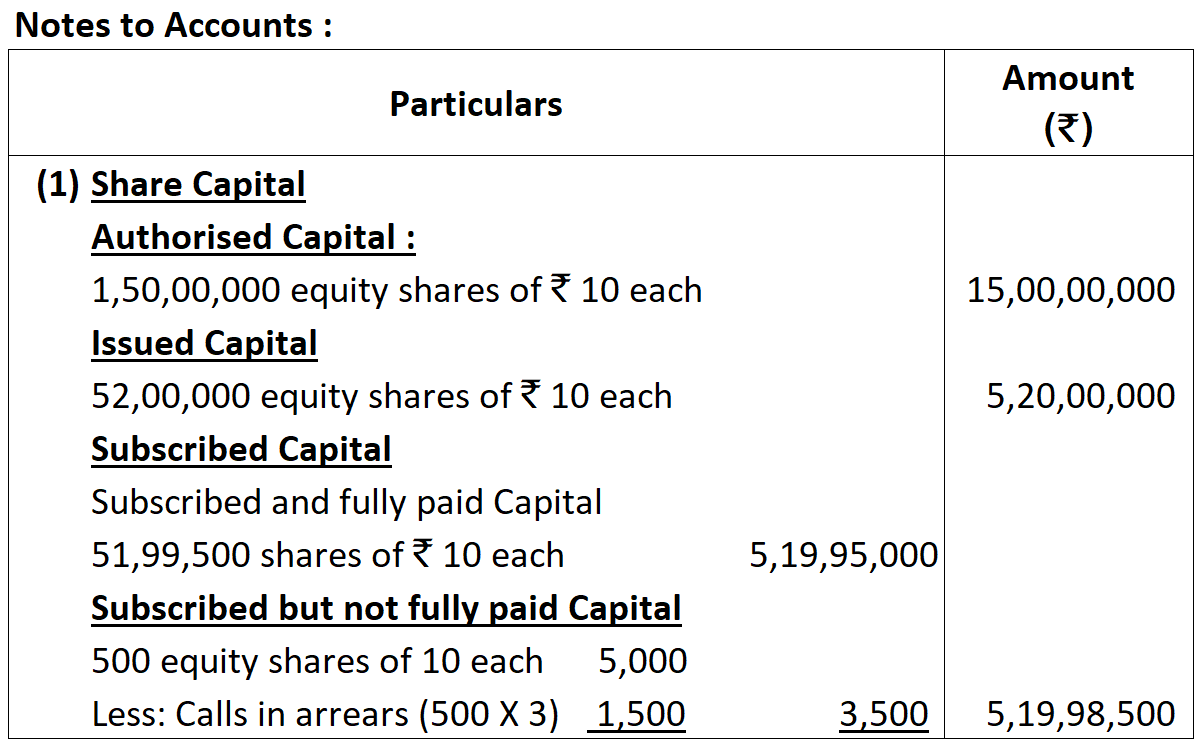
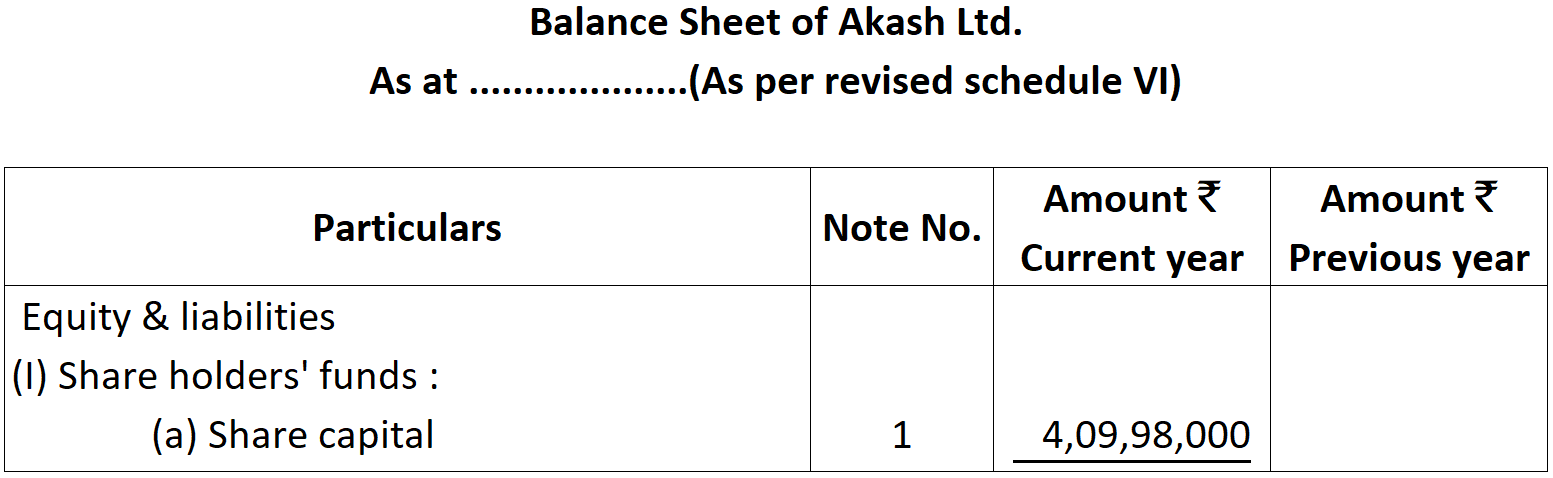
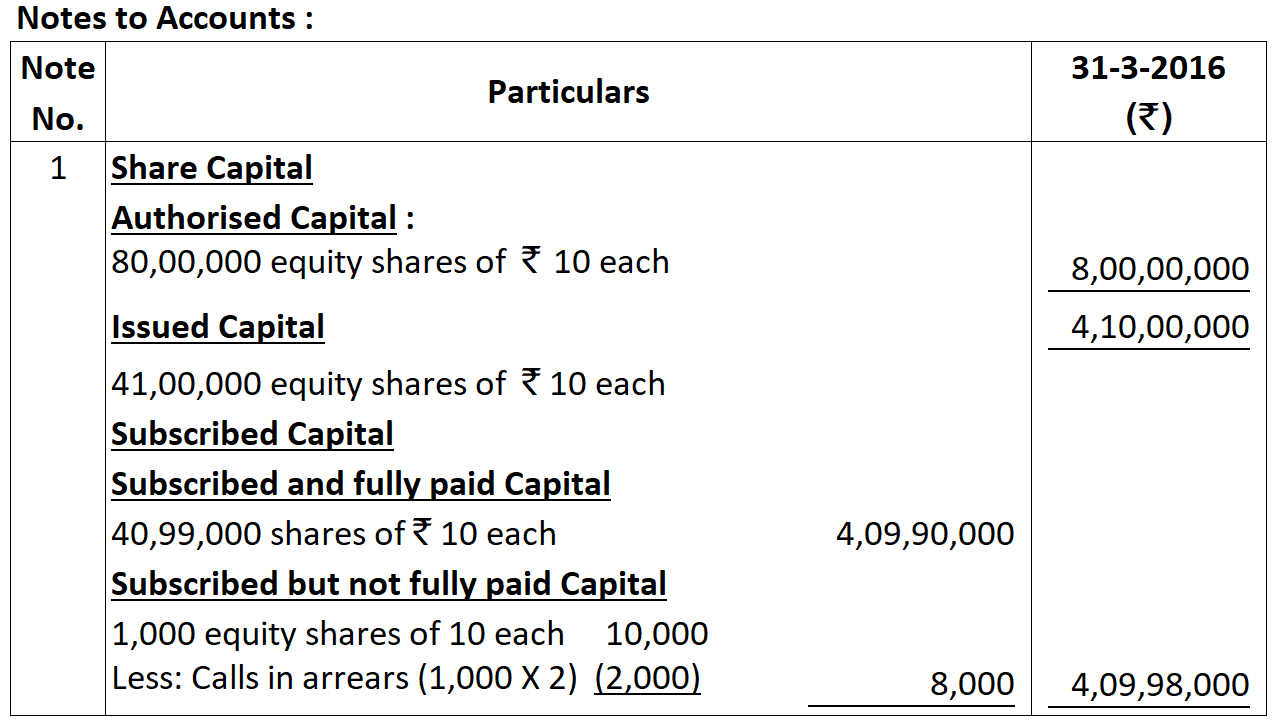
Akash Ltd. is registered with an authorized Capital of ₹ 8,00,00,000 divided into equity shares of ₹ 10 each. Subscribed and fully paid up share capital of the company was ₹ 4,00,00,000. For providing employment to the local youth and for the development of the rural areas of the Jammu and Kashmir State the company decided to set up a food processing unit in Anantnag district. The Company also decided to open skill development centres in Ladakh, Srinagar and Punch. To meet its new financial requirements the company decided to issue 1,00,000 equity shares of ₹ 10 each and 10,000, 9% debentures of ₹ 100 each. The debentures were redeemable after five years. The issue of equity shares and debentures was fully subscribed. A shareholder holding 1,000 shares failed to pay the final call of ₹ 2 per share.
Present the share capital in the Balance Sheet of the company as per the provisions of Schedule III of the Companies Act, 2013. Also, identify any two values that the company wishes to propagate.
Answer


Values:
  • Providing employment opportunities to the local youth.
  • Promotion of rural development.
  • Promotion of skill development in militant affected areas.
  • Paying attention towards regions of social unrest.
View full question & answer
Question 303 Marks
‘Tractors India Ltd.’ is registered with an authorized capital of ₹ 10,00,000 divided into 1,00,000 equity shares of ₹ 10 each. The company issued 50,000 equity shares at a premium of ₹ 5 per share. ₹ 2 per share were payable with application, ₹ 8 per share including premium on allotment and the balance amount on first and final call. The issue was fully subscribed and all the amount due was received except the first and final call money on 500 shares allotted to Balaram.Present the ‘Share Capital’ in the Balance Sheet of ‘Tractors India Ltd.’ as per Schedule VI Part I of the Companies Act, 1956. Also prepare Notes to Accounts for the same.
View full question & answer
Question 313 Marks
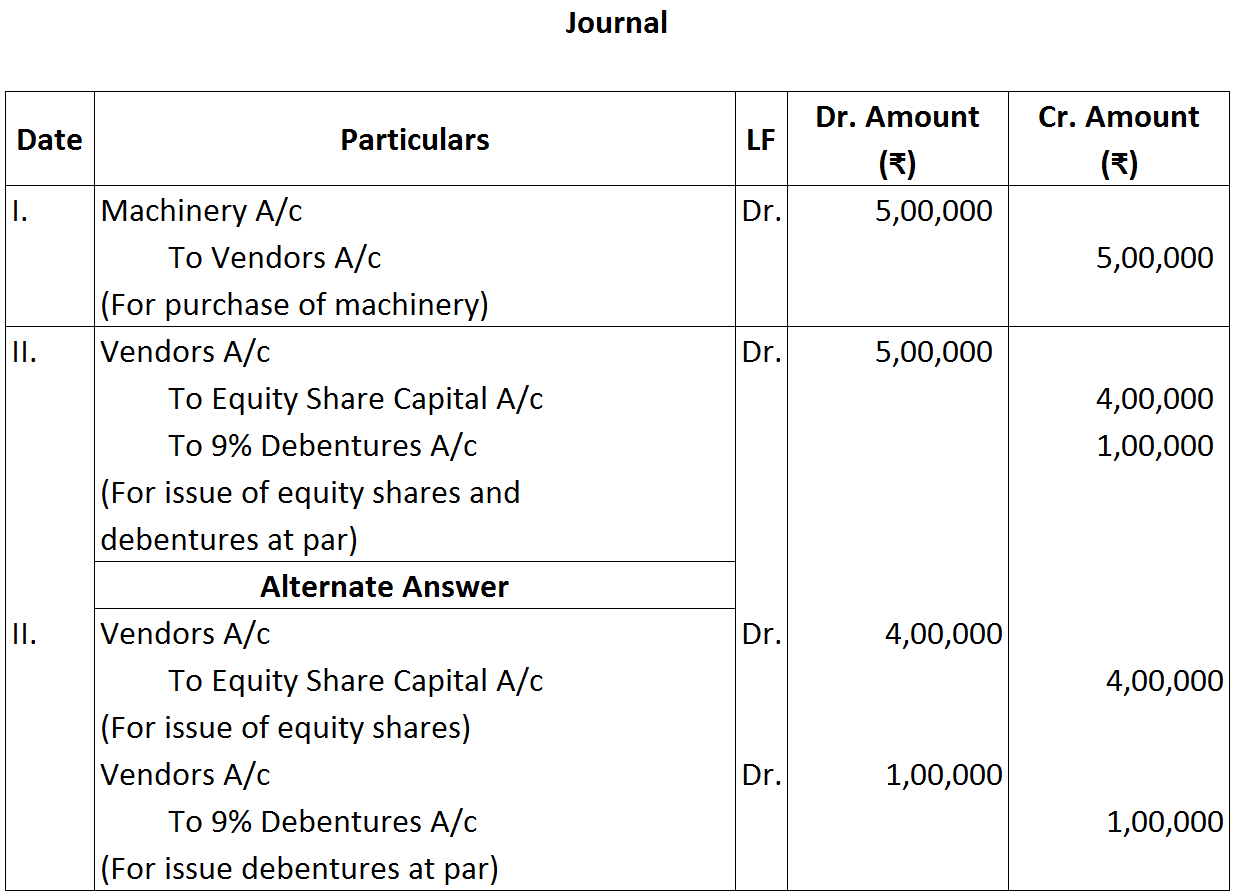
‘Sangam Woollens Ltd.’, Ludhiana, are the manufacturers and exporters of woollen garments. The company decided to distribute free of cost woollen garments to 10 villages of Lahaul and Spiti District of Himachal Pradesh. The company also decided to employ 50 young persons from these villages in its newly established factory. The company issued 40,000 equity shares of ₹ 10 each and 1,000 9% debentures of ₹ 100 each to the vendors for the purchase of machinery of ₹ 5,00,000.
Pass necessary Journal Entries. Also identify any one value that the company wants to communicate to the society.
Answer
  1.  
  1. Values which the company wants to communicate to the society:
  • Fulfilling/Discharging of social responsibility.
  • Generation of employment opportunities in rural areas.
View full question & answer
Question 323 Marks
State any three purposes other than ‘issue of bonus shares’ for which securities premium can be utilized.
Answer
The amount received as securities premium can be used other than ‘issue of bonus shares’ for the following purposes:
  • In writing off the preliminary expenses of the company.
  • For writing off the expenses, commission or discount allowed on issue of shares or debentures of the company.
  • For providing the premium payable on redemption of redeemable preference shares or debentures of the company.
  • For buy back of its own shares.
View full question & answer
Question 333 Marks
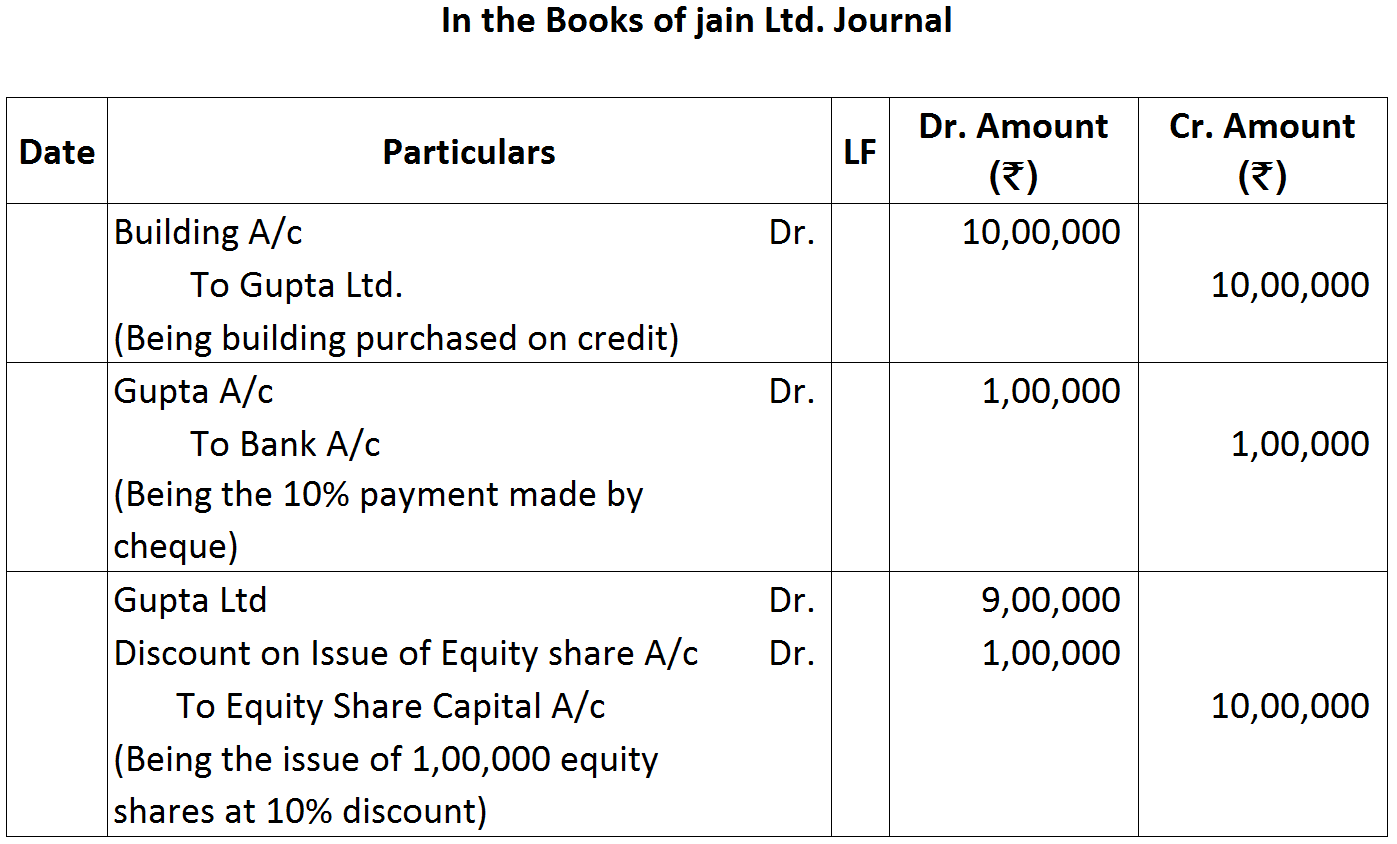
Jain Ltd. purchased Building for ₹ 10,00,000 from Gupta Ltd. 10% of the payable amount was paid by a cheque drawn in favour of Gupta Ltd. The balance was paid by issue of Equity Shares of ₹ 10 each at a discount of 10%.
Pass necessary Journal Entries in the books of Jain Ltd.
Answer

Working Note:
$\text{No.of Shares} = \frac {\text{Purchase Pr ice (Balance)}}{\text{Issueprice per share}}\\$
$=\frac{9,00,000}{9}=1,00,000 \text{ Shares}$
View full question & answer
Question 343 Marks
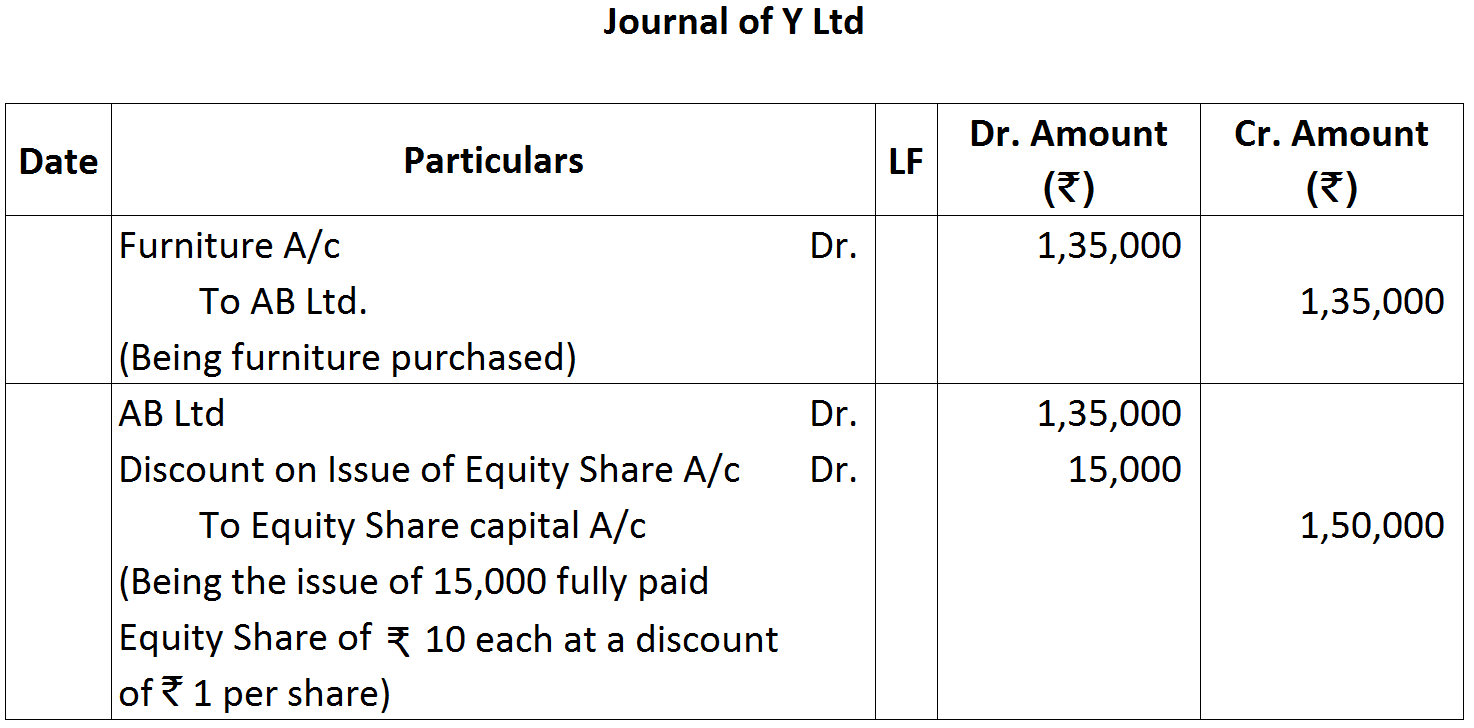
Y Ltd. purchased furniture costing ₹​​​ 1,35,000 from A. B. Ltd. The payment was made by issue of Equity Shares of ₹​​​ 10 each at a discount of ₹​​​ 1 per share. Pass necessary Journal entries in the books of Y Ltd.
Answer

Working Note:$\text{Number of Equity Shares to be issued}=\frac {\text{purchase price}} {\text{issue}}$
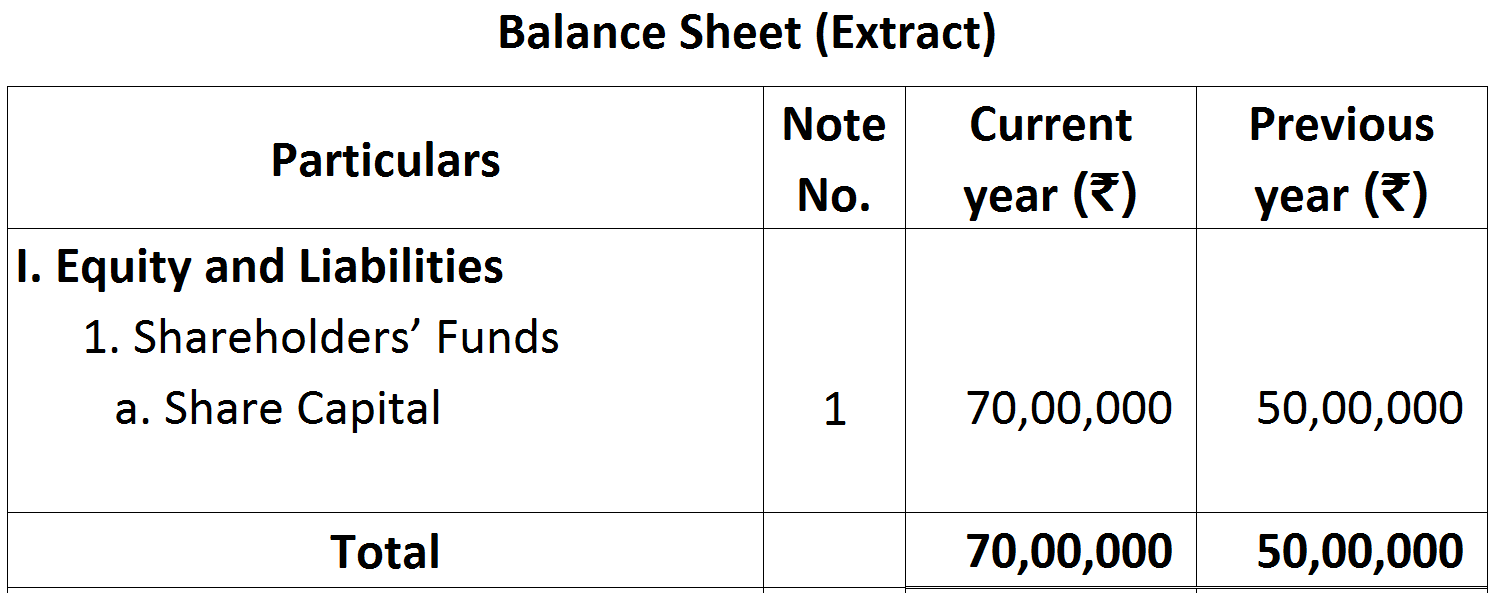
$​​​​\text{price per share}= \frac{1,35,000}{9}=15,000{\text{ shares.}}$
View full question & answer
Question 353 Marks
S.S.S. Ltd., has a paid-up share capital of ₹ 60,00,000 and a balance of ₹ 15,00,000 in the Securities Premium Account. The company management do not want to carry over this balance. State the ‘purposes for which this balance can be utilised.
Answer
U/s 78 of the Companies Act 1956 the amount of Securities Premium may be utilised for:
  1. Issue fully paid bonus share.
  2. Write off preliminary expenses.
  3. Write off the expenses or the commission paid or discount allowed on any issue of share or debentures of the company.
  4. Provide for the premium payable on the redemption of any redeemable preference shares or of any debentures of the company.
  5. For Buy Back of Shares (purchase of its own shares).
View full question & answer
Question 363 Marks
DN Ltd., issued 50,000 shares of ₹ 10 each at a discount of 10% payable as ₹ 2 per share on application, ₹ 3 on allotment and ₹ 2 each on first and final call. Applications were received for 70,000 shares. It was decided that (a) refuse allotment to the applicants for 10,000 shares (b) allot 20,000 shares to Mohan who had applied for similar number and (c) allot the remaining shares on pro-rata basis. Mohan failed to pay the allotment money and Sohan who belonged the category ‘c’ and was allotted 3,0,00 shares paid both the calls with allotment. Calculate the amount received on allotment.
Answer
Application Received 70,000 shares Allotted
Rejected 10,000 shares  
Mohan 20,000 (Applied) 20,000 (Allotted)
Others 40,000 (Applied) 30,000 (4:3) (Allotted)


Allotment Money due
(50,000 x 3)
1,50,000
Less recd. In advance (pro rata issue)
(10,000 x 2)
20,000
Less Calls in arrears (Mohan)
(20,000 x 3)
60, 000
Add Calls in advance
(3,000 x4)
12,000
Money received on Allotment
  82,000
View full question & answer
Question 373 Marks
The Directors of a Company forfeited 200 shares of ₹ 10 each issued at a premium of ₹ 3 per share, for the non-payment of the First Call Money of ₹ 3 per share. The final call of ₹ 2 per share has not been made. Half the forfeited shares were reissued at ₹1,000 fully paid. Record the Journal Entries for the forfeiture & reissue of shares.
View full question & answer
Question 383 Marks
Meena Ltd., issued 60,000 shares of ₹ 10 each at a premium of ₹ 2 per share payable as ₹ 3 on Application, ₹ 5 (Incl. Premium) on allotment and the balance on 1st and final call. Applications were received for 1,02,000 shares. The Directors resolved to allot as follows:
(A)
Applicants of 60,000 shares
30,000 shares
(B)
Applicants of 40,000 shares
30,000 shares
(C)
Applicants of 2,000 shares
Nil
Nikhil who had applied for 1,000 shares in category A, and Vish who was allotted 600 shares in category B failed to pay the allotment money. Calculate the amount received on Allotment.
Answer
Amount received on allotment (including premium)

= ₹ 3,00,000 – 90,000 – 30,000 –1,000 – 2,400 = ₹ 1,76,600

Working Notes:

Category A:
Shares Applied = 60,000
Shares allotted = 30,000
Excess money received = 30,000 X 3 = 90,000 ₹
$\text{Nikhil’s allotted shares}=\frac{30,000}{60,000}\times1,000=500₹$

Therefore, Shares Applied = 1,000
Shares allotted = 500
Excess money received = 500 X 3 = 1500/-
Amount due on allotment = 500 X 5 = 2500/-
Amount unpaid = 2500 – 1500 = 1000/-
Category B:
Shares Applied = 40000
Shares allotted = 30000
Vish’s allotted shares = 600
Excess money received = 10000 X 3 = 30000 ₹
Excess money received = 200 X 3 = 600 ₹
$\text{Shares Applied} = 600 \times\frac {40,000} {30,000}= 800$
Amount due on allotment = 600 X 5 = 3000 ₹
Amount unpaid = 3000 – 600 = 2400 ₹
View full question & answer
Question 393 Marks
PS Ltd forfeited 500 equity shares of Rs. 100 each for the non-payment of first call of Rs. 30 per share. The final call of Rs. 10 per share was not yet made. Then forfeited shares were re-issued for Rs. 65,000 fully paid up.
Pass necessary journal.entries in the books of the company.
View full question & answer
Question 403 Marks
NK Ltd., a truck manufacturing company, is registered with an authorised capital of ₹ 1,00,00,000 divided into equity shares of ₹ 100 each. The subscribed and paid up capital of the company is ₹ 50,00,000. The company decided to open technical schools in the Jhalawar district of Rajasthan to train the specially abled children of the area. It is planning to provide them employment in its various production units and industries in the neighbourhood area.
To meet the capital expenditure requirements of the project, the company offered 20,000 shares to the public for subscription. The shares were fully subscribed and paid.
Present the share capital in the Balance Sheet of the company as per the provisions of Schedule III of the Companies Act, 2013.
Also identify any two values that the company wants to communicate.
Answer

NOTES TO ACCOUNT

Values involved are:
  1. Generation of Employment.
  2. Social-upliftment by showing concerns for the differently-abled children.
View full question & answer
Question 413 Marks
What is meant by a ‘Share’? Give any two differences between ‘Preference Shares’ and ‘Equity Shares’.
Answer
A company is an entity incorporated by a group of persons through the process of law and has a share capital divided into shares, the owners of which are referred to as members or shareholders. Share here refers to a unit into which the share capital of a company is divided. It includes the stock of the company and represents ownership claims on business.
Basis of Difference
Preference Shares
Equity Shares
Voting Rights
Preference shareholders have voting rights only in special circumstances.
Equity shareholders have voting rights in all the circumstances.
Rate of Dividend
Fixed rate of dividend is received.
Rate of dividend is decided by the board every year and is approved by the shareholders.
View full question & answer
Question 423 Marks
X Ltd forfeited 1,000 Equity shares of ₹ 10 each issued at a premium of ₹ 3 per share for the non-payment of final call of ₹ 6 (including premium) per share. The forfeited shares were re-issued as fully paid up for ₹ 7 per share.
Pass necessary journal entries in the books of the company.
View full question & answer
Question 443 Marks
Give necessary journal entries:
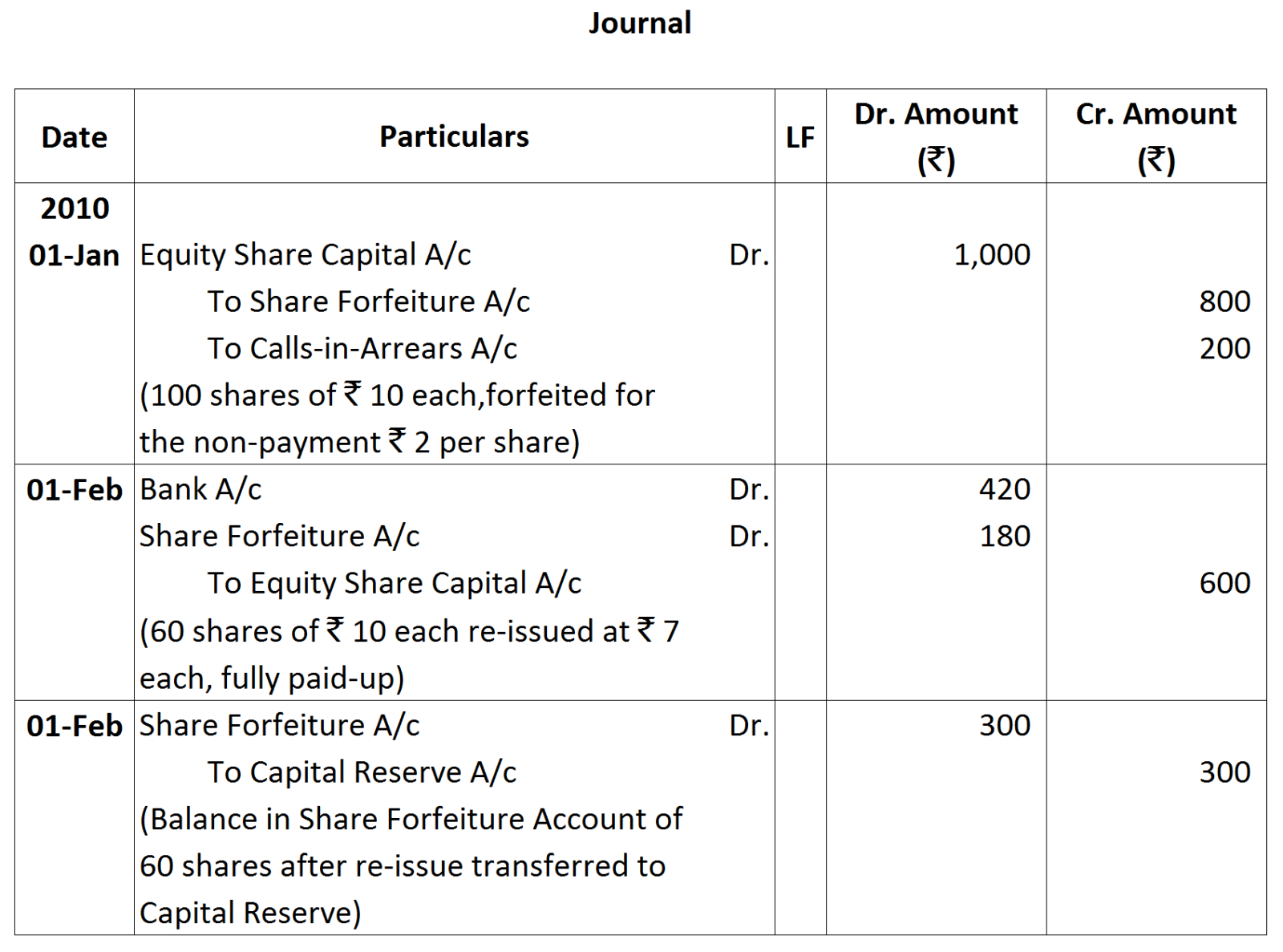
The Directors of Devendra Ltd. resolved on 1st January, 2010 that Equity Shares of ₹ 10 each, ₹ 8 paid-up be forfeited for non-payment of final call of ₹ 2. On 1st February, 60 of these shares were reissued @ ₹ 7 per share as fully paid-up.
Answer

Working Notes:
Forfeiture of re-issued shares
Share Forfeiture Credit
₹ 8
per share
Less: Share Forfeiture Debit
₹ 3
per share
Balance in Share Forfeiture after re-issue
5
per share
General Reserve = Balance in Share Forfeiture Account of re-issue (per share) × No. of shares reissued
= ₹ 5 × 60
= ₹ 300
View full question & answer
Question 453 Marks
Pass journal entries for the forfeiture and re-issue in the following case:
A Ltd. forfeited 100 shares of ₹ 10 each fully called-up for non-payment of first call of ₹ 3 per share and final call of ₹ 3 per share. All of these shares were re-issued as fully paid for ₹ 10 per share.
View full question & answer
Question 463 Marks
Samta Ltd. forfeited 800 equity shares of ₹ 100 each for the non-payment of first call of ₹ 30 per share. The final call of ₹ 20 per share was not yet made. Out of the forfeited shares 400 were re-issued at the rate of ₹ 105 per share fully paid up. Pass necessary journal entries in the books of Samta Ltd. for the above transactions.
View full question & answer
Question 473 Marks
The Directors of Devendra Ltd. resolved on 1st April, 2016 that 1,000 equity shares of ₹ 10 each ₹ 8 per-share called-up be forfeited for non-payment of first call of ₹ 2 per share. On 1st May, 2016, 600 of these shares were re-issued at ₹ 7 per share fully paid-up. Pass entries for forfeiture and re-issue of shares.
View full question & answer
Question 483 Marks
Pass journal entries for the forfeiture and re-issue in the following cases:
D Ltd. forfeited 1,000 shares of ₹ 10 each fully called-up on which the holder has paid only the application money @ ₹ 3 per share. Out of these, 600 shares were re-issued at ₹ 10.50 per share, fully paid up.
Answer

Note:
  1. ₹ 2,800 × (300 ÷ 400) = ₹ 2,100
₹ 2,100 - ₹ 600 = ₹ 1,500
  1. ₹ 3,500 × (300 ÷ 700) = ₹ 1,500
₹ 1,500 - ₹ 900 = ₹ 600
View full question & answer
Question 493 Marks
Ghosh Ltd. made the second and final call on its 50,000 Equity Shares @ ₹ 2 per share on 1st January, 2016. The entire amount was received on 15th January, 2016 except on 100 shares allotted to Venkat. Pass necessary journal entries for the call money due and received by opening Calls-in-Arrears Account.
View full question & answer
Question 503 Marks
Journalise the following:
Y Ltd. forfeited 400 shares of ₹ 100 each, issued at a premium of ₹ 5 per share (to be paid at the time of allotment) for non-payment of a first call of ₹ 20 per share. The second and final call of ₹ 20 has not yet been called. Out of these, 100 shares were re-issued on fully paid-up for ₹ 110 per share.
View full question & answer
3 Marks Question - Accountancy STD 12 Commerce Questions - Vidyadip