Question
What is meant by hydroboration-oxidati on reaction? Illustrate it with an example.
Answer

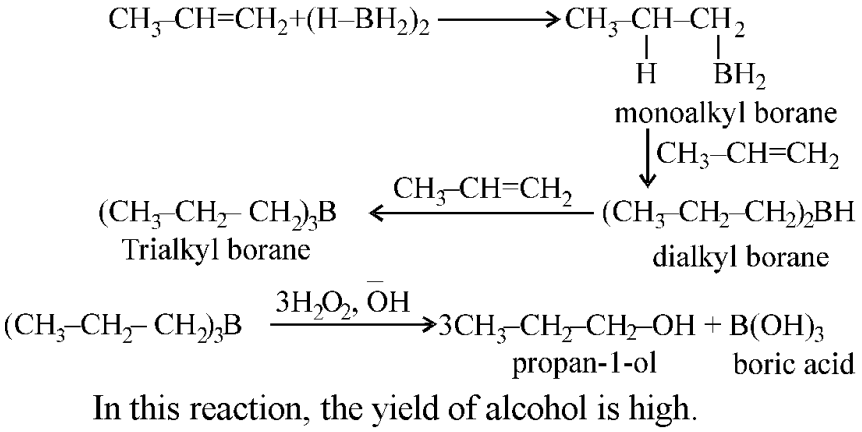
Hydroboration-Oxidation : The addition of borane followed by oxidation is known as the hydroboration0oxidation reaction. For example, propan-1-ol is produced by the hydroboration-oxidation reaction of propene. In this reaction, propene reacts with diborane $\left( B _2 H _6\right)$ to form tri alkyl borane as an addition product. This addition product is oxidised to alcohol by hydrogen peroxide in the presence of aqueous NaOH .
Image

Need a full question paper?

Generate a complete, print-ready paper with questions like this in minutes — across 16+ boards, with answer keys.

Start Generating Free

Similar questions

Describe the oxidising action of potassium dichromate and write the ionic equation for its reaction with : 
(i) Iodide, (ii) Iron, (II) solution and (iii) H2S
What are enantiomers? Draw the structures of the possible enantiomers of 3-methylpent-1-ene.
Consider the decomposition of hydrogen peroxide in alkaline medium which is catalysed by iodide ions.
$\text{2H}_2\text{O}_2\xrightarrow{\text{OH}^-}2\text{H}_2\text{O}+\text{O}_2$
This reaction takes place in two step as given below:
Step-I $\text{H}_2\text{O}_2+\text{I}^-\rightarrow\text{H}_2\text{O}_2+\text{IO}^-\text{ (slow)}$
Step-II $\text{H}_2\text{O}_2+\text{IO}^-\rightarrow\text{H}_2\text{O}_2+\text{I}+\text{O}_2\text{ (fast})$
  1. Write the rate law expression and determine the order of reaction w.r.t. H2O2.
  2. What is the molecularity of each individual step?
What is stereochemistry ? Explain plane polarised light, optical activity and optical isomers.
A solution of H2O2 when titrated against KMnO4 solution at different intervals of time gave the following results:

Time (minutes) 0 10 20
Volume of KMnO4 (mL) 23.8 14.7 9.1

Show that decomposition of H2O2 is first order reaction.

Write the Nernst equation and emf of the following cells at 298 K:
Fe(s) | Fe2+(0.001M) || H+ (1M) | H2(g)(1bar) | Pt(s)
Explain Van't Hoff factor.
Match the items of column I with items of column II.
 
Column I
 
Column II
(i)
Antifreeze used in car engine
(a)
Neutral ferric chloride
(ii)
Solvent used in perfumes
(b)
Glycerol
(iii)
Starting material for picric acid
(c)
Methanol
(iv)
Wood spirit
(d)
Phenol
(v)
Reagent used for detection of phenolic group
(e)
Ethleneglycol
(vi)
By product of soap industry used in cosmetics
(f)
Ethanol.
Calculate the charge of one mole of electrons.