Question
What is Mutation? Describe the main points of mutation theory?

Answer

Hugo de Vries (1901) experiment on Evening Primrose (7'0 clock plant) revealed that some plants suddenly become completely different from their own species. Not only this, various traits are inherited and passed from one generation to the next and create new species. De Vries termed sudden hereditary changes inherited form one to next generation as mutation and propounded the theory of mutation. It has also been known, from modern research that mutation in living organisms is caused by changes in the arrangement, structure and sequence of chromosomes and genes located in germ cells of organisms.
Following are the facts of DeVries's mutation theory :
1. Naturally reproducing species or species develop mutations from time to time. Mutant organisms are different from parent life.
2. Mutations are hereditary and lead to the development of new species.
3. Mutation appear all of a sudden. They become operational immediately.
4. Mutations are the raw material of evolution.
5. They can occur in any direction, hence they can be both beneficial and harmful.
6. Natural selection has an effect on mutation. Useful mutations are selected by where as Lethal mutations are eliminated however useless and less harmful once can persist in the progeny.
7. Darwin named these sudden changes as sports.
8. Excessive specialization of organs is explained by these sports or the initial stage of development of organs can be explained by the theory of mutation because mutations are complete from the beginning.
Importance of Mutation : There is not the slightest doubt that mutations occur in nature and their role in development. Natural selection and isolation of were also essential for evolution.
Need a full question paper?

Generate a complete, print-ready paper with questions like this in minutes — across 16+ boards, with answer keys.

Start Generating Free

Similar questions

Briefly describe the following: Transcription
What are the various public health measures, which you would suggest as safeguard against infectious diseases?
  1. State the cause and symptoms of colour-blindness in humans.
  2. Statistical data has shown that 8% of the human males are colour-blind whereas only 0.4% of females are colour-blind. Explain giving reasons how is it so.
State the three principles of Mendel’s law of inheritance.
  1. Draw a labelled diagram of L.S. of an embryo of grass (any six labels).
  2. Give reason for each of the following:
  1. Anthers of angiosperm flowers are described as dithecous.
  2. Hybrid seeds have to be produced year after year.
Read the following and answer any four questions from (i) to (v) given below:

Gene therapy is the technique of genetic engineering to replace a faulty gene by a normal healthy functional gene. It is a way of treating genetic disease by introducing a piece of DNA into the cells of an affected individual. Liposomes can be used for gene therapy as they target the cells affected by a genetic disease.

  1. A patient suffers from adenosine deaminase (ADA) deficiency, an autosomal recessive immune deficiency in which bone marrow lymphoblasts cannot replicate to generate immuno-competent lymphocytes. The treatment option that would cure the patient is:
  1. Germ-line gene therapy to replace one ADA gene copy.
  2. Germ-line gene therapy to replace both ADA gene copies.
  3. Somatic cell gene therapy to replace both ADA gene copies in circulating lymphocytes.
  4. Somatic cell gene therapy to replace one ADA gene copy in bone marrow lymphoblasts.
  1. Which type of gene therapy is least effective in transferring DNA to the nucleus?
  1. Adenoviruses.
  2. DNA attached to a ligand.
  3. Liposomes.
  4. Retroviruses.
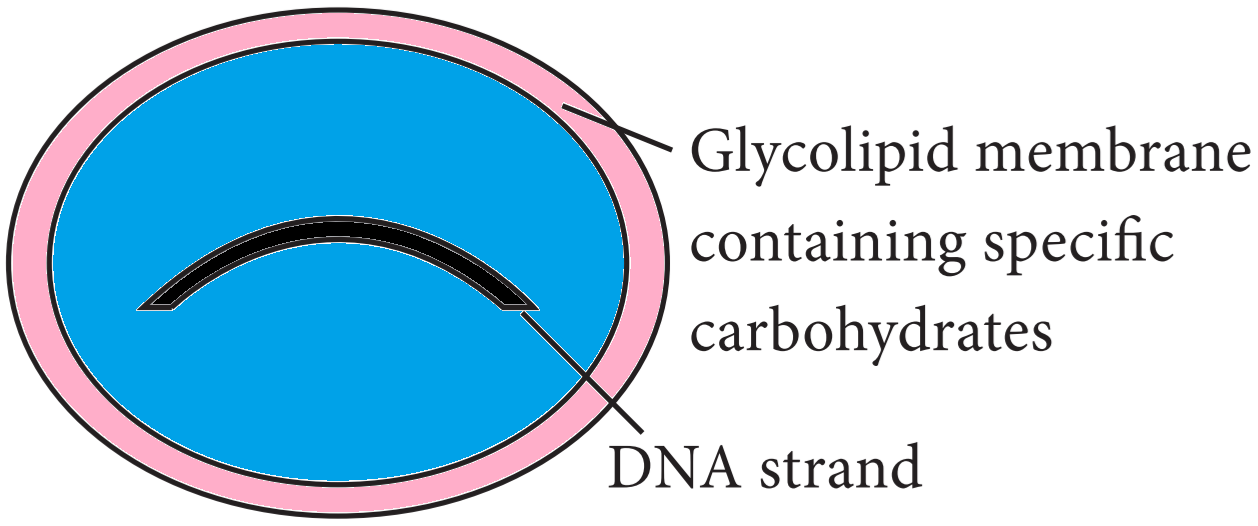
  1. Liposomes can be used for gene therapy as they target the cells affected by a genetic disease. The diagram shows the structure of a liposome.

What feature of a cell surface membrane allows the liposome to target cells affected by a genetic disease? 

  1. Carrier molecules.
  2. Phosphate groups.
  3. Protein channels.
  4. Receptor molecules.
  1. Which of the following disorders would gene therapy be least effective?
  1. Cystic fibrosis.
  2. Huntington's disease.
  3. Sickle cell anaemia.
  4. Type II diabetes.
  1. Following are some reasons explaining why gene therapy is not yet fully an effective treatment for genetic diseases.
  1. Lack of knowledge of DNA sequences.
  2. Lack of efficient and safe gene delivery system.
  3. Cost of the technology.
  4. Some diseases involve multiple genes.
  5. Problems with appropriate gene regulation.

Select the correct option. 

  1. I, III and V only
  2. II, IV and V only
  3. Ill, IV and V only
  4. I, III and IV only
  1. Work out a cross upto F, generation between two pure-bred pea plants, one bearing violet flowers and the other white flowers.
  2.  
  1. Name this type of cross.
  2. State the different laws of Mendel that can be derived from such a cross.
Complete the given table.
Name of the organism Product/ Enzyme/ Bioactive male cule
Aspergillus niger (i)
(ii) Ethanol
(iii) Cyclosporin-A
(iv) Acetic acid
Monascus purpureus (v)
Streptococcus (vi)
Compare the processes of DNA replication and transcription in prokaryotes.
A pea plant bearing axial flowers is crossed with a pea plant bearing terminal flowers. The cross is carried out to find the genotype of the pea plant bearing axial flowers. Work out the cross to show the conclusions you arrive at.