Question
What is mutualism? Describe any four examples.

Answer

Mutualism:
  • Mutualism is referred to as the interspecific interaction in which both the interacting species are benefited.
  • Some examples of mutualism:
  1. Lichens represent close association between fungus and photosynthetic algae or cyanobacteria, where the fungus helps in the absorption of nutrients and provides protection while algae or cyanobacterium prepares the food.
  2. Mycorrhizae are close mutual association between fungi and the roots of higher plants, where fungi helps the plant for absorption of nutrients while the plant provides food for the fungus.
  3. Mutualism are found in plant-animal relationships. Plants take the help of animals for pollination and dispersal of their seeds and animals are rewarded in the form of nectar or edible pollen or oviposition (site for laying egg).
  4. The male bee pseudocopulates with it and during this process of pseudocopulation, the pollen grains are dusted on the body of male bees.
  5. With such pollen dusts, male bee pseudocopulates to another flower of the same species and pollination takes place.

Need a full question paper?

Generate a complete, print-ready paper with questions like this in minutes — across 16+ boards, with answer keys.
Start Generating Free

Similar questions

  1. Explain Polygenic inheritance and Multiple allelism with the help of suitable examples.
  2. "Phenylketonuria is a good example that explains Pleiotropy." Justify.
Explain the post pollination events up to double fertilisation, that occur in an angiosperm.
Explain the steps involved in a polypeptide synthesis. How are the amino acids activated during polypeptide synthesis?
Draw a diagram of replication of AIDS virus, Name the pathogen of AIDS and describe the infection and symptoms of AIDS.
How many types of natural selection are there? Discuss each type with a suitable example.
Can you list 10 recombinant proteins which are used in medical practice? Find out where they are used as therapeutics (use the internet).
What is floriculture? Describe the structure of a stamen. Also draw a well labelled diagram of a typical stamen.
Recombinant DNA (rDNA) is a technology that uses enzymes to cut and paste together DNA sequences of interest. The recombined DNA sequences can be placed into vehicles called vectors that ferry the DNA into a suitable host cell where it can be copied or expressed.
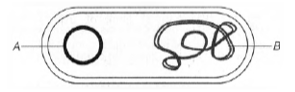
i. A bacterial cell is shown in the figure given below. Label the part 'A' and 'B'. Also, mention the use of part A in rDNA technology.
Image
ii. Suppose a linear DNA fragment and a plasmid has three restriction sites for EcoRI. How many fragments will be produced from linear DNA and plasmid, respectively?
A flower of brinjal plant following the process of sexual reproduction produces 360 viable seeds.
Answer the following questions giving reasons:
How many microspore mother cells must have undergone reduction division prior to dehiscence of another in the above case?
  1. Explain with the help of Griffith's experiment, how the search for genetic material was conducted and what was the conclusion drawn.
  2. How did Mac Leod, Mc Carty and Avery establish the Biochemical nature of the socalled. "genetic material' identified by Griffith in his experiments?