Question types

Organisms and Populations question types

668 questions across 8 question groups — pick any mix to generate a BIOLOGY paper with step-by-step answer keys.

668
Questions
8
Question groups
5
Question types
Sample Questions

Organisms and Populations questions

One sample from each question group in this chapter. Select any group above to see the full set with answer keys.

Q 3M.C.Q [1M]1 Mark
The response of different organisms to the environmental rhythms of light and darkness is called:
  • A
    Phototaxis.
  • B
    Phototropism.
  • C
    Vernalization.
  • D
    Photoperiodism.
View full solution
Q 5M.C.Q [1M]1 Mark
Formation of tropical forests needs mean annual temperature and mean annual precipitation as.
  • A
    18 – 25°C and 150 – 400cm.
  • B
    5 – 15°C and 50 – 100cm.
  • C
    30 – 50°C and 100 – 150cm.
  • D
    5 – 15°C and 100 – 200cm.
View full solution
For question two statements are given-one labelled Assertion and the other labelled Reason. Select the correct answer to these questions from the codes (a), (b), (c) and (d) as given below.
  1. Both assertion and reason are true and reason is the correct explanation of assertion.
  2. Both assertion and reason are true but reason is not the correct explanation of assertion.
  3. Assertion is true but reason is false.
  4. Both assertion and reason are false.
Assertion: Batesian mimicry is a protective mimicry.
Reason: Viceroy butterfly shows Batesian mimicry.
View full solution
For question two statements are given-one labelled Assertion and the other labelled Reason. Select the correct answer to these questions from the codes (a), (b), (c) and (d) as given below.
  1. Both assertion and reason are true and reason is the correct explanation of assertion.
  2. Both assertion and reason are true but reason is not the correct explanation of assertion.
  3. Assertion is true but reason is false.
  4. Both assertion and reason are false.
Assertion: Aerenchyma is present in the leaves and petioles ofhydrophytes.
Reason: Aerenchyma imparts buoyancy to the hydrophytes.
View full solution
For question two statements are given-one labelled Assertion and the other labelled Reason. Select the correct answer to these questions from the codes (a), (b), (c) and (d) as given below.
  1. Both assertion and reason are true and reason is the correct explanation of assertion.
  2. Both assertion and reason are true but reason is not the correct explanation of assertion.
  3. Assertion is true but reason is false.
  4. Both assertion and reason are false.
Assertion: Biotic potential is realised only when the environmental conditions are limiting.
Reason: Under such conditions only, the population size can increase at the maximum rate.
View full solution
For question two statements are given-one labelled Assertion and the other labelled Reason. Select the correct answer to these questions from the codes (a), (b), (c) and (d) as given below.
  1. Both assertion and reason are true and reason is the correct explanation of assertion.
  2. Both assertion and reason are true but reason is not the correct explanation of assertion.
  3. Assertion is true but reason is false.
  4. Both assertion and reason are false.
Assertion: No two species can occupy the same ecological niche in a habitat.
Reason: A habitat can contain only one ecological niche.
View full solution
For question two statements are given-one labelled Assertion and the other labelled Reason. Select the correct answer to these questions from the codes (a), (b), (c) and (d) as given below.
  1. Both assertion and reason are true and reason is the correct explanation of assertion.
  2. Both assertion and reason are true but reason is not the correct explanation of assertion.
  3. Assertion is true but reason is false.
  4. Both assertion and reason are false.
Assertion: Many mangrove plants possess high levels of organic solutes.
Reason: This is an adaptation to cope with the conditions of high salt concentration and osmotic potential.
View full solution
Select the statement which explains best parasitism.
  1. One organism is benefited.
  2. Both the organisms are benefited.
  3. One organism is benefited, other is not affected.
  4. One organism is benefited, other is affected.
View full solution
Read the following and answer any four questions from (i) to (v) given below:

Kangaroo rat seldom drinks water. It has thick coat to minimise evaporative desiccation. TI1e animal seldom comes out of its comparatively humid and cool burrow during the day time. 90% of its water requirement is met from metabolic water (water produced by respiratory breakdown of fats) while 10% is obtained from its food. Loss of water is minimised by producing nearly solid urine and faeces. As the animal faces acute water scarcity, it develops two types of adaptations : reducing water loss and ability to tolerate desert conditions.

  1. Kangaroo rat is a:
  1. Partial regulators
  2. Partial conformer
  3. Regulator
  4. Conformer
  1. Metabolic water refers to:
  1. Water required for metabolic activities.
  2. Water present in intercellular fluid.
  3. Water produced during oxidation of fat or carbohydrate.
  4. Water taken in, to promote metabolism.
  1. Desert animals minimise water loss by:
  1. Producing highly concentrated urine.
  2. Promoting maximum reabsorption of water in kidney tubules.
  3. Possessing one of the longest loop of Henle in kidney tubules.
  4. All of these.
  1. Assertion: Kangaroo rat can tolerate and thrive in wide temperature range and is known as stenothermal.

Reason: Kangaroo rats go into hibernation during winter to escape cold weather.

  1. Both assertion and reason are true and reason is the correct explanation of assertion.
  2. Both assertion and reason are true but reason is not the correct explanation of assertion.
  3. Assertion is true but reason is false.
  4. Both assertion and reason are false.
  1. The adaptations in an organism are meant for:
  1. Optimum primary production.
  2. Optimum life span.
  3. Optimum mobility.
  4. Optimum survival and reproduction.
View full solution
Read the following and answer any four questions from (i) to (v) given below:

ln many species of fig trees, there is a tight one-to-one relationship with the pollinator species of wasp. It means that a given fig species can be pollinated only by its 'partner' wasp species and no other species. The wasp pollinates the fig inflorescence while looking for suitable egg-laying sites. ln return for the favour of pollination, the fig offers the wasp some of its developing seeds as food for the developing wasp larvae.

  1. The interaction between fig trees and wasp is an example of:
  1. Mutualism
  2. Commensalism
  3. Amensalism
  4. Parasitism
  1. AD the given interactions are similar to interaction between fig trees and wasp, except.
  1. Plant and animal relation for pollination.
  2. Association of algae and fungi in lichens.
  3. Association of cattle egret and grazing cattle.
  4. Association of fungi and roots of higher plants in mycorrhiza.
  1. In which of the following interactions both partners are adversely affected?
  1. Parasitism
  2. Mutualism
  3. Competition
  4. Predation
  1. ln relationship between fig and wasp:
  1. One benefitted other harmed.
  2. Both are benefitted.
  3. One benefitted other unaffected.
  4. One inhibited, other unaffected.
  1. Assertion: Fig and wasp cannot complete their life cycle without each other.

Reason: They show mutualistic relationship.

  1. Both assertion and reason are true and reason is the correct explanation of assertion.
  2. Both assertion and reason are true but reason is not the correct explanation of assertion.
  3. Assertion is true but reason is false.
  4. Both assertion and reason are false.
View full solution
Read the following and answer any four questions from (i) to (v) given below:

Unlike animals, plants cannot runaway for their defence, therefore, they have evolved an astonishing variety of morphological and chemical defences against herbivores. Thorns are the most common morphological means of defence. Many plants produce and store chemicals that make the herbivore sick when they are eaten, inhibit feeding or digestion, disrupt its reproduction or even kill it. Some plants produce highly poisonous chemicals and that is why no cattle or goats browse on those plants. A wide variety of chemical substances that we extract from plants on a conunercial scale are produced by them actually as defence against grazers and browsers.

  1. Why you never see cattle or goats browsing on weed Calotropisl?
  1. It produces highly poisonous tannins.
  2. It produces quinine which is bitter in taste.
  3. It produces poisonous cardiac glycosides.
  4. It bears prickles.


  1. What could be the possible reason for invasive growth of the prickly pear cactus introduced in Australia?
  1. Absence of predators.
  2. New mycorrhizal association.
  3. Abundant water availability.
  4. All of these.
  1. Which of the following is most likely to sick by consuming chemicals produced by plants?
  1. Frog
  2. Goat
  3. Human
  4. Pigeon
  1. Plant evolve variety of morphological and chemical defences against.
  1. Prey
  2. Predator
  3. Commenal
  4. Mutualist
  1. Assertion: Some plant functions as predator in nature.

Reason: Phytoph ago us insects feed on plant sap.
  1. Both assertion and reason are true and reason is the correct explanation of assertion.
  2. Both assertion and reason are true but reason is not the correct explanation of assertion.
  3. Assertion is true but reason is false.
  4. Both assertion and reason are false.
View full solution
Read the following and answer any four questions from (i) to (v) given below:

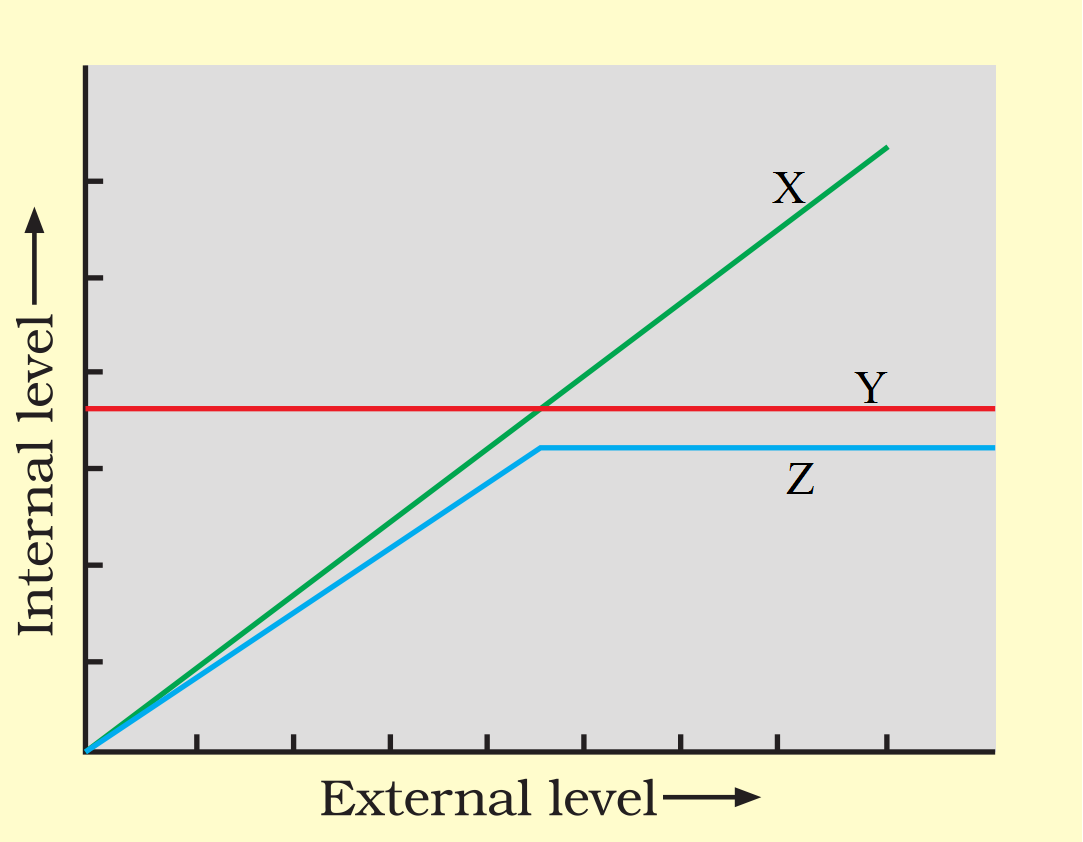
A desert lizard (an ectotherm) and a mouse (an endotherm) are placed inside a chamber at 15ºC and their body temperature [T(L) for the lizard and T(M) for the mouse] and metabolic rates [M(L) for lizard and M(M) for the mouse] are monitored.

  1. Which of the following is correct regardingT(L), M(L), T(M) and M(M)?
  1. T(L) and M(L) will fall while T(M) and M(M) will increase.
  2. T(L) and M(L) will increase while T(M) and M(M) will fall.
  3. T(L) and M(L) will fall, T(M) will remain same and M(M) will increase.
  4. T(L) and M(L) will remain same, T(M) and M(M) will decrease.
  1. It can be said that some animals in their evolutionary development preferred to be ectotherms than endotherms. Which of the following can be the best suited reason for it?
  1. The metabolic reactions of these organisms can occur at a very wide range of temperature.
  2. Maintaining homeostasis is an energetically expensive process.
  3. The enzymes of these organisms are functional at high temperatures.
  4. Both (b) and (c).
  1. Organisms that can maintain a constant internal temperature are called.
  1. Homoeothermic
  2. Poikilothermic
  3. Oligothennic
  4. Heterothennic
  1. An animal that survives at temperature of 10ºC and 40ºC both can be placed under the category of:
  1. Ectotherm.
  2. Endotherm.
  3. Modifiers.
  4. Migratory organisms.
  1. Study the graph carefully and select the correct option.

  1. X could be desert lizard.
  2. Y could be mouse.
  3. Z could be desert lizard.
  4. Both (a) and (b).
View full solution
Read the following and answer any four questions from (i) to (v) given below:

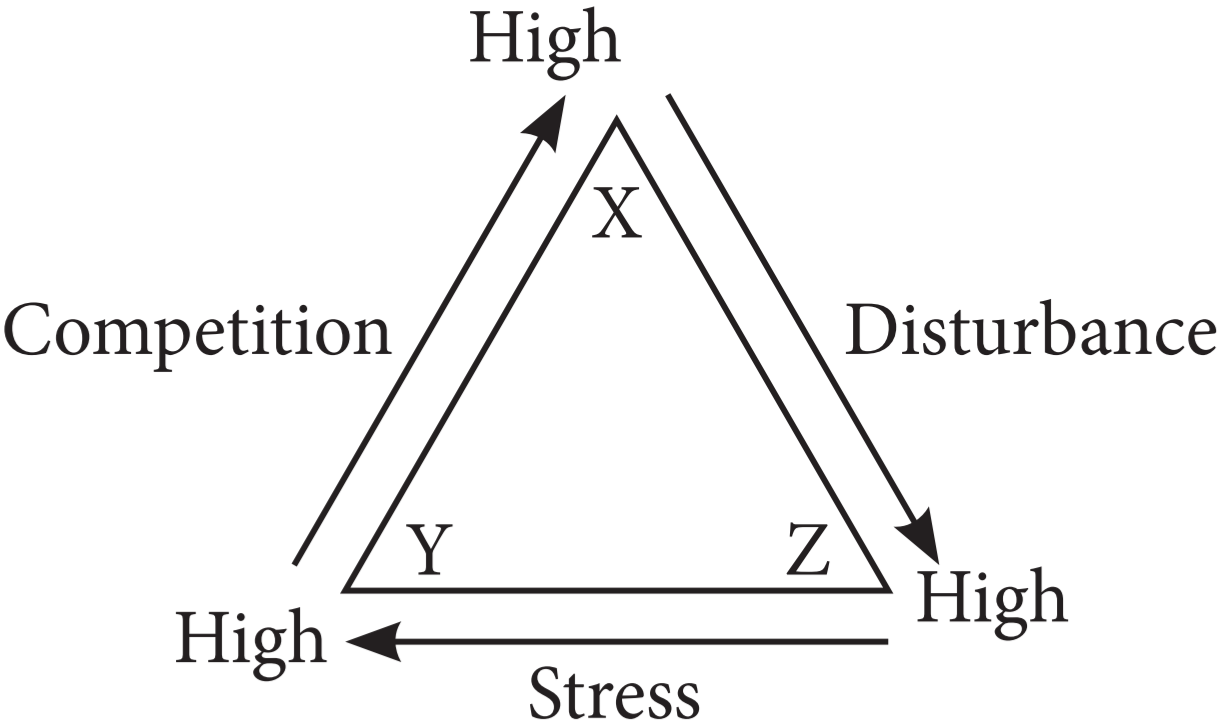
During teaching about various environmental factors, a teacher draw a figure that depicts like history strategies for three plant species (X, Y and Z) along 3 axes - strength of competition with other organisms, level of disturbance in the habitat and level of environmental stress in the habitat. Species X grows in habitats where competition among species is high but disturbance and stress are low. Species Y grows in habitats with high environmental stress but with low intraspecies competition. Species Z grows in highly disturbed habitats with low environmental stress.

  1. Which of the following is correct regarding plant type X?
  1. It has slow growth rate.
  2. It lives in area with high probability of severe environmental changes.
  3. It has good competitive ability at low population densities near the carrying capacity.
  4. None of these.
  1. Environmental stress occurs through.
  1. Very low temperature.
  2. Drought.
  3. Nutrient deficiency.
  4. All of these.
  1. Select the correct option regarding plant type X, Y and Z.
  1. X type of plants are likely to be trees.
  2. Y type of plants could be desert plants.
  3. Z type of plants could be herbaceous plant.
  4. All of these.
  1. Y type of plants grow under high stress and:
  1. Produce large number of seeds in a short time after rains.
  2. Have rapid growth.
  3. Produce less number of seed in a long time after rain.
  4. Both (a) and (b).
  1. Assertion: Plant growth rate is high in area of high stress and high disturbance.

Reason: High stress and high disturbance promote breeding capacity in plants.

  1. Both assertion and reason are true and reason is the correct explanation of assertion.
  2. Both assertion and reason are true but reason is not the correct explanation of assertion.
  3. Assertion is true but reason is false.
  4. Both assertion and reason are false.
View full solution

Generate a Organisms and Populations paper free

Pick question groups from the list above, set marks and difficulty, and export a branded PDF with step-by-step answer keys. First 3 chapters free — no signup.

Download App